• HOME
  • NEWS
  • EXPLORE
    • CAREER
      • Companies
      • Jobs
    • EVENTS
    • iGEM
      • News
      • Team
    • PHOTOS
    • VIDEO
    • WIKI
  • BLOG
  • COMMUNITY
    • FACEBOOK
    • INSTAGRAM
    • TWITTER
Monday, May 11, 2026
BIOENGINEER.ORG
No Result
View All Result
  • Login
  • HOME
  • NEWS
  • EXPLORE
    • CAREER
      • Companies
      • Jobs
        • Lecturer
        • PhD Studentship
        • Postdoc
        • Research Assistant
    • EVENTS
    • iGEM
      • News
      • Team
    • PHOTOS
    • VIDEO
    • WIKI
  • BLOG
  • COMMUNITY
    • FACEBOOK
    • INSTAGRAM
    • TWITTER
  • HOME
  • NEWS
  • EXPLORE
    • CAREER
      • Companies
      • Jobs
        • Lecturer
        • PhD Studentship
        • Postdoc
        • Research Assistant
    • EVENTS
    • iGEM
      • News
      • Team
    • PHOTOS
    • VIDEO
    • WIKI
  • BLOG
  • COMMUNITY
    • FACEBOOK
    • INSTAGRAM
    • TWITTER
No Result
View All Result
Bioengineer.org
No Result
View All Result
Home NEWS Science News Chemistry

Simulating quantum systems with neural networks

Bioengineer by Bioengineer
July 1, 2019
in Chemistry
Reading Time: 2 mins read
0
IMAGE
Share on FacebookShare on TwitterShare on LinkedinShare on RedditShare on Telegram

IMAGE

Credit: A. Nagy and A. Anelli (EPFL)

Even on the scale of everyday life, nature is governed by the laws of quantum physics. These laws explain common phenomena like light, sound, heat, or even the trajectories of balls on a pool table. But when applied to a large number of interacting particles, the laws of quantum physics actually predict a variety of phenomena that defy intuition.

In order to study quantum systems made of many particles, physicists must first be able to simulate them. This can be done by solving the equations describing their inner workings on supercomputers. But while Moore’s Law predicts that the processing power of computers doubles every couple of years, this is a far cry from the power needed to tackle the challenges of quantum physics.

The reason is that predicting the properties of a quantum system is enormously complex, demanding a computational power that grows exponentially with the size of the quantum system – an “intrinsically complex” task, according to Professor Vincenzo Savona, who directs the Laboratory of Theoretical Physics of Nanosystems at EPFL.

“Things become even more complicated when the quantum system is open, meaning that it is subject to the disturbances of its surrounding environment,” Savona adds. And yet, tools to efficiently simulate open quantum systems are much needed, as most modern experimental platforms for quantum science and technology are open systems, and physicists are constantly in search of new ways to simulate and benchmark them.

But significant progress has been made thanks to a new computational method that simulates quantum systems with neural networks. The method was developed by Savona and his PhD student Alexandra Nagy at EPFL – and independently by scientists at Université Paris Diderot, the Heriot-Watt University in Edinburgh, and the Flatiron Institute in New York. The total body of work is being published across three papers in Physical Review Letters.

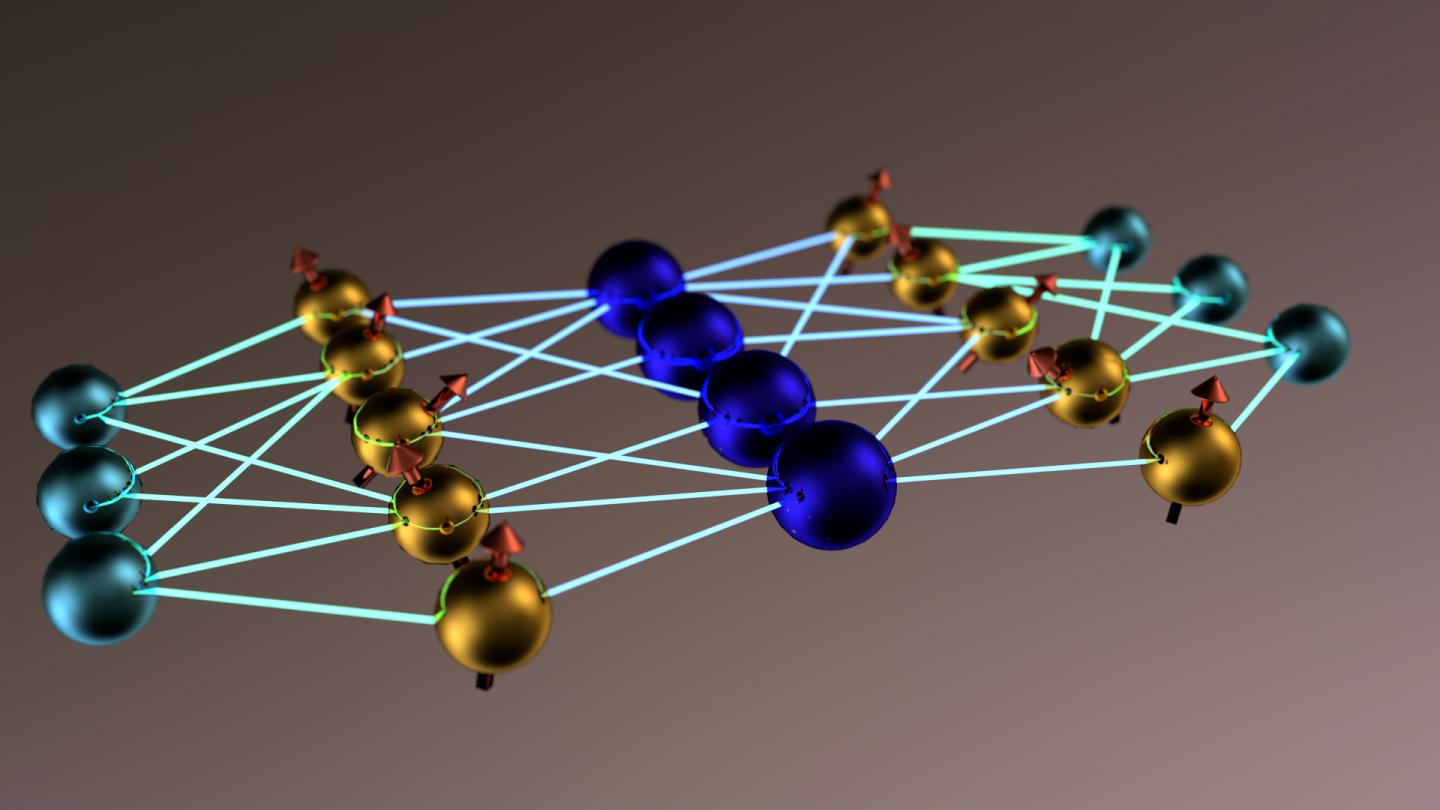
“We basically combined advances in neural networks and machine-learning with quantum Monte Carlo tools,” says Savona, referring to a large toolkit of computational methods that physicists use to study complex quantum systems. The scientists trained a neural network to represent simultaneously the many quantum states in which a quantum system can be cast by the influence of its environment.

The neural-network approach allowed the physicists to predict the properties of quantum systems of considerable size and arbitrary geometry. “This is a novel computational approach that addresses the problem of open quantum systems with versatility and a lot of potential for scaling up,” says Savona. The method is set to become a tool of choice for the study of complex quantum systems, and, looking a bit more into the future, for assessing the effects of noise on quantum hardware.

###

Reference

Alexandra Nagy, Vincenzo Savona. Variational quantum Monte Carlo with neural network ansatz for open quantum systems. Physical Review Letters Phys. Rev. Lett. 122, 250501 (2019). DOI: 10.1103/PhysRevLett.122.250501

Media Contact
Nik Papageorgiou
[email protected]

Related Journal Article

http://dx.doi.org/10.1103/PhysRevLett.122.250501

Tags: Atomic/Molecular/Particle PhysicsChemistry/Physics/Materials SciencesComputer ScienceParticle PhysicsRobotry/Artificial IntelligenceSoftware Engineering
Share12Tweet8Share2ShareShareShare2

Related Posts

Humans and Zebra Finches Share Similar Speech Learning Techniques #ASA190 — Chemistry

Humans and Zebra Finches Share Similar Speech Learning Techniques #ASA190

May 11, 2026
Unveiling Dark Matter Through Molecular Insights — Chemistry

Unveiling Dark Matter Through Molecular Insights

May 11, 2026

From Touch to Sight: A Bioinspired Multisensory Framework Endows Robots with Human-Like Perception

May 11, 2026

Announcing the 2026 Carbon Future Young Investigator Award Winners

May 11, 2026
Please login to join discussion

POPULAR NEWS

  • Research Indicates Potential Connection Between Prenatal Medication Exposure and Elevated Autism Risk

    841 shares
    Share 336 Tweet 210
  • New Study Reveals Plants Can Detect the Sound of Rain

    728 shares
    Share 290 Tweet 182
  • Salmonella Haem Blocks Macrophages, Boosts Infection

    62 shares
    Share 25 Tweet 16
  • Breastmilk Balances E. coli and Beneficial Bacteria in Infant Gut Microbiomes

    57 shares
    Share 23 Tweet 14

About

We bring you the latest biotechnology news from best research centers and universities around the world. Check our website.

Follow us

Recent News

Humans and Zebra Finches Share Similar Speech Learning Techniques #ASA190

New Study Uncovers How Fungal Parasites Attack Strawberries and Raspberries

City of Hope Researchers to Present Groundbreaking Immunotherapy and Precision Medicine Advances Across Multiple Cancer Types at ASCO 2026

Subscribe to Blog via Email

Enter your email address to subscribe to this blog and receive notifications of new posts by email.

Join 82 other subscribers
  • Contact Us

Bioengineer.org © Copyright 2023 All Rights Reserved.

Welcome Back!

Login to your account below

Forgotten Password?

Retrieve your password

Please enter your username or email address to reset your password.

Log In
No Result
View All Result
  • Homepages
    • Home Page 1
    • Home Page 2
  • News
  • National
  • Business
  • Health
  • Lifestyle
  • Science

Bioengineer.org © Copyright 2023 All Rights Reserved.