• HOME
  • NEWS
  • EXPLORE
    • CAREER
      • Companies
      • Jobs
    • EVENTS
    • iGEM
      • News
      • Team
    • PHOTOS
    • VIDEO
    • WIKI
  • BLOG
  • COMMUNITY
    • FACEBOOK
    • INSTAGRAM
    • TWITTER
Thursday, January 15, 2026
BIOENGINEER.ORG
No Result
View All Result
  • Login
  • HOME
  • NEWS
  • EXPLORE
    • CAREER
      • Companies
      • Jobs
        • Lecturer
        • PhD Studentship
        • Postdoc
        • Research Assistant
    • EVENTS
    • iGEM
      • News
      • Team
    • PHOTOS
    • VIDEO
    • WIKI
  • BLOG
  • COMMUNITY
    • FACEBOOK
    • INSTAGRAM
    • TWITTER
  • HOME
  • NEWS
  • EXPLORE
    • CAREER
      • Companies
      • Jobs
        • Lecturer
        • PhD Studentship
        • Postdoc
        • Research Assistant
    • EVENTS
    • iGEM
      • News
      • Team
    • PHOTOS
    • VIDEO
    • WIKI
  • BLOG
  • COMMUNITY
    • FACEBOOK
    • INSTAGRAM
    • TWITTER
No Result
View All Result
Bioengineer.org
No Result
View All Result
Home NEWS Science News Chemistry

Rich defects boosting the oxygen evolution reaction

Bioengineer by Bioengineer
June 27, 2019
in Chemistry
Reading Time: 2 mins read
0
IMAGE
Share on FacebookShare on TwitterShare on LinkedinShare on RedditShare on Telegram

IMAGE

Credit: ©Science China Press

The oxygen evolution reaction (OER) with sluggish reaction kinetics and large over-potential is the severe reaction in water splitting that is promising for energy storage and conversion. However, it is still the bottleneck reaction of the water-splitting system because of the slow kinetics and large over-potential during the anodic polarization process. Therefore, it is crucial to develop highly efficient OER catalysts which can lower the over-potential effectively and accelerate reaction kinetics.

At present, CoFe double metal oxides or hydroxides have been proved by many studies to be efficient catalysts for catalyzing OER. However, the performance of the corresponding bulk catalysts is still unsatisfactory in practical applications. Based on this, it is of considerable significance to achieve the simultaneous improvement of the apparent activity and intrinsic activity of CoFe-based catalysts through material nanostructure engineering and electronic structure regulation.

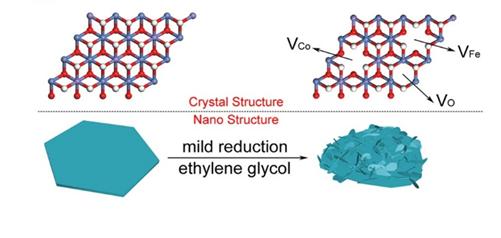
Recently, Professor Shuangyin Wang’s group from Hunan University, based on the strategy of defect engineering, used a mild reducing agent-ethylene glycol as a solvent in the solvothermal reduction of bulk CoFe LDHs to achieve defects construction. Such treatment realized the formation of anion and cation defects (O, Co, and Fe), and the bulk CoFe LDHs were in situ exfoliated, and a three-dimensional hierarchical structure was formed due to the intercalation effect of large size ethylene glycol during the solvothermal process.

After further morphology and electronic structure characterization, the authors found that the defect-rich structure significantly increased the intrinsic activity of the material, and the resulted 3-dimensional hierarchical structure promoted the mass transfer in the catalytic process, ultimately achieving effective OER performance.

Besides, compared with the conventional the two-dimensional material exfoliation or defect construction methods, this method breaks through the bottleneck of scale-up exfoliation of two-dimensional material, and the exfoliation of two-dimensional catalyst and in-situ development of three-dimensional structure are realized by a simple one-step solvothermal method. It provides a new direction for the large-scale preparation and application of OER catalysts.

###

This research was funded by the Fundamental Research Funds for the Central Universities (Grant Nos. 531107051102), the National Natural Science Foundation of China (Grant No. 51402100, 21573066, and 21522305) and the Provincial Natural Science Foundation of Hunan (Grant no. 2016TP1009) and the Shenzhen Discovery Funding (JCYJ20170306141659388).

See the article: Zhou P, He J, Zou Y, Wang Y, Xie C, Chen R, Zang S, Wang S. Single-crystalline layered double hydroxides with rich defects and hierarchical structure by mild reduction for enhancing the oxygen evolution reaction. Sci. China Chem., 2019, DOI:10.1007/s11426-019-9511-x.

http://engine.scichina.com/doi.org/10.1007/s11426-019-9511-x

Media Contact
Shuangyin Wang
[email protected]

Related Journal Article

http://dx.doi.org/10.1007/s11426-019-9511-x

Tags: Chemistry/Physics/Materials Sciences
Share12Tweet8Share2ShareShareShare2

Related Posts

blank

Thermal [2+2] Cycloaddition Builds Gem-Difluoro Bicycloalkanes

January 13, 2026
blank

Cobalt-Catalyzed Thioester Coupling via Siloxycarbene

January 12, 2026

Advancing Alkene Chemistry: Homologative Difunctionalization Breakthrough

January 8, 2026

Biocompatible Ligand Enables Safe In-Cell Protein Arylation

January 8, 2026
Please login to join discussion

POPULAR NEWS

  • Enhancing Spiritual Care Education in Nursing Programs

    155 shares
    Share 62 Tweet 39
  • PTSD, Depression, Anxiety in Childhood Cancer Survivors, Parents

    147 shares
    Share 59 Tweet 37
  • Robotic Ureteral Reconstruction: A Novel Approach

    75 shares
    Share 30 Tweet 19
  • Study Reveals Lipid Accumulation in ME/CFS Cells

    53 shares
    Share 21 Tweet 13

About

We bring you the latest biotechnology news from best research centers and universities around the world. Check our website.

Follow us

Recent News

Single-Atom Trapping via Metasurface Tweezers

Mitochondrial Insights into Phrynocephalus Guttatus Evolution

Marine Molecules Target Type 1 Diabetes Insights

Subscribe to Blog via Email

Enter your email address to subscribe to this blog and receive notifications of new posts by email.

Join 71 other subscribers
  • Contact Us

Bioengineer.org © Copyright 2023 All Rights Reserved.

Welcome Back!

Login to your account below

Forgotten Password?

Retrieve your password

Please enter your username or email address to reset your password.

Log In
No Result
View All Result
  • Homepages
    • Home Page 1
    • Home Page 2
  • News
  • National
  • Business
  • Health
  • Lifestyle
  • Science

Bioengineer.org © Copyright 2023 All Rights Reserved.