• HOME
  • NEWS
  • EXPLORE
    • CAREER
      • Companies
      • Jobs
    • EVENTS
    • iGEM
      • News
      • Team
    • PHOTOS
    • VIDEO
    • WIKI
  • BLOG
  • COMMUNITY
    • FACEBOOK
    • INSTAGRAM
    • TWITTER
Monday, June 1, 2026
BIOENGINEER.ORG
No Result
View All Result
  • Login
  • HOME
  • NEWS
  • EXPLORE
    • CAREER
      • Companies
      • Jobs
        • Lecturer
        • PhD Studentship
        • Postdoc
        • Research Assistant
    • EVENTS
    • iGEM
      • News
      • Team
    • PHOTOS
    • VIDEO
    • WIKI
  • BLOG
  • COMMUNITY
    • FACEBOOK
    • INSTAGRAM
    • TWITTER
  • HOME
  • NEWS
  • EXPLORE
    • CAREER
      • Companies
      • Jobs
        • Lecturer
        • PhD Studentship
        • Postdoc
        • Research Assistant
    • EVENTS
    • iGEM
      • News
      • Team
    • PHOTOS
    • VIDEO
    • WIKI
  • BLOG
  • COMMUNITY
    • FACEBOOK
    • INSTAGRAM
    • TWITTER
No Result
View All Result
Bioengineer.org
No Result
View All Result
Home NEWS Science News Chemistry

Rich defects boosting the oxygen evolution reaction

Bioengineer by Bioengineer
June 27, 2019
in Chemistry
Reading Time: 2 mins read
0
IMAGE
Share on FacebookShare on TwitterShare on LinkedinShare on RedditShare on Telegram

IMAGE

Credit: ©Science China Press

The oxygen evolution reaction (OER) with sluggish reaction kinetics and large over-potential is the severe reaction in water splitting that is promising for energy storage and conversion. However, it is still the bottleneck reaction of the water-splitting system because of the slow kinetics and large over-potential during the anodic polarization process. Therefore, it is crucial to develop highly efficient OER catalysts which can lower the over-potential effectively and accelerate reaction kinetics.

At present, CoFe double metal oxides or hydroxides have been proved by many studies to be efficient catalysts for catalyzing OER. However, the performance of the corresponding bulk catalysts is still unsatisfactory in practical applications. Based on this, it is of considerable significance to achieve the simultaneous improvement of the apparent activity and intrinsic activity of CoFe-based catalysts through material nanostructure engineering and electronic structure regulation.

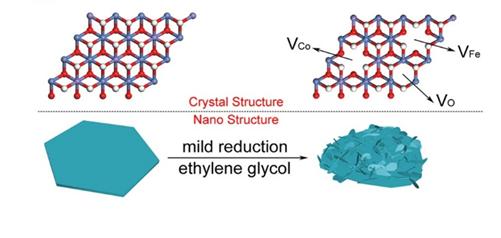
Recently, Professor Shuangyin Wang’s group from Hunan University, based on the strategy of defect engineering, used a mild reducing agent-ethylene glycol as a solvent in the solvothermal reduction of bulk CoFe LDHs to achieve defects construction. Such treatment realized the formation of anion and cation defects (O, Co, and Fe), and the bulk CoFe LDHs were in situ exfoliated, and a three-dimensional hierarchical structure was formed due to the intercalation effect of large size ethylene glycol during the solvothermal process.

After further morphology and electronic structure characterization, the authors found that the defect-rich structure significantly increased the intrinsic activity of the material, and the resulted 3-dimensional hierarchical structure promoted the mass transfer in the catalytic process, ultimately achieving effective OER performance.

Besides, compared with the conventional the two-dimensional material exfoliation or defect construction methods, this method breaks through the bottleneck of scale-up exfoliation of two-dimensional material, and the exfoliation of two-dimensional catalyst and in-situ development of three-dimensional structure are realized by a simple one-step solvothermal method. It provides a new direction for the large-scale preparation and application of OER catalysts.

###

This research was funded by the Fundamental Research Funds for the Central Universities (Grant Nos. 531107051102), the National Natural Science Foundation of China (Grant No. 51402100, 21573066, and 21522305) and the Provincial Natural Science Foundation of Hunan (Grant no. 2016TP1009) and the Shenzhen Discovery Funding (JCYJ20170306141659388).

See the article: Zhou P, He J, Zou Y, Wang Y, Xie C, Chen R, Zang S, Wang S. Single-crystalline layered double hydroxides with rich defects and hierarchical structure by mild reduction for enhancing the oxygen evolution reaction. Sci. China Chem., 2019, DOI:10.1007/s11426-019-9511-x.

http://engine.scichina.com/doi.org/10.1007/s11426-019-9511-x

Media Contact
Shuangyin Wang
[email protected]

Related Journal Article

http://dx.doi.org/10.1007/s11426-019-9511-x

Tags: Chemistry/Physics/Materials Sciences
Share12Tweet8Share2ShareShareShare2

Related Posts

Transforming Microalgae Waste into High-Performance Membranes for Enhanced Municipal Wastewater Treatment — Chemistry

Transforming Microalgae Waste into High-Performance Membranes for Enhanced Municipal Wastewater Treatment

May 29, 2026
Hydrochar Transforms Agricultural Waste into a Potent Solution for Healthier, Carbon-Rich Soils — Chemistry

Hydrochar Transforms Agricultural Waste into a Potent Solution for Healthier, Carbon-Rich Soils

May 29, 2026

FAPESP Aims to Strengthen Scientific Collaboration Between São Paulo and the United Kingdom

May 29, 2026

Mild Ketone-to-Ketyl Conversion Enables Redox-Neutral Coupling

May 29, 2026
Please login to join discussion

POPULAR NEWS

  • ESMO 2025: mRNA COVID Vaccines Enhance Efficacy of Cancer Immunotherapy

    319 shares
    Share 128 Tweet 80
  • Multi-Hospital Study Reveals Long Covid Burden Is Twice as High as Current Estimates

    81 shares
    Share 32 Tweet 20
  • Common Food Preservatives Associated with Elevated Blood Pressure and Increased Heart Disease Risk

    56 shares
    Share 22 Tweet 14
  • AI-Powered Atlas Uncovers Extensive Whole-Body Damage Linked to Obesity

    53 shares
    Share 21 Tweet 13

About

We bring you the latest biotechnology news from best research centers and universities around the world. Check our website.

Follow us

Recent News

Impact of Immigration Restrictions on the US Healthcare Workforce

Study Reveals Cancer Diagnostic Delays Linked to Population-Based Screening Using Cell-Free DNA Multicancer Early Detection Test

Innovative AI Technique Predicts Radiation Dosage Prior to Treatment in Advanced Prostate Cancer

Subscribe to Blog via Email

Success! An email was just sent to confirm your subscription. Please find the email now and click 'Confirm' to start subscribing.

Join 82 other subscribers
  • Contact Us

Bioengineer.org © Copyright 2023 All Rights Reserved.

Welcome Back!

Login to your account below

Forgotten Password?

Retrieve your password

Please enter your username or email address to reset your password.

Log In
No Result
View All Result
  • Homepages
    • Home Page 1
    • Home Page 2
  • News
  • National
  • Business
  • Health
  • Lifestyle
  • Science

Bioengineer.org © Copyright 2023 All Rights Reserved.