


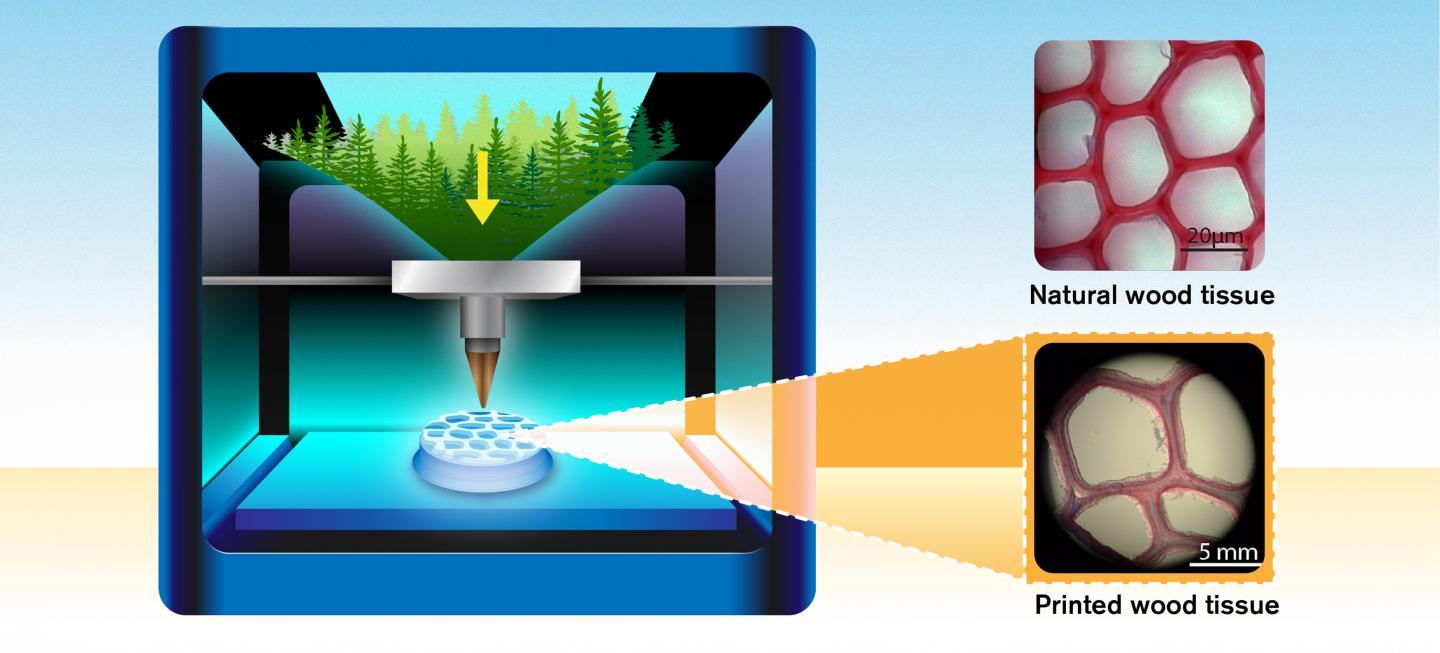
Credit: Yen Strandqvist/Chalmers University of Technology
Researchers at Chalmers University of Technology, Sweden, have succeeded in 3D printing with a wood-based ink in a way that mimics the unique ‘ultrastructure’ of wood. Their research could revolutionise the manufacturing of green products. Through emulating the natural cellular architecture of wood, they now present the ability to create green products derived from trees, with unique properties – everything from clothes, packaging, and furniture to healthcare and personal care products.
The way in which wood grows is controlled by its genetic code, which gives it unique properties in terms of porosity, toughness and torsional strength. But wood has limitations when it comes to processing. Unlike metals and plastics, it cannot be melted and easily reshaped, and instead must be sawn, planed or curved. Processes which do involve conversion, to make products such as paper, card and textiles, destroy the underlying ultrastructure, or architecture of the wood cells. But the new technology now presented allows wood to be, in effect, grown into exactly the shape desired for the final product, through the medium of 3D printing.
By previously converting wood pulp into a nanocellulose gel, researchers at Chalmers had already succeeded in creating a type of ink that could be 3D printed. Now, they present a major progression -successfully interpreting wood’s genetic code, and digitising it so that it can instruct a 3D printer.
It means that now, the arrangement of the cellulose nanofibrils can be precisely controlled during the printing process, to actually replicate the desirable ultrastructure of wood. Being able to manage the orientation and shape means that they can capture those useful properties of natural wood.
“This is a breakthrough in manufacturing technology. It allows us to move beyond the limits of nature, to create new sustainable, green products. It means that those products which today are already forest-based can now be 3D printed, in a much shorter time. And the metals and plastics currently used in 3D printing can be replaced with a renewable, sustainable alternative,” says Professor Paul Gatenholm, who has led this research through the Wallenberg Wood Science Centre at Chalmers.
A further advance is the addition of hemicellulose, a natural component of plant cells, to the nanocellulose gel. The hemicellulose acts as a glue, giving the cellulose sufficient strength to be useful, in a similar manner to the natural process of lignification, through which cell walls are built.
The new technology opens up a whole new area of possibilities. Wood-based products could now be designed and ‘grown’ to order – at a vastly reduced timescale compared with natural wood.
Paul Gatenholm’s group has already developed a prototype for an innovative packaging concept. They printed out honeycomb structures, with chambers in between the printed walls, and then managed to encapsulate solid particles inside those chambers. Cellulose has excellent oxygen barrier properties, meaning this could be a promising method for creating airtight packaging for foodstuffs or pharmaceuticals for example.
“Manufacturing products in this way could lead to huge savings in terms of resources and harmful emissions,” he says. “Imagine, for example, if we could start printing packaging locally. It would mean an alternative to today’s industries, with heavy reliance on plastics and C02-generating transport. Packaging could be designed and manufactured to order without any waste”.
They have also developed prototypes for healthcare products and clothing. Another area where Paul Gatenholm sees huge potential for the technology is in space, believing that it offers the perfect first test bed to develop the technology further.
“The source material of plants is fantastically renewable, so the raw materials can be produced on site during longer space travel, or on the moon or on Mars. If you are growing food, there will probably be access to both cellulose and hemicellulose,” says Paul Gatenholm.
The researchers have already successfully demonstrated their technology at a workshop at the European Space Agency, ESA, and are also working with Florida Tech and NASA on another project, including tests of materials in microgravity.
“Traveling in space has always been the catalyst for material development on earth,” he says.
###
Read the article “Materials from trees assembled by 3D printing – Wood tissue beyond nature limits” published in Applied Materials Today. The paper was first published online on 1 March 2019, with the print edition appearing in June 2019.
For more information, contact:
Paul Gatenholm
Professor, Chemistry and Chemical Engineering, Biopolymer Technology
[email protected]
+46 31 772 34 07
Media Contact
Joshua Worth
[email protected]
Original Source
http://www.
Related Journal Article
http://dx.


