• HOME
  • NEWS
  • EXPLORE
    • CAREER
      • Companies
      • Jobs
    • EVENTS
    • iGEM
      • News
      • Team
    • PHOTOS
    • VIDEO
    • WIKI
  • BLOG
  • COMMUNITY
    • FACEBOOK
    • INSTAGRAM
    • TWITTER
Thursday, December 4, 2025
BIOENGINEER.ORG
No Result
View All Result
  • Login
  • HOME
  • NEWS
  • EXPLORE
    • CAREER
      • Companies
      • Jobs
        • Lecturer
        • PhD Studentship
        • Postdoc
        • Research Assistant
    • EVENTS
    • iGEM
      • News
      • Team
    • PHOTOS
    • VIDEO
    • WIKI
  • BLOG
  • COMMUNITY
    • FACEBOOK
    • INSTAGRAM
    • TWITTER
  • HOME
  • NEWS
  • EXPLORE
    • CAREER
      • Companies
      • Jobs
        • Lecturer
        • PhD Studentship
        • Postdoc
        • Research Assistant
    • EVENTS
    • iGEM
      • News
      • Team
    • PHOTOS
    • VIDEO
    • WIKI
  • BLOG
  • COMMUNITY
    • FACEBOOK
    • INSTAGRAM
    • TWITTER
No Result
View All Result
Bioengineer.org
No Result
View All Result
Home NEWS Science News Chemistry

A study from IRB Barcelona describes the reaction mechanism of DNAzymes

Bioengineer by Bioengineer
June 20, 2019
in Chemistry
Reading Time: 3 mins read
0
IMAGE
Share on FacebookShare on TwitterShare on LinkedinShare on RedditShare on Telegram

IMAGE

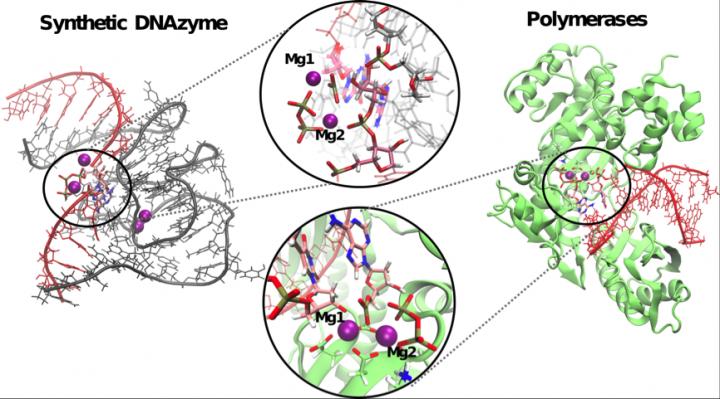
Credit: Juan Aranda, IRB Barcelona

A study from the Institute for Research in Biomedicine (IRB Barcelona) has published a study in the journal Nature Catalysis that describes the reaction mechanism used by the DNAzyme 9DB1, the first structurally available catalyser formed by DNA.

Until recently, it was widely assumed that DNA served to store genetic information in a stable and irreversible manner. However, in the last ten years, the discovery of the epigenetic code and the finding that nucleic acids can also catalyse certain reactions have changed this vision.

The team headed by Modesto Orozco, head of the Molecular Modelling and Bioinformatics Lab at IRB Barcelona, found that this DNAzyme catalyses RNA ligation through a similar mechanism to that used by natural enzymes.

The conclusion drawn by the study may lead to improvements in current catalysers and in the design of novel biocatalysers formed by DNA. Indeed, given that DNAzymes can carry out a variety of reactions on messenger RNA and can trigger the silencing of genes, they are being developed for diagnostic and biomedical applications.

“The role of DNAzymes as catalysers is of great interest since they are easier to synthesise than proteins and RNA molecules, as well as being more stable and less expensive. However, to date, the catalytic mechanism used by DNAzymes was unknown, as were the differences between catalysers made of DNA and RNA or the protein enzymes,” says Orozco, senior professor at the University of Barcelona.

The study published by the IRB Barcelona team aimed to unravel the details of the catalytic mechanism of DNAzymes. To this end, Juan Aranda and Montserrat Terrazas, postdoctoral fellows at IRB Barcelona and first authors of the work, studied DNAzyme 9DB1 at the atomic level using computational simulations and then experimentally validated their findings.

The various computational techniques, ranging from molecular dynamics to the combined use of quantum mechanics and classical mechanics, included in the study have allowed the characterisation of the catalytic state of 9DB1. Using these approaches, the researchers have achieved the first atomic description of the reaction mechanism of a DNAzyme and have characterised the most important interaction in the catalysis and in the transition state of the reaction.

They have experimentally synthesised in vitro variants of 9DB1 to confirm the mechanism that was predicted through the computational approach. The reaction mechanism used by the DNAzyme resembles that of polymerases, which use two divalent cations.

Finally, the scientists have analysed the differences and similarities between the catalytic capacity of DNA, RNA and polymerases. Such atomic information is expected to lead to the design of more efficient DNAzymes.

###

The study has been funded by the Ministry of Science, Innovation and Universities, the Catalan Government, the Spanish National Bioinformatics Institute, the European Research Council (ERC), the Horizon 2020 Programme of the European Union, and the European Regional Development Fund (ERDF).

Reference article:

Juan Aranda, Montserrat Terrazas, Hansel Gómez, Núria Villegas y Modesto Orozco

An artificial DNAzyme RNA ligase shows a reaction mechanism resembling that of cellular polymerases

Nature Catalysis (2019) DOI: 10.1038/s41929-019-0290-y

Media Contact
Communications IRB Barcelona
[email protected]

Original Source

https://www.irbbarcelona.org/en/news/a-study-from-irb-barcelona-describes-the-reaction-mechanism-of-dnazymes-and-opens-new-propsects

Related Journal Article

http://dx.doi.org/10.1038/s41929-019-0290-y

Tags: BiochemistryBioinformaticsBiologyBiomechanics/BiophysicsBiotechnologyMolecular Biology
Share12Tweet8Share2ShareShareShare2

Related Posts

blank

Iridium Catalysis Enables Piperidine Synthesis from Pyridines

December 3, 2025
Neighboring Groups Speed Up Polymer Self-Deconstruction

Neighboring Groups Speed Up Polymer Self-Deconstruction

November 28, 2025

Activating Alcohols as Sulfonium Salts for Photocatalysis

November 26, 2025

Carbonate Ions Drive Water Ordering in CO₂ Reduction

November 25, 2025
Please login to join discussion

POPULAR NEWS

  • New Research Unveils the Pathway for CEOs to Achieve Social Media Stardom

    New Research Unveils the Pathway for CEOs to Achieve Social Media Stardom

    204 shares
    Share 82 Tweet 51
  • Scientists Uncover Chameleon’s Telephone-Cord-Like Optic Nerves, A Feature Missed by Aristotle and Newton

    120 shares
    Share 48 Tweet 30
  • Neurological Impacts of COVID and MIS-C in Children

    107 shares
    Share 43 Tweet 27
  • MoCK2 Kinase Shapes Mitochondrial Dynamics in Rice Fungal Pathogen

    69 shares
    Share 28 Tweet 17

About

We bring you the latest biotechnology news from best research centers and universities around the world. Check our website.

Follow us

Recent News

Boosting Cancer Immunotherapy by Targeting DNA Repair

Evaluating eGFR Equations in Chinese Children

Metformin-Alogliptin Combo vs. Monotherapy in Diabetes

Subscribe to Blog via Email

Enter your email address to subscribe to this blog and receive notifications of new posts by email.

Join 69 other subscribers
  • Contact Us

Bioengineer.org © Copyright 2023 All Rights Reserved.

Welcome Back!

Login to your account below

Forgotten Password?

Retrieve your password

Please enter your username or email address to reset your password.

Log In
No Result
View All Result
  • Homepages
    • Home Page 1
    • Home Page 2
  • News
  • National
  • Business
  • Health
  • Lifestyle
  • Science

Bioengineer.org © Copyright 2023 All Rights Reserved.