Could more heat tolerant, non-preferred algae could revive bleached coral communities even if the relationship is less efficient?
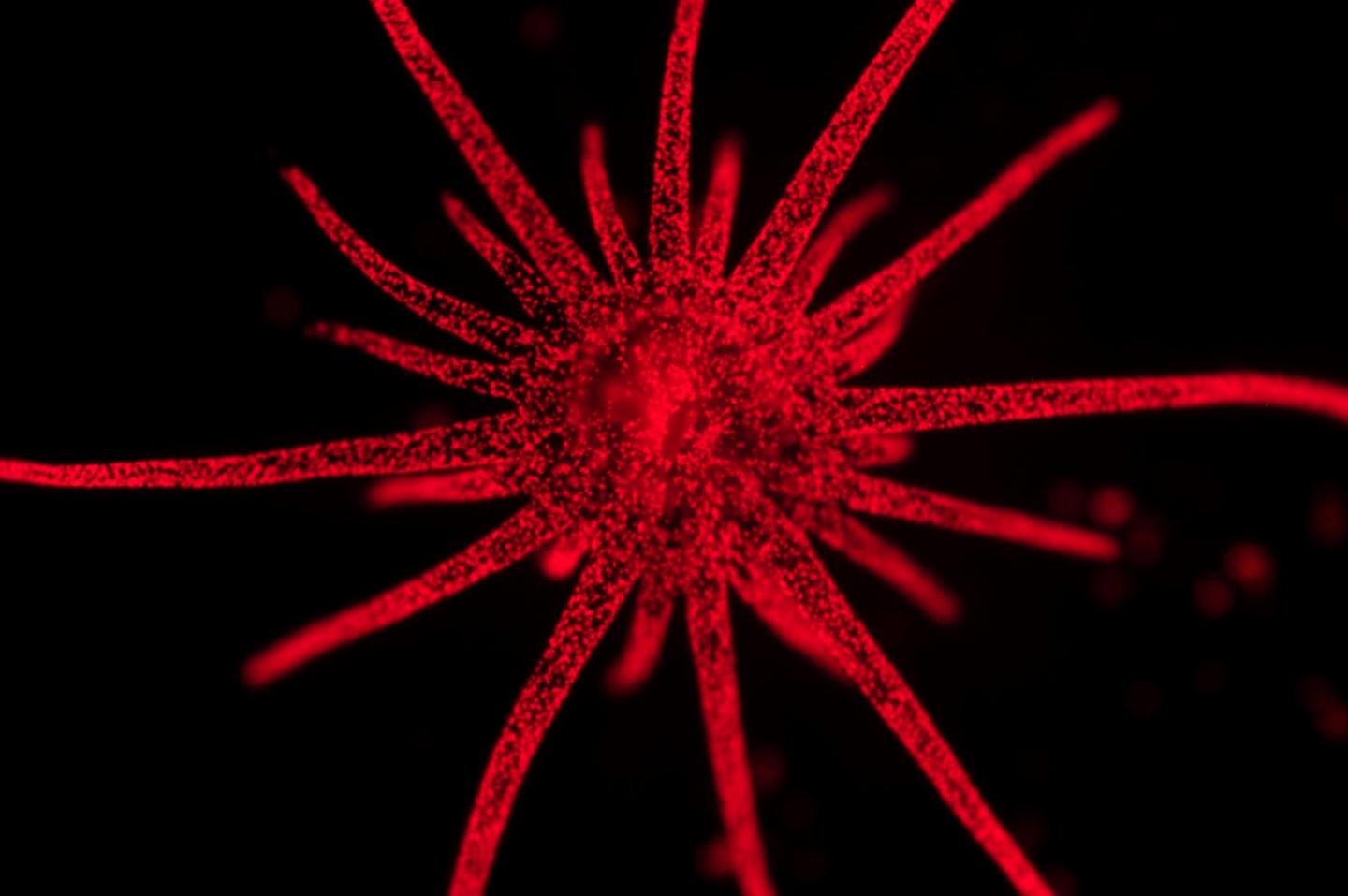
Credit: Tingting Xiang
Palo Alto, CA–What factors govern algae’s success as “tenants” of their coral hosts both under optimal conditions and when oceanic temperatures rise? A Victoria University of Wellington-led team of experts that includes Carnegie’s Arthur Grossman investigates this question.
Corals are marine invertebrates that build large exoskeletons from which colorful reefs are constructed. But this reef-building is only possible because of a mutually beneficial relationship between the coral and various species of single-celled algae called dinoflagellates that live inside the cells of coral polyps.
These algae are photosynthetic, which means that like plants they can convert the Sun’s energy into chemical energy in the form of food. Many of the photosynthetically derived nutrients synthesized by an alga serve as food for its coral host, while the host in turn provides the alga with essential inorganic nutrients, including carbon dioxide, nitrogen in the form of ammonium, and phosphate. However, ocean warming due to climate change is causing many corals to lose their native algal tenants–along with the nutrients that they provide–a phenomenon called bleaching. If the bleached coral is not recolonized with new algal tenants, it can die.
Some species of the dinoflagellate algae form these symbiotic relationships with multiple types of coral, others are more specific.
“We’re interested in understanding the cellular processes that maintain those preferential relationships,” Grossman said. “We also want to know if it’s possible that more heat tolerant, non-preferred algae could revive bleached coral communities even if the relationship is less efficient.”
Other organisms such as sea anemones are part of the same phylum as coral, called cnidaria; they also host algae but are easier to study. In this paper–published by The ISME Journal–the researchers analyzed the differences in cellular function that occurred when a type of anemone called Exaiptasia pallida was populated by two different genera of dinoflagellate algae–one native and highly susceptible to thermal bleaching and the other, which is non-native but more heat-resistant.
“In this study we hoped to elucidate proteins that function to improve nutrient exchange between the anemone and its native algae and why the anemone’s success is compromised when it hosts the non-native heat resistant algae,” Grossman said.
The team found that anemones colonized by native algae expressed elevated levels of proteins associated with the metabolism of organic nitrogen and lipids–nutrients that can be efficiently synthesized as a consequence of the algae’s photosynthetic activity. These anemones also synthesized a protein called NPC2-d which is thought to be key to cnidarian’s ability to take up the algae and recognize it as a symbiotic partner.
In contrast, anemones with the non-native tenant expressed proteins associated with stress, which likely reflects less optimal integration of the metabolisms of the two organisms.
“Our findings open doors to future studies to identify key proteins and cellular mechanisms involved in maintaining a robust relationship between the alga and its cnidarian host and the ways in which the metabolism of the organisms are integrated,” Grossman concluded.
###
This research was supported by the Marsden Fund of the Royal Society Te Aparangi.
The Carnegie Institution for Science is a private, nonprofit organization headquartered in Washington, D.C., with six research departments throughout the U.S. Since its founding in 1902, the Carnegie Institution has been a pioneering force in basic scientific research. Carnegie scientists are leaders in plant biology, developmental biology, astronomy, materials science, global ecology, and Earth and planetary science.
Media Contact
Arthur Grossman
[email protected]
Related Journal Article
http://dx.