• HOME
  • NEWS
  • EXPLORE
    • CAREER
      • Companies
      • Jobs
    • EVENTS
    • iGEM
      • News
      • Team
    • PHOTOS
    • VIDEO
    • WIKI
  • BLOG
  • COMMUNITY
    • FACEBOOK
    • INSTAGRAM
    • TWITTER
Saturday, February 7, 2026
BIOENGINEER.ORG
No Result
View All Result
  • Login
  • HOME
  • NEWS
  • EXPLORE
    • CAREER
      • Companies
      • Jobs
        • Lecturer
        • PhD Studentship
        • Postdoc
        • Research Assistant
    • EVENTS
    • iGEM
      • News
      • Team
    • PHOTOS
    • VIDEO
    • WIKI
  • BLOG
  • COMMUNITY
    • FACEBOOK
    • INSTAGRAM
    • TWITTER
  • HOME
  • NEWS
  • EXPLORE
    • CAREER
      • Companies
      • Jobs
        • Lecturer
        • PhD Studentship
        • Postdoc
        • Research Assistant
    • EVENTS
    • iGEM
      • News
      • Team
    • PHOTOS
    • VIDEO
    • WIKI
  • BLOG
  • COMMUNITY
    • FACEBOOK
    • INSTAGRAM
    • TWITTER
No Result
View All Result
Bioengineer.org
No Result
View All Result
Home NEWS Science News Health

Rutgers scientist creates ‘virtual biopsy’ device to detect skin tumors

Bioengineer by Bioengineer
June 13, 2019
in Health
Reading Time: 2 mins read
0
IMAGE
Share on FacebookShare on TwitterShare on LinkedinShare on RedditShare on Telegram

IMAGE

Credit: Rutgers University

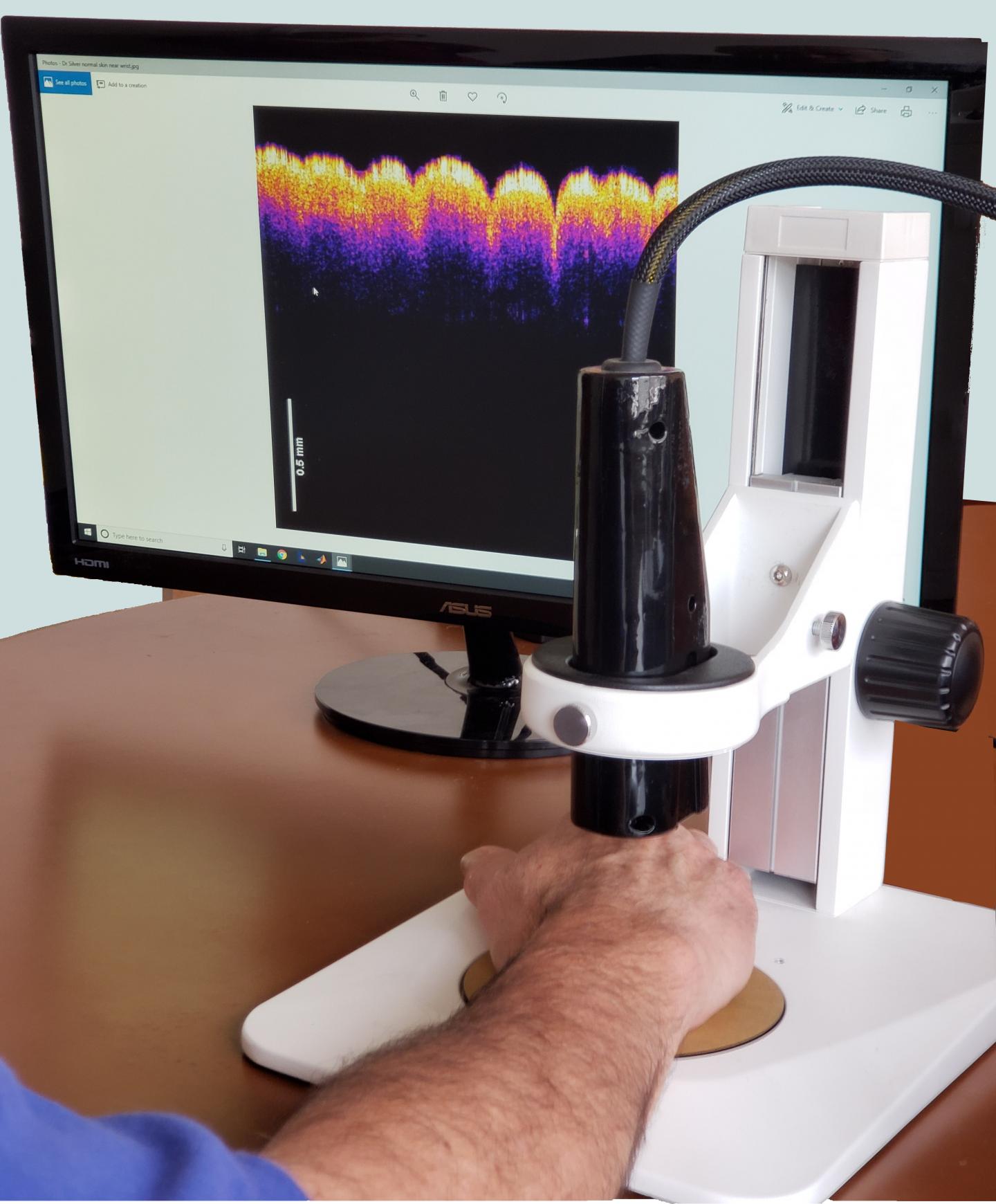
Using sound vibrations and pulses of near-infrared light, a Rutgers University scientist has developed a new “virtual biopsy” device that can quickly determine a skin lesion’s depth and potential malignancy without using a scalpel.

The ability to analyze a skin tumor non-invasively could make biopsies much less risky and distressing to patients, according to a report in Wiley Online Library. Currently, physicians who perform surgical biopsies often don’t know the extent of a lesion – and whether it will be necessary to refer the patient to a specialist for extensive tissue removal or plastic surgery – until surgery has already begun.

The first-of-its-kind experimental procedure, called vibrational optical coherence tomography (VOCT), creates a 3-D map of the legion’s width and depth under the skin with a tiny laser diode. It also uses soundwaves to test the lesion’s density and stiffness since cancer cells are stiffer than healthy cells. An inch-long speaker applies audible soundwaves against the skin to measure the skin’s vibrations and determine whether the lesion is malignant.

“This procedure can be completed in 15 minutes with no discomfort to the patient, who feels no sensation from the light or the nearly inaudible sound. It’s a significant improvement over surgical biopsies, which are invasive, expensive and time consuming,” said lead researcher Frederick Silver, a professor of pathology and laboratory at Rutgers Robert Wood Johnson Medical School.

The study found that a prototype VOCT device, which awaits FDA approval for large-scale testing, is able to accurately distinguish between healthy skin and different types of skin lesions and carcinomas. The researchers tested the device over six months on four skin excisions and on eight volunteers without skin lesions. Further studies are needed to fine-tune the device’s ability to identify a lesion’s borders and areas of greatest density and stiffness, which would allow physicians to remove tumors with minimally invasive surgery.

###

Ruchit Shah, who was a Rutgers doctoral candidate at biomedical engineering at the time of the study, and researchers at the Neigel Center for Cosmetic and Laser Surgery and Center for Advanced Eye Care, co-authored the study.

Media Contact
Neal Buccino
[email protected]

Original Source

https://news.rutgers.edu/rutgers-scientist-creates-%E2%80%9Cvirtual-biopsy%E2%80%9D-device-detect-skin-tumors/20190613#.XQJWksR7l7M

Related Journal Article

http://dx.doi.org/10.1111/srt.12712

Tags: AgingcancerDermatologyMedicine/HealthSurgery
Share12Tweet8Share2ShareShareShare2

Related Posts

Boosting Remote Healthcare: Stepped-Wedge Trial Insights

February 7, 2026

Barriers and Boosters of Seniors’ Physical Activity in Karachi

February 7, 2026

Evaluating Pediatric Emergency Care Quality in Ethiopia

February 7, 2026

TPMT Expression Predictions Linked to Azathioprine Side Effects

February 7, 2026
Please login to join discussion

POPULAR NEWS

  • Robotic Ureteral Reconstruction: A Novel Approach

    Robotic Ureteral Reconstruction: A Novel Approach

    82 shares
    Share 33 Tweet 21
  • Digital Privacy: Health Data Control in Incarceration

    63 shares
    Share 25 Tweet 16
  • Study Reveals Lipid Accumulation in ME/CFS Cells

    57 shares
    Share 23 Tweet 14
  • Breakthrough in RNA Research Accelerates Medical Innovations Timeline

    53 shares
    Share 21 Tweet 13

About

We bring you the latest biotechnology news from best research centers and universities around the world. Check our website.

Follow us

Recent News

Boosting Remote Healthcare: Stepped-Wedge Trial Insights

Barriers and Boosters of Seniors’ Physical Activity in Karachi

Evaluating Pediatric Emergency Care Quality in Ethiopia

Subscribe to Blog via Email

Enter your email address to subscribe to this blog and receive notifications of new posts by email.

Join 73 other subscribers
  • Contact Us

Bioengineer.org © Copyright 2023 All Rights Reserved.

Welcome Back!

Login to your account below

Forgotten Password?

Retrieve your password

Please enter your username or email address to reset your password.

Log In
No Result
View All Result
  • Homepages
    • Home Page 1
    • Home Page 2
  • News
  • National
  • Business
  • Health
  • Lifestyle
  • Science

Bioengineer.org © Copyright 2023 All Rights Reserved.