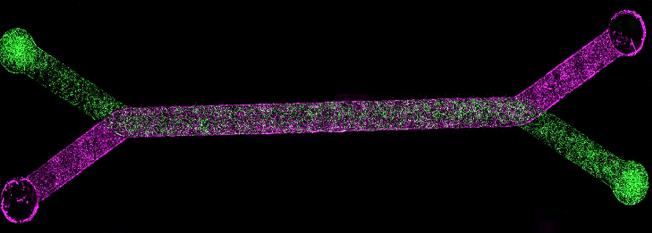
Credit: Dr. Gad Vatine/BGU
BEER-SHEVA, Israel…June 12 – Researchers at Ben-Gurion University of the Negev (BGU) and Cedars-Sinai Medical Center in Los Angeles have, for the first time, duplicated a patient’s blood-brain barrier (BBB), creating a human BBB chip with stem cells, which can be used to develop personalized medicine and new techniques to research brain disorders.
The new research, published in the journal Cell Stem Cell, is a collaboration between Dr. Gad Vatine of BGU’s Regenerative Medicine and Stem Cell Research Center and Department of Physiology and Cell Biology and Dr. Clive N. Svendsen, of Cedars-Sinai Medical Center in Los Angeles.
The blood-brain barrier blocks toxins and other foreign substances in the bloodstream from entering brain tissue and causing damage. But it also can prevent therapeutic drugs from reaching the brain. Neurological disorders such as multiple sclerosis, epilepsy, Alzheimer’s disease, and Huntington’s disease, which collectively affect millions worldwide, have been linked to a defective blood-brain barrier.
In the study, the researchers genetically manipulated blood cells collected from an individual into stem cells (known as induced pluripotent stem cells), which can produce any type of cell. These are used to create the various cells that comprise the blood-brain barrier. The cells are placed on a microfluidic BBB organ-chip approximately the size of an AA battery, which contains tiny hollow channels lined with tens of thousands of living human cells and tissues. This living, micro-engineered environment recreates the natural physiology and mechanical forces that cells experience within the human body, including the BBB.
The living cells recreate a functioning BBB, including blocking entry of certain drugs. Significantly, when this blood-brain barrier was derived from cells of patients with Allan-Herndon-Dudley syndrome, a rare congenital neurological disorder, and Huntington’s disease patients, the barrier malfunctioned in the same way that it does in patients with these diseases.
“By combining patient-specific stem cells and organ-on-chip technology, we generated a personalized model of the human BBB,” says Dr. Vatine. “BBB-on-chips generated from several individuals allows the prediction of the best suited brain drug in a personalized manner. The study’s findings create dramatic new possibilities for precision medicine.”
This is of particular importance for neurological diseases like epilepsy or schizophrenia, for which several FDA-approved drugs are available, but current treatment selections are largely based on trial and error.
“By combining organ-chip technology and human iPSC-derived tissue, we have created a neurovascular unit that recapitulates complex BBB functions, provides a platform for modeling inheritable neurological disorders, and advances drug screening, as well as personalized medicine,” Dr. Vatine says.
###
The project was supported by the Israel Science Foundation, the California Institute for Regenerative Medicine and the Sherman Family Foundation.
About American Associates, Ben-Gurion University of the Negev
American Associates, Ben-Gurion University of the Negev (AABGU) plays a vital role in sustaining David Ben-Gurion’s vision: creating a world-class institution of education and research in the Israeli desert, nurturing the Negev community and sharing the University’s expertise locally and around the globe. As Ben-Gurion University of the Negev (BGU) looks ahead to turning 50 in 2020, AABGU imagines a future that goes beyond the walls of academia. It is a future where BGU invents a new world and inspires a vision for a stronger Israel and its next generation of leaders. Together with supporters, AABGU will help the University foster excellence in teaching, research and outreach to the communities of the Negev for the next 50 years and beyond. Visit vision.aabgu.org to learn more.
Media Contact
Andrew Lavin
[email protected]
Related Journal Article
http://dx.