• HOME
  • NEWS
  • EXPLORE
    • CAREER
      • Companies
      • Jobs
    • EVENTS
    • iGEM
      • News
      • Team
    • PHOTOS
    • VIDEO
    • WIKI
  • BLOG
  • COMMUNITY
    • FACEBOOK
    • INSTAGRAM
    • TWITTER
Saturday, May 16, 2026
BIOENGINEER.ORG
No Result
View All Result
  • Login
  • HOME
  • NEWS
  • EXPLORE
    • CAREER
      • Companies
      • Jobs
        • Lecturer
        • PhD Studentship
        • Postdoc
        • Research Assistant
    • EVENTS
    • iGEM
      • News
      • Team
    • PHOTOS
    • VIDEO
    • WIKI
  • BLOG
  • COMMUNITY
    • FACEBOOK
    • INSTAGRAM
    • TWITTER
  • HOME
  • NEWS
  • EXPLORE
    • CAREER
      • Companies
      • Jobs
        • Lecturer
        • PhD Studentship
        • Postdoc
        • Research Assistant
    • EVENTS
    • iGEM
      • News
      • Team
    • PHOTOS
    • VIDEO
    • WIKI
  • BLOG
  • COMMUNITY
    • FACEBOOK
    • INSTAGRAM
    • TWITTER
No Result
View All Result
Bioengineer.org
No Result
View All Result
Home NEWS Science News Chemistry

Using physics to print living tissue

Bioengineer by Bioengineer
June 4, 2019
in Chemistry
Reading Time: 3 mins read
0
IMAGE
Share on FacebookShare on TwitterShare on LinkedinShare on RedditShare on Telegram

Laws of physics replace trial and error in new approaches to bioprinting
IMAGE

Credit: Ashkan Shafiee

WASHINGTON, D.C., June 4, 2019 — 3D printers can be used to make a variety of useful objects by building up a shape, layer by layer. Scientists have used this same technique to “bioprint” living tissues, including muscle and bone.

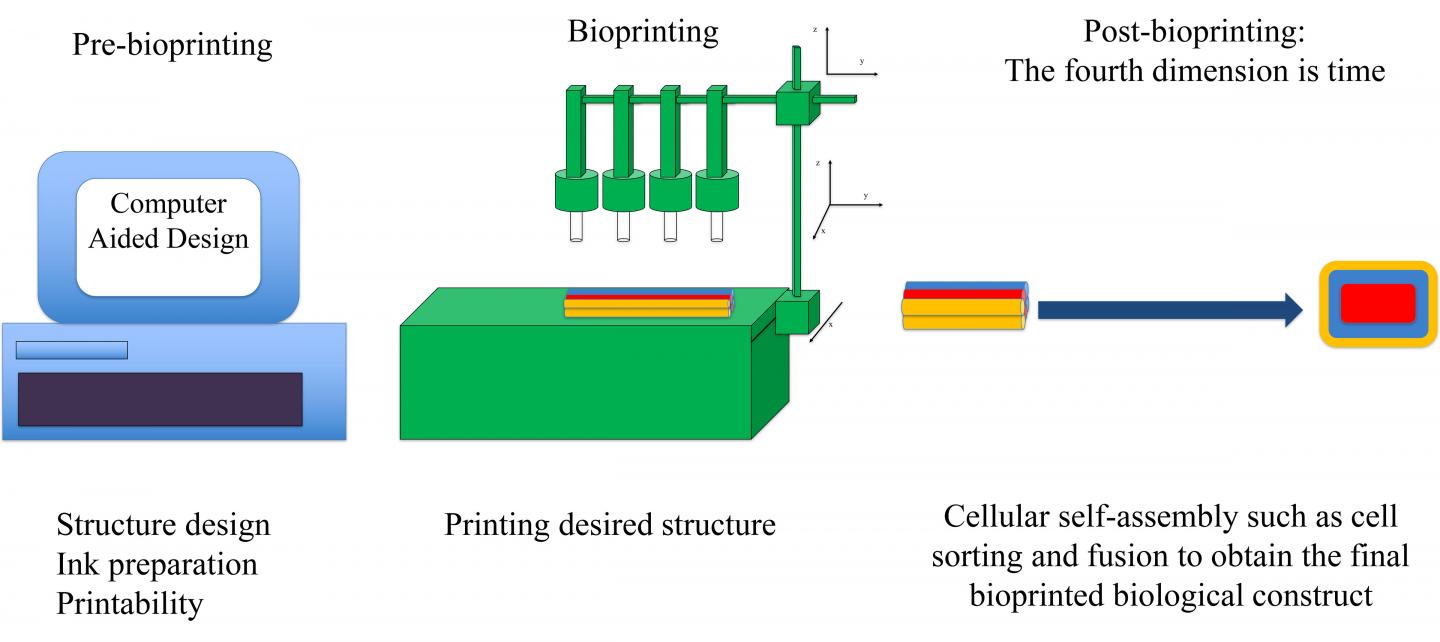
Bioprinting is a relatively new technology that has advanced mostly by trial and error. Scientists are now using the laws of physics and predictive computer modeling to improve these techniques and optimize the bioprinting process. These new advances are reviewed in the June 4 issue of Applied Physics Reviews, from AIP Publishing.

The most widely used bioprinters are extrusion, inkjet and laser-based printers. Each type involves slightly different physics, and each has its own advantages and disadvantages.

Said co-author Ashkan Shafiee, “The only way to achieve a significant transition from ‘trial and error’ to the ‘predict and control’ phase of bioprinting is to understand and apply the underlying physics.”

An extrusion printer loads a material, known as bioink, into a syringe and prints it by forcing the ink out with a piston or air pressure. The bioink may be a collection of pure living cells or a suspension of cells in a hydrogel or a polymer. Inkjet bioprinters function in a similar way but use either a piezoelectric crystal or a heater to create droplets from a small opening. Laser printers focus a laser beam on a ribbon, where a thin layer of bioink is spread, and results in high cell viability.

Biological products created by bioprinting are generally not immediately usable. While the printer may create an initial configuration of cells, these cells will multiply and reassemble into a new configuration. The process is similar to what occurs when an embryo develops, and cells fuse with other cells and sort themselves into new regions.

Computer modeling techniques were developed in the mid-2010s to optimize the post-printing self-assembly step of bioprinting, where small fragments of tissue are delivered into a supporting material with the desired biological structure’s shape, such as an organ, with bioink. The small fragments then develop further and self-assemble into the final biological structure.

The model involves equations that describe the forces of attraction and repulsion between cells. The authors showed that simulations using this method — known as cellular particle dynamics, or CPD — correctly predict the pattern in which a collection of cells will assemble after the initial printing step.

###

The article, “Physics of bioprinting,” is authored by Ashkan Shafiee, Elham Ghadiri, Haripriya Ramesh, Carlos V. Kengla, Jareer Kassis, Paul Calvert, David Williams, Ali Khademhosseini, Roger Narayan, Gabor Forgacs and Anthony Atala. The article will appear in the journal Applied Physics Reviews on June 4, 2019 (DOI: 10.1063/1.5087206). After that date, it can be accessed at http://aip.scitation.org/doi/full/10.1063/1.5087206.

In addition, the journal features a collection of articles on 3D bioprinting that focus on the physical and chemical processes, challenges and proposed solutions related to development of 3D bioprinting approaches. The collection can be accessed at https://aip.scitation.org/toc/are/collection/10.1063/are.2019.3DB.issue-1.

ABOUT THE JOURNAL

Applied Physics Reviews is the dedicated home for open access multidisciplinary research from and for the applied physics community. The journal publishes reviews of current research in applied physics. See https://aip.scitation.org/journal/are.

Media Contact
Larry Frum
[email protected]

Related Journal Article

http://dx.doi.org/10.1063/1.5087206

Tags: Algorithms/ModelsBiologyBiomechanics/BiophysicsBiomedical/Environmental/Chemical EngineeringBiotechnologyCell BiologyChemistry/Physics/Materials SciencesMedicine/HealthTechnology/Engineering/Computer Science
Share13Tweet8Share2ShareShareShare2

Related Posts

New Drexel Study Reveals Key to Keeping Students on Track in Physics Learning — Chemistry

New Drexel Study Reveals Key to Keeping Students on Track in Physics Learning

May 15, 2026
Reversible Glue Technology Powers Up with Electric Activation — Chemistry

Reversible Glue Technology Powers Up with Electric Activation

May 15, 2026

Sweet as Honey: Unveiling a New Heat Transport Regime in Ultrathin Semiconductors

May 15, 2026

High-Precision Boltzmann Luminescent Nanothermometry Achieved Through Predictive Rules

May 15, 2026
Please login to join discussion

POPULAR NEWS

  • Research Indicates Potential Connection Between Prenatal Medication Exposure and Elevated Autism Risk

    844 shares
    Share 338 Tweet 211
  • New Study Reveals Plants Can Detect the Sound of Rain

    730 shares
    Share 291 Tweet 182
  • Salmonella Haem Blocks Macrophages, Boosts Infection

    62 shares
    Share 25 Tweet 16
  • Breastmilk Balances E. coli and Beneficial Bacteria in Infant Gut Microbiomes

    58 shares
    Share 23 Tweet 15

About

We bring you the latest biotechnology news from best research centers and universities around the world. Check our website.

Follow us

Recent News

Congenital Heart Disease’s Lasting Impact on Brain Health

Metabolic Stress Worsens Parkinson’s via Mitochondrial Ferroptosis

Four New Hydroxyl Fatty Acids from Bacillus sp.

Subscribe to Blog via Email

Enter your email address to subscribe to this blog and receive notifications of new posts by email.

Join 82 other subscribers
  • Contact Us

Bioengineer.org © Copyright 2023 All Rights Reserved.

Welcome Back!

Login to your account below

Forgotten Password?

Retrieve your password

Please enter your username or email address to reset your password.

Log In
No Result
View All Result
  • Homepages
    • Home Page 1
    • Home Page 2
  • News
  • National
  • Business
  • Health
  • Lifestyle
  • Science

Bioengineer.org © Copyright 2023 All Rights Reserved.