• HOME
  • NEWS
  • EXPLORE
    • CAREER
      • Companies
      • Jobs
    • EVENTS
    • iGEM
      • News
      • Team
    • PHOTOS
    • VIDEO
    • WIKI
  • BLOG
  • COMMUNITY
    • FACEBOOK
    • INSTAGRAM
    • TWITTER
Wednesday, January 14, 2026
BIOENGINEER.ORG
No Result
View All Result
  • Login
  • HOME
  • NEWS
  • EXPLORE
    • CAREER
      • Companies
      • Jobs
        • Lecturer
        • PhD Studentship
        • Postdoc
        • Research Assistant
    • EVENTS
    • iGEM
      • News
      • Team
    • PHOTOS
    • VIDEO
    • WIKI
  • BLOG
  • COMMUNITY
    • FACEBOOK
    • INSTAGRAM
    • TWITTER
  • HOME
  • NEWS
  • EXPLORE
    • CAREER
      • Companies
      • Jobs
        • Lecturer
        • PhD Studentship
        • Postdoc
        • Research Assistant
    • EVENTS
    • iGEM
      • News
      • Team
    • PHOTOS
    • VIDEO
    • WIKI
  • BLOG
  • COMMUNITY
    • FACEBOOK
    • INSTAGRAM
    • TWITTER
No Result
View All Result
Bioengineer.org
No Result
View All Result
Home NEWS Science News Chemistry

Dissolving protein traffic jam at the entrance of mitochondria

Bioengineer by Bioengineer
May 23, 2019
in Chemistry
Reading Time: 2 mins read
0
IMAGE
Share on FacebookShare on TwitterShare on LinkedinShare on RedditShare on Telegram

IMAGE

Credit: Illustration: Christoph Mårtensson

The research lab of the associate professor (Privatdozent) Dr. Thomas Becker at the University of Freiburg discovered a mechanism that solves blockades on the protein highway towards the powerhouse of the cell. The researchers published their findings in Nature.

Mitochondria produce the bulk of cellular energy and are therefore referred to as powerhouses of the cell. In order to fulfill their functions, mitochondria depend on the import of about 1.000 different proteins. These proteins are synthesized as precursors in the cytosol. Specific protein machineries, termed protein translocases, transport these precursor proteins across the two surrounding membranes of mitochondria. The translocase of the outer membrane, TOM complex, forms the entry gate for almost all precursor proteins. A small portion of the precursors proteins can be stalled in the translocation channel of the TOM complex and blocks the import of further proteins into mitochondria. Impaired protein translocation into mitochondria is deleterious for the cell and leads to a number of cellular stress responses. How the cell prevents an accumulation of such clogged TOM complex is unclear.

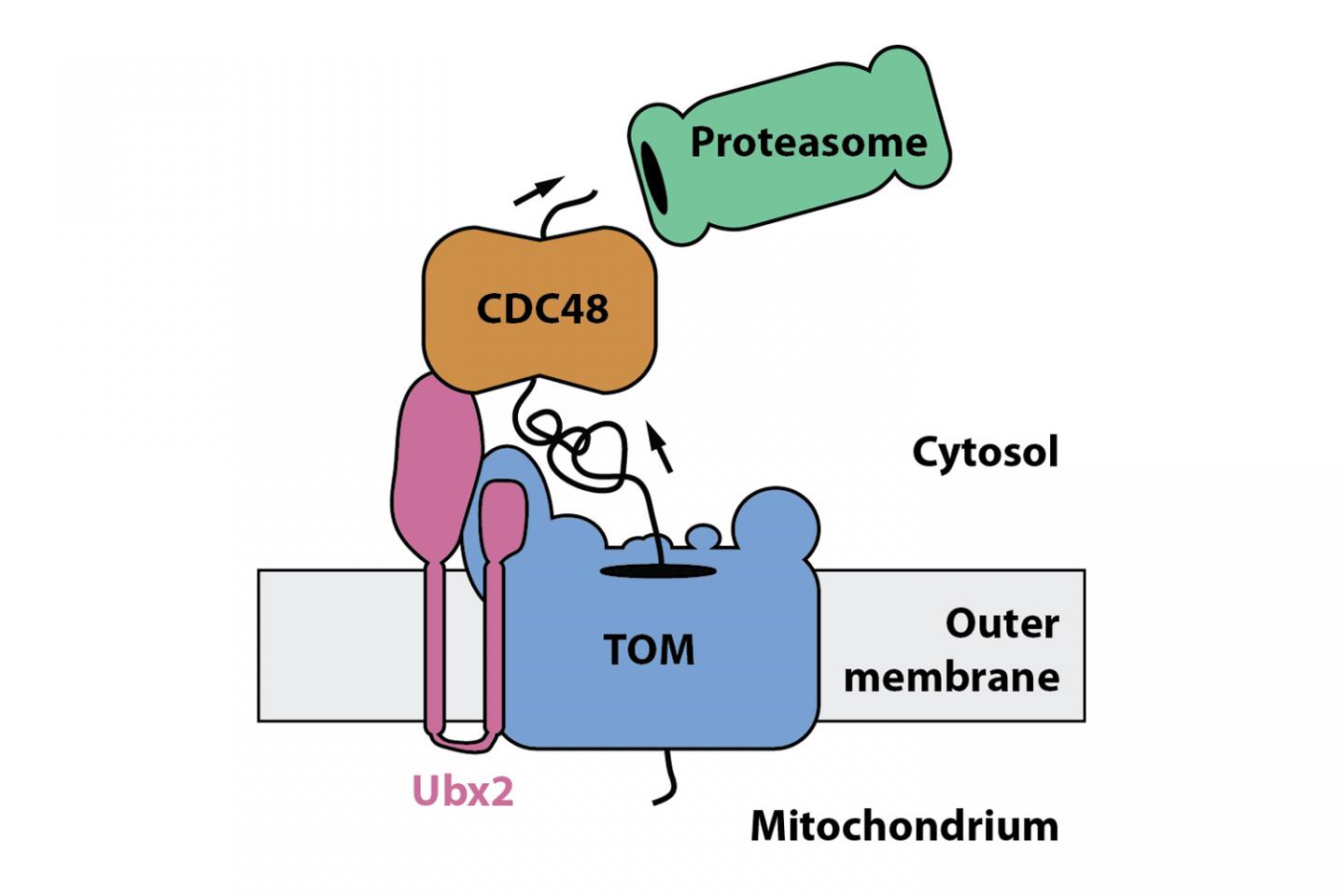
Researchers from the research training group 2202 “Transport Across and Into Membranes”, and the cluster of excellence CIBSS – Centre for Integrative Biological Signalling Studies at the University of Freiburg discovered a new mechanism that clears TOM complexes from stalled precursor proteins. Christoph Mårtensson from the Becker lab showed in collaboration with the group of Prof. Dr. Bettina Warscheid an interaction of the protein Ubx2 with the TOM complex. This finding was unexpected for the researchers since Ubx2 was previously found to function in the removal of misfolded proteins from the endoplasmic reticulum, another cell organelle. Becker´s team showed that Ubx2 is also present in mitochondria, where it binds to the TOM complex to recruit the cytosolic Cdc48. Cdc48 powers the extraction of stalled precursor protein from the TOM complex and transfers it to the cellular protein degradation machinery, the proteasome.

The researchers termed this pathway the “mitochondrial protein translocation-associated degradation”, mitoTAD. The mitoTAD mechanism allows efficient removal of clogged precursor proteins from the TOM complex and ensures unimpeded protein traffic into mitochondria. Since defects in protein transport into mitochondria has been linked to neurodegenerative disorders, the mitoTAD pathway could provide new insights into the molecular mechanisms that lead to the development of such diseases.

###

Original publication:
Mårtensson, C.U., Priesnitz, C., Song, J., Ellenrieder, L., Doan, K.N., Boos, F., Floerchinger, A., Zufall, N., Oeljeklaus, S., Warscheid, B. and Becker, T. (2019). Mitochondrial protein translocation-associated degradation. In: Nature. doi: 10.1038/s41586-019-1227-y

Media Contact
Dr. Thomas Becker
[email protected]

Related Journal Article

http://dx.doi.org/10.1038/s41586-019-1227-y

Tags: BiochemistryBiologyCell BiologyMicrobiology
Share12Tweet8Share2ShareShareShare2

Related Posts

blank

Thermal [2+2] Cycloaddition Builds Gem-Difluoro Bicycloalkanes

January 13, 2026
blank

Cobalt-Catalyzed Thioester Coupling via Siloxycarbene

January 12, 2026

Advancing Alkene Chemistry: Homologative Difunctionalization Breakthrough

January 8, 2026

Biocompatible Ligand Enables Safe In-Cell Protein Arylation

January 8, 2026
Please login to join discussion

POPULAR NEWS

  • Enhancing Spiritual Care Education in Nursing Programs

    154 shares
    Share 62 Tweet 39
  • PTSD, Depression, Anxiety in Childhood Cancer Survivors, Parents

    147 shares
    Share 59 Tweet 37
  • Robotic Ureteral Reconstruction: A Novel Approach

    73 shares
    Share 29 Tweet 18
  • Study Reveals Lipid Accumulation in ME/CFS Cells

    52 shares
    Share 21 Tweet 13

About

BIOENGINEER.ORG

We bring you the latest biotechnology news from best research centers and universities around the world. Check our website.

Follow us

Recent News

Integrative Multi-Omics Links GWAS to Genes in Cattle

Wireless Implant Tracks Airway Stent Migration Continuously

Gut Dysbiosis: Key Driver of Immunoresistance in Cancer

Subscribe to Blog via Email

Enter your email address to subscribe to this blog and receive notifications of new posts by email.

Join 71 other subscribers
  • Contact Us

Bioengineer.org © Copyright 2023 All Rights Reserved.

Welcome Back!

Login to your account below

Forgotten Password?

Retrieve your password

Please enter your username or email address to reset your password.

Log In
No Result
View All Result
  • Homepages
    • Home Page 1
    • Home Page 2
  • News
  • National
  • Business
  • Health
  • Lifestyle
  • Science

Bioengineer.org © Copyright 2023 All Rights Reserved.