Researchers at Osaka University develop a new process for producing palladium nanoparticles that are 12 times more sensitive to hydrogen than those made with previous methods — devices that may be vital to the transition to a hydrogen energy ecosystem
Credit: Osaka University
Osaka, Japan – A team at Osaka University has invented a new process for creating high-precision sensing devices that respond to the presence of hydrogen gas. By carefully controlling the deposition of metallic nanoparticles on a silicon surface, the researchers were able to create a sensor that can detect low levels of hydrogen on the basis of changes in electrical current. This research may have important benefits as part of a switch to hydrogen-based fuels, which could power the zero-emission cars of the future and help fight anthropogenic climate change.
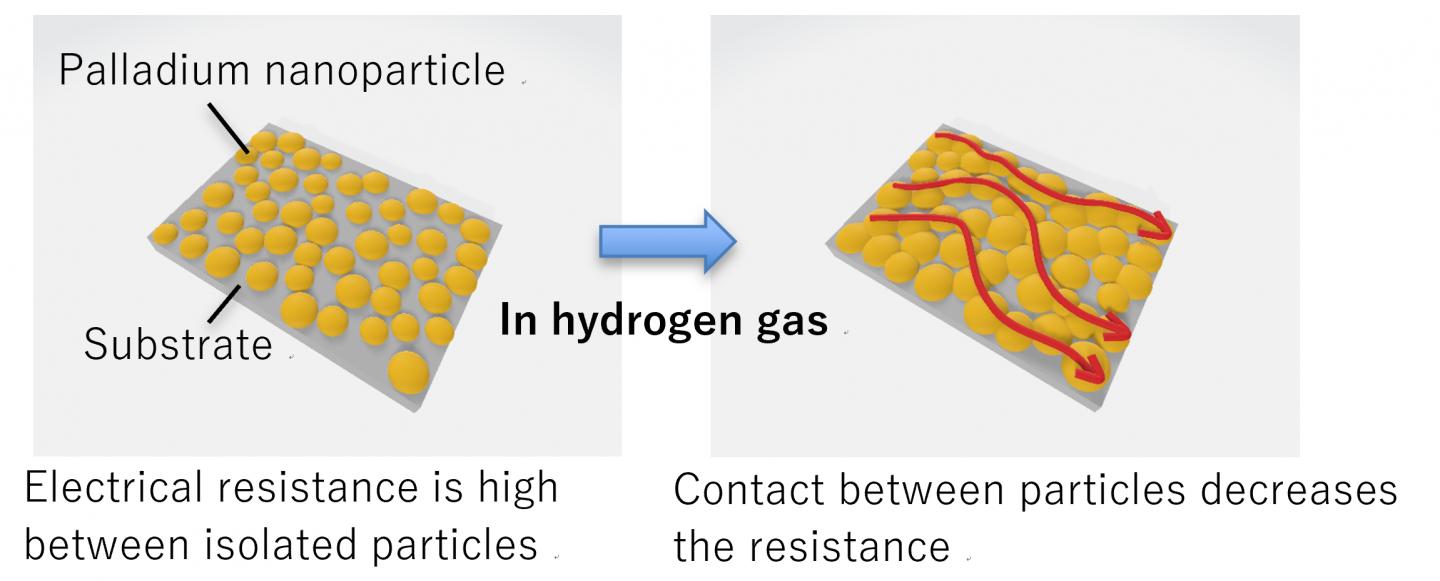
To fabricate a hydrogen sensor, the researchers deposited metallic palladium on a silicon substrate. The deposited palladium forms nanoparticles on the substrate, and they act like tiny islands that are excellent conductors of electricity, but, because they do not form a connected network, the current across the device is very small.
However, when hydrogen atoms are present, they are absorbed into the palladium nanoparticles, increasing volume of the nanoparticles, and then bridge the gaps between the islands. Eventually, a completely connected path is formed, and electrons can flow with much less resistance. In this way, even a tiny change in hydrogen concentration can lead to a massive increase in current, so the devices can be made very sensitive.
A significant challenge the Osaka researchers had to overcome was precisely controlling the gaps between islands to deposit in the first place. If the deposition time was too short, gaps between the nanoparticles are too wide and they would not be bridged even when hydrogen was present. Conversely, if the deposition time was too long, the nanoparticles would form a connected network on their own, even before hydrogen was applied. To optimize the response of the sensor, the research team developed a novel method for monitoring and controlling the deposition of palladium called piezoelectric resonance.
“Piezoelectric materials, such as a quartz crystal in a wristwatch, can vibrate at a very specific frequency in response to an applied voltage,” senior author Dr. Hirotsugu Ogi explains. Here, a piece of piezoelectric lithium niobate was set to vibrate underneath the sample during the metallic nanoparticle deposition. The oscillating piezoelectric created an electric field around the sample, which in turn induced a current in the device that depended on the connectivity of the palladium network.
Then, the attenuation of the oscillation changes depending on the connectivity. Therefore, by listening to the sound (measuring the attenuation) of the piezoelectric material, the connectivity can be monitored.
“By optimizing the deposition time using the piezoelectric resonance method, the resulting hydrogen sensors were 12 times more sensitive than before,” first author Dr. Nobutomo Nakamura says. “These devices may represent a step towards a cleaner energy future involving hydrogen.”
The work is published in Applied Physics Letters as “Precise control of hydrogen response of semicontinuous palladium ?lm using piezoelectric resonance method.” (DOI:10.1063/1.5094917)
###
About Osaka University
Osaka University was founded in 1931 as one of the seven imperial universities of Japan and now has expanded to one of Japan’s leading comprehensive universities. The University has now embarked on open research revolution from a position as Japan’s most innovative university and among the most innovative institutions in the world according to Reuters 2015 Top 100 Innovative Universities and the Nature Index Innovation 2017. The university’s ability to innovate from the stage of fundamental research through the creation of useful technology with economic impact stems from its broad disciplinary spectrum.
Website: https:/
Media Contact
Saori Obayashi
[email protected]
Related Journal Article
http://dx.