Credit: Ivan Nekhaev, a postdoc at St Petersburg University
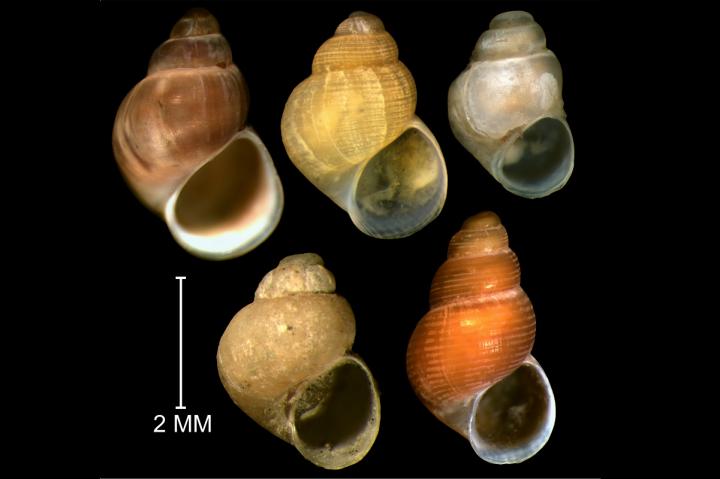
Ivan Nekhaev, a postdoc at St Petersburg University, studied snails of the genus Boreocingula – tiny gastropods as small as half a centimeter – and first discovered that Arctic micromolluscs can show signs of pseudohermaphroditism. Boreocingula martyni adult females grow underdeveloped male genital organs.
Fragments of the genital system of molluscs Boreocingula martyni: in the centre is the male’s copulatory organ. On the sides are underdeveloped copulative organs found in females. Interestingly, snails with the rare anomaly were found in the polluted port areas of the Arctic. So, in the future these molluscs can be used for environmental monitoring. The findings of the research were published in Polar Biology.
‘Some species of molluscs are completely hermaphroditic (they have both male and female genitals). Other species can change their sex during their lifetime, but it happens quite rarely. Moreover, the anomaly when an individual of one sex starts to develop sexual characteristics of the other sex is also extremely rare’, said Ivan Nekhaev, a scientist from the Laboratory of Macroecology and Biogeography of Invertebrates, St Petersburg University.
This unusual metamorphosis only occurred with adult sexually mature females of the Boreocingula martini micromolluscs. Ivan Nekhaev found that all the snails had a small rudimentary penis. Samples of this species were collected in the Rogers Bay, Wrangel Island and in the Pevek Bay, Chukotka. These are the port territories contaminated with organotin compounds.
These substances were actively used in paints for ships as their toxic compounds prevented ships from being encrusted with the marine growth of molluscs and crustaceans. The International Convention on the Control of Harmful Anti-fouling Systems on Ships banned the use of organotin compounds in September 2008, which is relatively recently. So, the adverse effect on marine ecosystems is still being observed.
Ivan Nekhaev told us that there are studies that have been conducted on molluscs from another family such as Muricidae. These studies show a clear connection between the number of individuals with the same anomaly and the concentration of organotin compounds in their habitat. This phenomenon was shown in the experiments of scientists from Tunisia. At the same time, environmental pollution is the only reason researchers currently know about for molluscs becoming pseudohermaphrodites.
‘This allows us to suggest a hypothesis that the Boreocingula martyni micromolluscs can be used for bioindication of marine pollution,’ said Ivan Nekhaev. ‘The fact is that at present it is cheaper to gather a few dozen snails and open them than to analyse water samples. Such work can be carried out, for example, at specially equipped stations near the coast. It will also become necessary to have a stereo microscope and a specially trained person. Moreover, the distribution density of micromolluscs is much higher than that of larger organisms. So, they are easier to be found.’
In total, Ivan Nekhaev analysed about 1,000 individuals from the collections of the Zoological Institute of the Russian Academy of Sciences, as well as academic institutions from Denmark, Norway and the USA. The material under study also have molluscs collected in the 1830s as well as at the end of the 2000s. In addition, Ivan Nekhaev described a new species of micromolluscs previously unknown to science in his work. It is Boreocingula sirenkoi, named after Boris Sirenko, a chief research associate of the Laboratory of the Marine Research, the Zoological Institute of the Russian Academy of Sciences. He made a great contribution to the study of marine molluscs in Russia.
###
Media Contact
Polina Ogorodnikova
[email protected]
Original Source
http://english.
Related Journal Article
http://dx.