• HOME
  • NEWS
  • EXPLORE
    • CAREER
      • Companies
      • Jobs
    • EVENTS
    • iGEM
      • News
      • Team
    • PHOTOS
    • VIDEO
    • WIKI
  • BLOG
  • COMMUNITY
    • FACEBOOK
    • INSTAGRAM
    • TWITTER
Saturday, February 7, 2026
BIOENGINEER.ORG
No Result
View All Result
  • Login
  • HOME
  • NEWS
  • EXPLORE
    • CAREER
      • Companies
      • Jobs
        • Lecturer
        • PhD Studentship
        • Postdoc
        • Research Assistant
    • EVENTS
    • iGEM
      • News
      • Team
    • PHOTOS
    • VIDEO
    • WIKI
  • BLOG
  • COMMUNITY
    • FACEBOOK
    • INSTAGRAM
    • TWITTER
  • HOME
  • NEWS
  • EXPLORE
    • CAREER
      • Companies
      • Jobs
        • Lecturer
        • PhD Studentship
        • Postdoc
        • Research Assistant
    • EVENTS
    • iGEM
      • News
      • Team
    • PHOTOS
    • VIDEO
    • WIKI
  • BLOG
  • COMMUNITY
    • FACEBOOK
    • INSTAGRAM
    • TWITTER
No Result
View All Result
Bioengineer.org
No Result
View All Result
Home NEWS Science News Health

Half of all patients with syncope have CT head performed with a yield of 1.2% to 3.8%

Bioengineer by Bioengineer
May 13, 2019
in Health
Reading Time: 2 mins read
0
IMAGE
Share on FacebookShare on TwitterShare on LinkedinShare on RedditShare on Telegram

IMAGE

Credit: KIRSTY CHALLEN, B.SC., MBCHB, MRES, PH.D., LANCASHIRE TEACHING HOSPITALS, UNITED KINGDOM

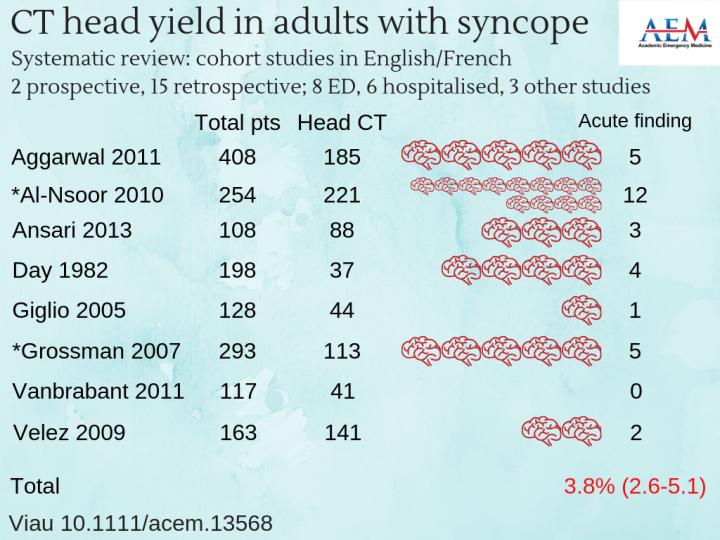
DES PLAINES, IL — More than half of patients with syncope underwent CT head with a diagnostic yield of 1.1 percent to 3.8 percent. That is the conclusion of a study to be published in the May 2019 issue of ACADEMIC EMERGENCY MEDICINE (AEM), a journal of the Society for ACADEMIC EMERGENCY MEDICINE (SAEM).

The lead author of the study J. Alexander Viau, MA, BMBS, Ottawa Hospital Research Institute, Ottawa, Ontario, Canada and the University of Limerick, Limerick, Ireland.

The study results indicate that caution should be exercised against indiscriminate use of computed tomography head in the evaluation of patients with syncope. A few studies identified presence of neurologic deficits as a risk factor for underlying serious intracranial conditions.

The authors recommend future large-scale studies to provide more reliable estimates for diagnostic yield for computed tomography of the head among patients with syncope, to develop a robust prediction tool to guide physicians for optimal use of computed tomography of the head, and to produce expert clinical consensus regarding acceptable miss rate.

Commenting on the study is Benjamin Sun, MD, MPP, professor and chair of the Department of Emergency Medicine in the Perelman School of Medicine at the University Pennsylvania and Senior Fellow, Leonard Davis Institute of Health Economics:

“The findings of this study are consistent with the 2017 AHA/ ACC Syncope Guideline Recommendations: CT of the head is not recommended in the routine evaluation of patients with syncope in the absence of focal neurological findings or head injury that support further evaluation.”

###

ABOUT ACADEMIC EMERGENCY MEDICINE

ACADEMIC EMERGENCY MEDICINE, the monthly journal of Society for ACADEMIC EMERGENCY MEDICINE, features the best in peer-reviewed, cutting-edge original research relevant to the practice and investigation of emergency care. The above study is published open access and can be downloaded by following the DOI link: 10.1111/acem.13568. Journalists wishing to interview the authors may contact Stacey Roseen at [email protected].

ABOUT THE SOCIETY FOR ACADEMIC EMERGENCY MEDICINE

SAEM is a 501(c)(3) not-for-profit organization dedicated to the improvement of care of the acutely ill and injured patient by leading the advancement of ACADEMIC EMERGENCY MEDICINE through education and research, advocacy, and professional development. To learn more, visit saem.org.

Media Contact
Stacey Roseen
[email protected]

Related Journal Article

http://dx.doi.org/10.1111/acem.13568

Tags: Critical Care/Emergency MedicineHealth Care Systems/ServicesHealth ProfessionalsMedicine/HealthTrauma/Injury
Share13Tweet8Share2ShareShareShare2

Related Posts

Decoding Prostate Cancer Origins via snFLARE-seq, mxFRIZNGRND

February 7, 2026

Digital Health Perspectives from Baltic Sea Experts

February 7, 2026

Exploring Decision-Making in Dementia Caregivers’ Mobility

February 7, 2026

Succinate Receptor 1 Limits Blood Cell Formation, Leukemia

February 7, 2026
Please login to join discussion

POPULAR NEWS

  • Robotic Ureteral Reconstruction: A Novel Approach

    Robotic Ureteral Reconstruction: A Novel Approach

    82 shares
    Share 33 Tweet 21
  • Digital Privacy: Health Data Control in Incarceration

    63 shares
    Share 25 Tweet 16
  • Study Reveals Lipid Accumulation in ME/CFS Cells

    57 shares
    Share 23 Tweet 14
  • Breakthrough in RNA Research Accelerates Medical Innovations Timeline

    53 shares
    Share 21 Tweet 13

About

We bring you the latest biotechnology news from best research centers and universities around the world. Check our website.

Follow us

Recent News

Decoding Prostate Cancer Origins via snFLARE-seq, mxFRIZNGRND

Digital Health Perspectives from Baltic Sea Experts

Florida Cane Toad: Complex Spread and Selective Evolution

Subscribe to Blog via Email

Enter your email address to subscribe to this blog and receive notifications of new posts by email.

Join 73 other subscribers
  • Contact Us

Bioengineer.org © Copyright 2023 All Rights Reserved.

Welcome Back!

Login to your account below

Forgotten Password?

Retrieve your password

Please enter your username or email address to reset your password.

Log In
No Result
View All Result
  • Homepages
    • Home Page 1
    • Home Page 2
  • News
  • National
  • Business
  • Health
  • Lifestyle
  • Science

Bioengineer.org © Copyright 2023 All Rights Reserved.