• HOME
  • NEWS
  • EXPLORE
    • CAREER
      • Companies
      • Jobs
    • EVENTS
    • iGEM
      • News
      • Team
    • PHOTOS
    • VIDEO
    • WIKI
  • BLOG
  • COMMUNITY
    • FACEBOOK
    • INSTAGRAM
    • TWITTER
Saturday, February 7, 2026
BIOENGINEER.ORG
No Result
View All Result
  • Login
  • HOME
  • NEWS
  • EXPLORE
    • CAREER
      • Companies
      • Jobs
        • Lecturer
        • PhD Studentship
        • Postdoc
        • Research Assistant
    • EVENTS
    • iGEM
      • News
      • Team
    • PHOTOS
    • VIDEO
    • WIKI
  • BLOG
  • COMMUNITY
    • FACEBOOK
    • INSTAGRAM
    • TWITTER
  • HOME
  • NEWS
  • EXPLORE
    • CAREER
      • Companies
      • Jobs
        • Lecturer
        • PhD Studentship
        • Postdoc
        • Research Assistant
    • EVENTS
    • iGEM
      • News
      • Team
    • PHOTOS
    • VIDEO
    • WIKI
  • BLOG
  • COMMUNITY
    • FACEBOOK
    • INSTAGRAM
    • TWITTER
No Result
View All Result
Bioengineer.org
No Result
View All Result
Home NEWS Science News Cancer

WVU researcher studies incurable blood disease usually diagnosed in children

Bioengineer by Bioengineer
May 13, 2019
in Cancer
Reading Time: 2 mins read
0
IMAGE
Share on FacebookShare on TwitterShare on LinkedinShare on RedditShare on Telegram

IMAGE

Credit: WVU

MORGANTOWN, W.Va.–Treating a stubborn blood disease that strikes children may come down to tweaking energy production in stem cells, suggests research out of West Virginia University.

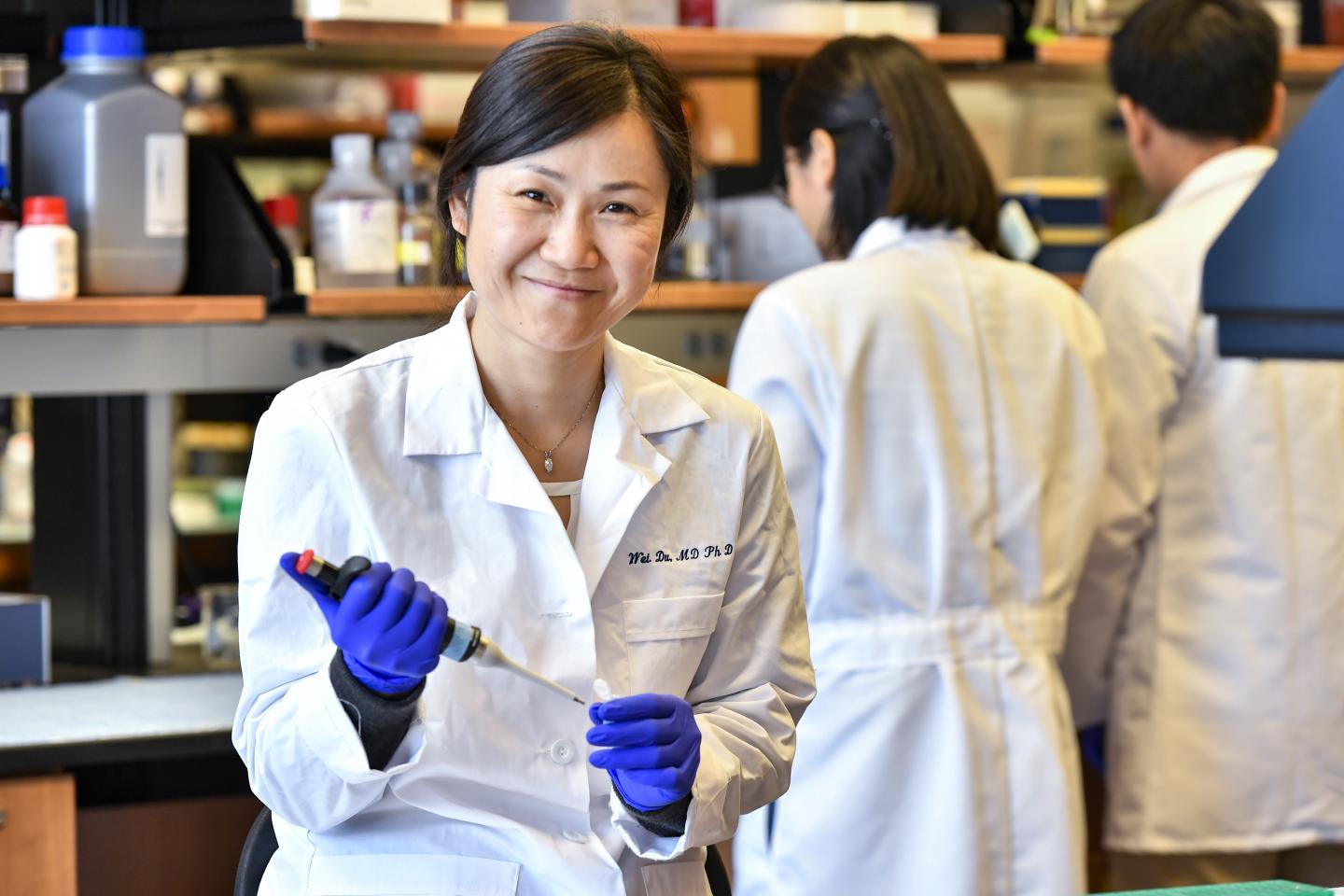
Wei Du, an assistant professor in the School of Pharmacy, is investigating the link between how stem cells make energy and how Fanconi anemia develops. The disease makes it harder for bone marrow to churn out the blood cells our bodies need to fight illnesses, stanch bleeding and transport oxygen. It also makes repairing damaged DNA more difficult.

“Almost all of the kids with Fanconi anemia will develop leukemia eventually,” said Du, who co-leads the Alexander B. Osborn Hematopoietic Malignancy and Transplantation Program at the WVU Cancer Institute. According to St. Jude Children’s Research Hospital, the average lifespan for people with the disease is between 20 and 30 years.

Du and her research team discovered that, in animal models of Fanconi anemia, stem cells tended to use aerobic–or oxygen-based–processes to make energy. That’s unusual: normally stem cells found in bone marrow and blood prefer an anaerobic process that doesn’t rely on oxygen.

This metabolic distinction suggests that Fanconi anemia’s diverse symptoms–from fatigue and shortness of breath, to frequent bruising and nosebleeds–may hinge on cellular-level energy production.

In fact, a single step in the metabolic process seems crucial. The researchers identified a specific signaling pathway–called the p53-TIGAR axis–that was overexpressed in the anemic models. The overexpression correlated to the aerobic “rerouting” of the stem cells’ energy production.

The current standard of care for Fanconi anemia includes bone marrow transplant, but as Du explained, it works less than one-third of the time. “In people with Fanconi anemia, blood cells aren’t the only ones that have a mutation,” she said. “So do other cells in other parts of the body that support stem cell survival.” For that reason, the patients’ bodies can’t support the replication of healthy, transplanted normal cells properly, and their anemia persists.

But Du’s findings could lead to new and better treatments for Fanconi anemia. One promising option is a drug that inhibits the overactivation of the p53-TIGAR signal. Preventing p53-TIGAR from inordinate activation may guide the stem cells’ energy production back to the usual pathway.

Her insights might even deepen researchers’ understanding of gene-therapy techniques. “If you know more about diseases of the stem cell–how they regulate energy, and how they regulate differentiation and self-renewal–you probably can improve gene therapy as well,” Du said. “If you can manually balance the energy production of the diseased stem cells then maybe this can be a benefit when you harvest those gene-delivery cells and transplant them into the patient.”

###

Media Contact
Christa Currey
[email protected]

Related Journal Article

http://dx.doi.org/10.1002/stem.3015

Tags: cancerHematologyMedicine/Health
Share12Tweet8Share2ShareShareShare2

Related Posts

Deep Learning Uncovers Tetrahydrocarbazoles as Potent Broad-Spectrum Antitumor Agents with Click-Activated Targeted Cancer Therapy Approach

February 7, 2026

Newly Discovered Limonoid DHL-11 from Munronia henryi Targets IMPDH2 to Combat Triple-Negative Breast Cancer

February 7, 2026

New Discovery Reveals Why Ovarian Cancer Spreads Rapidly in the Abdomen

February 6, 2026

New Study Finds Americans Favor In-Clinic Screening Over At-Home Tests for Cervical Cancer

February 6, 2026
Please login to join discussion

POPULAR NEWS

  • Robotic Ureteral Reconstruction: A Novel Approach

    Robotic Ureteral Reconstruction: A Novel Approach

    82 shares
    Share 33 Tweet 21
  • Digital Privacy: Health Data Control in Incarceration

    63 shares
    Share 25 Tweet 16
  • Study Reveals Lipid Accumulation in ME/CFS Cells

    57 shares
    Share 23 Tweet 14
  • Breakthrough in RNA Research Accelerates Medical Innovations Timeline

    53 shares
    Share 21 Tweet 13

About

We bring you the latest biotechnology news from best research centers and universities around the world. Check our website.

Follow us

Recent News

Inflammasome Protein ASC Drives Pancreatic Cancer Metabolism

Phage-Antibiotic Combo Beats Resistant Peritoneal Infection

Boosting Remote Healthcare: Stepped-Wedge Trial Insights

Subscribe to Blog via Email

Enter your email address to subscribe to this blog and receive notifications of new posts by email.

Join 73 other subscribers
  • Contact Us

Bioengineer.org © Copyright 2023 All Rights Reserved.

Welcome Back!

Login to your account below

Forgotten Password?

Retrieve your password

Please enter your username or email address to reset your password.

Log In
No Result
View All Result
  • Homepages
    • Home Page 1
    • Home Page 2
  • News
  • National
  • Business
  • Health
  • Lifestyle
  • Science

Bioengineer.org © Copyright 2023 All Rights Reserved.