• HOME
  • NEWS
  • EXPLORE
    • CAREER
      • Companies
      • Jobs
    • EVENTS
    • iGEM
      • News
      • Team
    • PHOTOS
    • VIDEO
    • WIKI
  • BLOG
  • COMMUNITY
    • FACEBOOK
    • INSTAGRAM
    • TWITTER
Thursday, March 26, 2026
BIOENGINEER.ORG
No Result
View All Result
  • Login
  • HOME
  • NEWS
  • EXPLORE
    • CAREER
      • Companies
      • Jobs
        • Lecturer
        • PhD Studentship
        • Postdoc
        • Research Assistant
    • EVENTS
    • iGEM
      • News
      • Team
    • PHOTOS
    • VIDEO
    • WIKI
  • BLOG
  • COMMUNITY
    • FACEBOOK
    • INSTAGRAM
    • TWITTER
  • HOME
  • NEWS
  • EXPLORE
    • CAREER
      • Companies
      • Jobs
        • Lecturer
        • PhD Studentship
        • Postdoc
        • Research Assistant
    • EVENTS
    • iGEM
      • News
      • Team
    • PHOTOS
    • VIDEO
    • WIKI
  • BLOG
  • COMMUNITY
    • FACEBOOK
    • INSTAGRAM
    • TWITTER
No Result
View All Result
Bioengineer.org
No Result
View All Result
Home NEWS Science News Biology

The sicker the better

Bioengineer by Bioengineer
May 1, 2019
in Biology
Reading Time: 3 mins read
0
IMAGE
Share on FacebookShare on TwitterShare on LinkedinShare on RedditShare on Telegram

Parasites help beetle hosts function more effectively
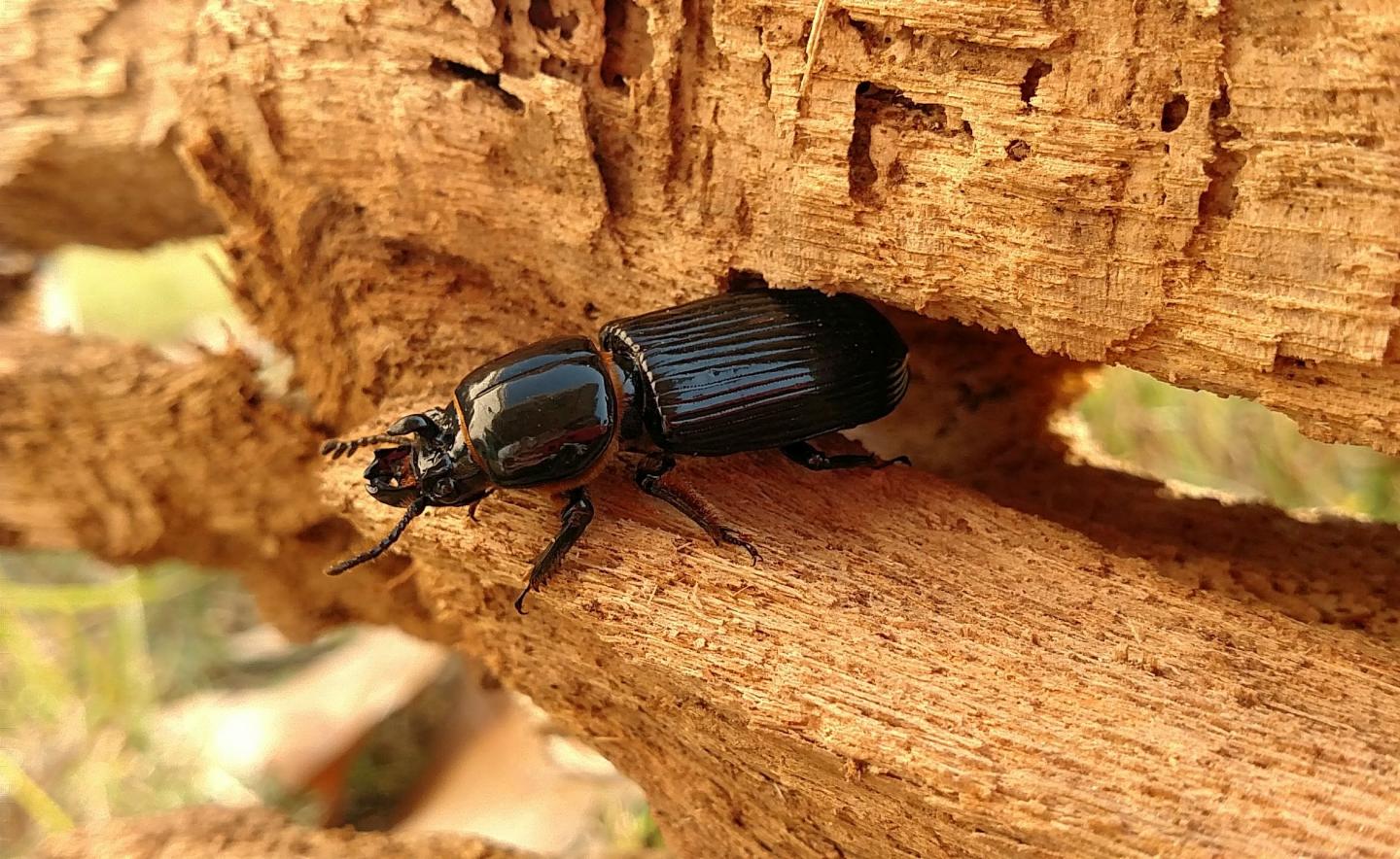
IMAGE

Credit: Andy K. Davis

Athens, Ga. – A common woodland beetle that plays an important role in the decomposition of fallen trees may be getting a boost from a surprising source: parasites.

New research from the University of Georgia found that horned passalus beetles infected with a nematode parasite are able to process wood 15% faster than uninfected beetles. The study, by Andy K. Davis, a research scientist in the Odum School of Ecology, and undergraduate ecology student Cody Prouty, was just published in Biology Letters. It contributes to a growing understanding that parasites play important–and not always negative–roles in ecosystems.

“What this means is that parasitized beetles are more effective at breaking down logs, so that they provide a more effective ecosystem service,” said Davis. “In other words, this parasite could be considered beneficial to the forest ecosystem.”

Horned passalus beetles, also known as bess beetles, are common in eastern U.S. forests. They live in decaying logs, which they help break down by eating and making tunnels, speeding up decomposition and the return of the logs’ nutrients to the soil.

Davis had previously found that many of these beetles are infected with a naturally occurring nematode parasite. He and Prouty noticed that infected beetles appeared to suffer no ill effects from their parasites; in fact, previous studies showed that some infected beetles were larger than uninfected ones. The researchers suspected that the infected beetles might be eating more to compensate for the nutrients they were losing to the parasites, and they devised a laboratory experiment to find out.

They started by collecting 113 horned passalus beetles from a wooded area near the UGA campus. They placed each beetle in an individual container with a piece of intact wood from the same log where it was found. After three months, the researchers examined what was left of the wood, measuring how much had been broken down into fine material. This allowed them to calculate how much wood each beetle processed per day.

Next they examined the beetles, determining weight, sex and whether parasites were present.

They found that approximately 70% of the beetles were infected with the parasites–a typical rate of prevalence–and that parasitized beetles were 6% heavier than their uninfected counterparts. Furthermore, the parasitized beetles processed wood about 15% more quickly.

“It is interesting to think that although the beetle and nematode have a parasitic relationship, the ecosystem benefits from not only the beetle performing its function, but the parasite increasing the efficiency of the beetle,” said Prouty. “Over the course of a few years the parasitized beetles could process many more logs than unparasitized beetles, and lead to an increase of organic matter in soils.”

###

The paper, “The sicker the better: nematode-infected passalus beetles provide enhanced ecosystem services,” is available online at https://royalsocietypublishing.org/doi/10.1098/rsbl.2018.0842

Media Contact
Beth Gavrilles
[email protected]

Original Source

https://news.uga.edu/parasites-help-beetle-hosts-function-effectively/

Related Journal Article

http://dx.doi.org/10.1098/rsbl.2018.0842

Tags: BiologyEcology/EnvironmentEvolutionParasitology
Share13Tweet8Share2ShareShareShare2

Related Posts

How to sway group opinions: Encourage opponents to stay undecided

How to sway group opinions: Encourage opponents to stay undecided

March 23, 2026
Deep Learning Model Maps How Individual Cells Shape Disease Outcomes

Deep Learning Model Maps How Individual Cells Shape Disease Outcomes

March 20, 2026

Removing only 15 female sharks annually could endanger the entire population, scientists warn

March 20, 2026

Scientists Urge Fragrance Industry to Transition from Sustainability Talk to Active Funding of Plant Conservation

March 20, 2026
Please login to join discussion

POPULAR NEWS

  • blank

    Revolutionary AI Model Enhances Precision in Detecting Food Contamination

    96 shares
    Share 38 Tweet 24
  • Imagine a Social Media Feed That Challenges Your Views Instead of Reinforcing Them

    1003 shares
    Share 397 Tweet 248
  • Uncovering Functions of Cavernous Malformation Proteins in Organoids

    54 shares
    Share 22 Tweet 14
  • Promising Outcomes from First Clinical Trials of Gene Regulation in Epilepsy

    51 shares
    Share 20 Tweet 13

About

We bring you the latest biotechnology news from best research centers and universities around the world. Check our website.

Follow us

Recent News

In-Sensor Cryptography Links Physical Process to Digital Identity

Can Psychosocial Factors Influence Cancer Risk?

Depression Factors in Elderly: Pre vs. Post-COVID Analysis

Subscribe to Blog via Email

Success! An email was just sent to confirm your subscription. Please find the email now and click 'Confirm' to start subscribing.

Join 78 other subscribers
  • Contact Us

Bioengineer.org © Copyright 2023 All Rights Reserved.

Welcome Back!

Login to your account below

Forgotten Password?

Retrieve your password

Please enter your username or email address to reset your password.

Log In
No Result
View All Result
  • Homepages
    • Home Page 1
    • Home Page 2
  • News
  • National
  • Business
  • Health
  • Lifestyle
  • Science

Bioengineer.org © Copyright 2023 All Rights Reserved.