• HOME
  • NEWS
  • EXPLORE
    • CAREER
      • Companies
      • Jobs
    • EVENTS
    • iGEM
      • News
      • Team
    • PHOTOS
    • VIDEO
    • WIKI
  • BLOG
  • COMMUNITY
    • FACEBOOK
    • INSTAGRAM
    • TWITTER
Thursday, June 25, 2026
BIOENGINEER.ORG
No Result
View All Result
  • Login
  • HOME
  • NEWS
  • EXPLORE
    • CAREER
      • Companies
      • Jobs
        • Lecturer
        • PhD Studentship
        • Postdoc
        • Research Assistant
    • EVENTS
    • iGEM
      • News
      • Team
    • PHOTOS
    • VIDEO
    • WIKI
  • BLOG
  • COMMUNITY
    • FACEBOOK
    • INSTAGRAM
    • TWITTER
  • HOME
  • NEWS
  • EXPLORE
    • CAREER
      • Companies
      • Jobs
        • Lecturer
        • PhD Studentship
        • Postdoc
        • Research Assistant
    • EVENTS
    • iGEM
      • News
      • Team
    • PHOTOS
    • VIDEO
    • WIKI
  • BLOG
  • COMMUNITY
    • FACEBOOK
    • INSTAGRAM
    • TWITTER
No Result
View All Result
Bioengineer.org
No Result
View All Result
Home NEWS Science News Chemistry

New mathematical approach tested for the search of flight MH370

Bioengineer by Bioengineer
April 30, 2019
in Chemistry
Reading Time: 3 mins read
0
IMAGE
Share on FacebookShare on TwitterShare on LinkedinShare on RedditShare on Telegram

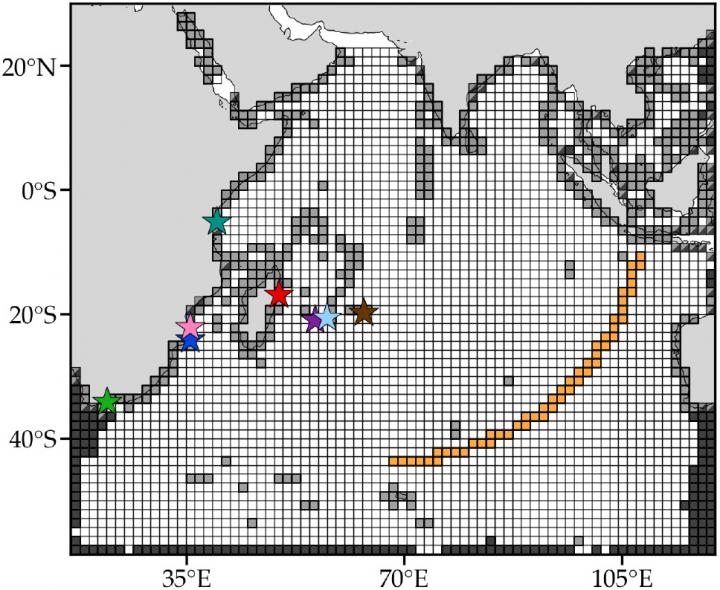
International team of researchers use data from research buoys to simulate the crash site’s location based on how debris drifts in the Indian Ocean
IMAGE

Credit: Philippe Miron

WASHINGTON, D.C., April 30, 2019 — The 2014 disappearance of Malaysia Airlines Flight MH370 remains ones of the biggest mysteries in aviation. More than $150 million has been spent so far to identify where the plane carrying 239 passengers crashed into the Indian Ocean, with no success. Recent efforts combining satellite data with a new mathematical approach aim to make headway in the search for plane crashes.

An international team of researchers has developed a new mathematical approach to analyzing how debris moves around the ocean that has been able to identify a potential crash site. Using what are known as Markov chain models, they have narrowed down a potential crash location substantially north of the region where most search efforts have concentrated.

A Markov chain model predicts the behavior of complicated systems by determining the probability of each outcome from the current state of what is being studied. They have been used to power Google search algorithms and model financial markets.

In the study, reported in the journal Chaos, from AIP Publishing, the group used data from the Global Drifters Program, a publicly available dataset that uses satellites to track spherical buoys as the ocean’s currents, waves and wind push them along paths over time.

In true Markovian fashion, each aimless buoy’s next turn is an independent event from every other movement it has made in the past. The buoys were then placed on a grid with more than 3,000 virtual squares to simulate where plane debris would float to.

One issue is that very little debris has been found so far.

“Surprisingly, after more than three years, there is only a handful of confirmed debris recovered from the airplane,” said Philippe Miron from University of Miami and the lead author on the paper. “This increases the errors of the model.”

Seasonal variation in the Indian Ocean also required the team to develop three separate models to accurately predict debris movement during the protracted search effort.

“The monsoon in the Indian Ocean has important effects on the circulation of the region,” Miron said.

After the analysis, the team’s estimated search area was from 33 to 17 degrees south latitude along the arc of the last satellite to contact the downed plane, whose northern edge has remained largely unscrutinized.

Miron said he hopes the group’s approach will encourage future efforts to deploy more trackable devices in the ocean to provide more data to solve similarly vexing problems. He looks to use mathematical models to further understand how drifting objects move in the ocean, including the flow of hydrocarbons following undersea oil spills.

###

The article, “Markov-chain-inspired search for MH370,” is authored by Philippe Miron, Francisco Beron-Vera, Maria J. Olascoaga and Peter Koltai. It will appear in Chaos on April 30, 2019 (DOI: 10.1063/1.5092132). After that date, it can be accessed at http://aip.scitation.org/doi/full/10.1063/1.5092132.

ABOUT THE JOURNAL

Chaos is devoted to increasing the understanding of nonlinear phenomena in all disciplines and describing their manifestations in a manner comprehensible to researchers from a broad spectrum of disciplines. See http://chaos.aip.org.

Media Contact
AIP Media Line
[email protected]

Related Journal Article

http://dx.doi.org/10.1063/1.5092132

Tags: Algorithms/ModelsChemistry/Physics/Materials SciencesEarth ScienceGeophysicsMathematics/StatisticsOceanographySystems/Chaos/Pattern Formation/Complexity
Share13Tweet8Share2ShareShareShare2

Related Posts

AI and Physics Collaborate to Design Advanced Hydrogen Storage Materials

June 25, 2026

International Team Including Dresden Scientists Develops Novel Designer Proteins for Advanced Study of Living Tissue

June 25, 2026

New Study Uncovers Key Factors Driving Water Chemistry in Nanoscale Environments

June 25, 2026

Plasma Technology Extends Catalyst Lifespan in Hydrogen Production

June 24, 2026
Please login to join discussion

POPULAR NEWS

  • Saying Goodbye to PGY-6: Pediatric Fellowship Realities

    103 shares
    Share 41 Tweet 26
  • Multi-Hospital Study Reveals Long Covid Burden Is Twice as High as Current Estimates

    92 shares
    Share 36 Tweet 23
  • Detection of EDCs in Breast Milk and Infant Urine Up to Six Months Highlights Early Exposure Risks

    77 shares
    Share 31 Tweet 19
  • New Drug Candidate Developed at McMaster Shows Potential for Treating Brain Cancer

    58 shares
    Share 23 Tweet 15

About

We bring you the latest biotechnology news from best research centers and universities around the world. Check our website.

Follow us

Recent News

Tracking Lanthanide-Labeled Microplastics in Plants

POSTECH Researchers Slash Cost of Reconstituted Cell-Free Systems by 95%

AI and Physics Collaborate to Design Advanced Hydrogen Storage Materials

Subscribe to Blog via Email

Success! An email was just sent to confirm your subscription. Please find the email now and click 'Confirm' to start subscribing.

Join 82 other subscribers
  • Contact Us

Bioengineer.org © Copyright 2023 All Rights Reserved.

Welcome Back!

Login to your account below

Forgotten Password?

Retrieve your password

Please enter your username or email address to reset your password.

Log In
No Result
View All Result
  • Homepages
    • Home Page 1
    • Home Page 2
  • News
  • National
  • Business
  • Health
  • Lifestyle
  • Science

Bioengineer.org © Copyright 2023 All Rights Reserved.