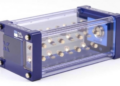
Low-cost acoustic tags attached to fishing nets are being trialled as part of a major new project to reduce marine litter and ‘ghost fishing’.
Lost fishing gear – known as ghost nets – are a major threat to life in our oceans. Choking coral reefs, damaging marine habitats and entangling fish, marine mammals and seabirds, they are also a danger to boats, catching in the propellers. And they are a key source of plastic pollution, gradually breaking up and disintegrating to add to the growing volume of microplastics in the ocean.
Often lost during storms or in strong currents, the nets can travel long distances and can continue to fish for years afterwards – hence the phrase ghost fishing. Because of this, locating and removing the nets is both highly desirable and a major challenge.
The new NetTag project has been set up to try to reduce and prevent marine litter by developing new technology for the location and recovery of lost fishing gear based on miniature transponders – acoustic devices that pick up and automatically respond to an incoming signal. The project also aims to promote improved practices for the management of fishing waste.
The project is a collaboration between Newcastle University (UK) who develop underwater communication and tracking technology, CIIMAR (PT), INESC-TEC (PT), and the Universities of Aveiro (PT) and Santiago de Compostela (ES), together with stakeholders from the fishing industry across Europe.
Newcastle University lead Jeff Neasham, a Senior Lecturer in the School of Engineering, explains:
“By attaching miniature, low-cost, subsea acoustic transponders to fishing nets or other gear, the aim is to be able to precisely locate lost gear from a search vessel and to investigate how underwater robots may be used to aid recovery where necessary.
“A unit on board the surface vessel will send out interrogation signals and any tagged gear within a range of 3km will send a reply from which it may be located.
“Recent developments by our team have delivered technology that is cheap enough to be viable for this application and low enough in energy consumption to allow small battery powered devices to be located many months after they are lost.
“We want to achieve a win-win scenario where modest investment by fishermen can be more than paid back, by avoiding the loss of valuable assets, while also significantly reducing a major source of plastic pollution in the marine environment.”
Taking the Internet of Things underwater
Radio waves cannot penetrate water which is why communication and tracking below the sea is carried out via acoustic waves (sound).
Underwater acoustic transponders and modems have historically been large and expensive technology (sold for up to £15,000) which has limited their use mainly to high value applications, for example in the oil and gas industry.
Furthermore, many devices emit high power in transmission (up to 100 Watts), which has environmental implications for large scale use, or consume significant power when listening which requires large battery packs for long deployment.
Newcastle University’s recent research has focused on miniature devices, around the size of a matchbox, which may be manufactured for less than £50, consume milliWatts when receiving and transmit less than 1 Watt of power using signals designed to minimise impact on marine life. Despite this, they are able to send data reliably up to 3km range at a rate of 500 bits per second which is able to support many applications in underwater data gathering, diver messaging and asset tracking.
Multiple uses for the underwater technology
Newcastle University has carried out world class research in underwater communications technology for over 25 years and their previous technologies are incorporated in over 2000 devices in use around the globe for underwater vehicle navigation, diver tracking/messaging and marine environmental monitoring.
The team are also collaborating with Heriot-Watt University and the University of York to develop large-scale smart sensing networks in the £1.3M EPSRC funded project USMART, as well as a NERC funded project with marine biologists using this technology to monitor marine mammal distributions and the impact of wind farms off the Northumberland coast.
###
Media Contact
Louella Houldcroft
[email protected]