The GRACE twin satellite system has contributed two decades worth of crucial data on climate change
Credit: Cockrell School Of Engineering, The University of Texas at Austin
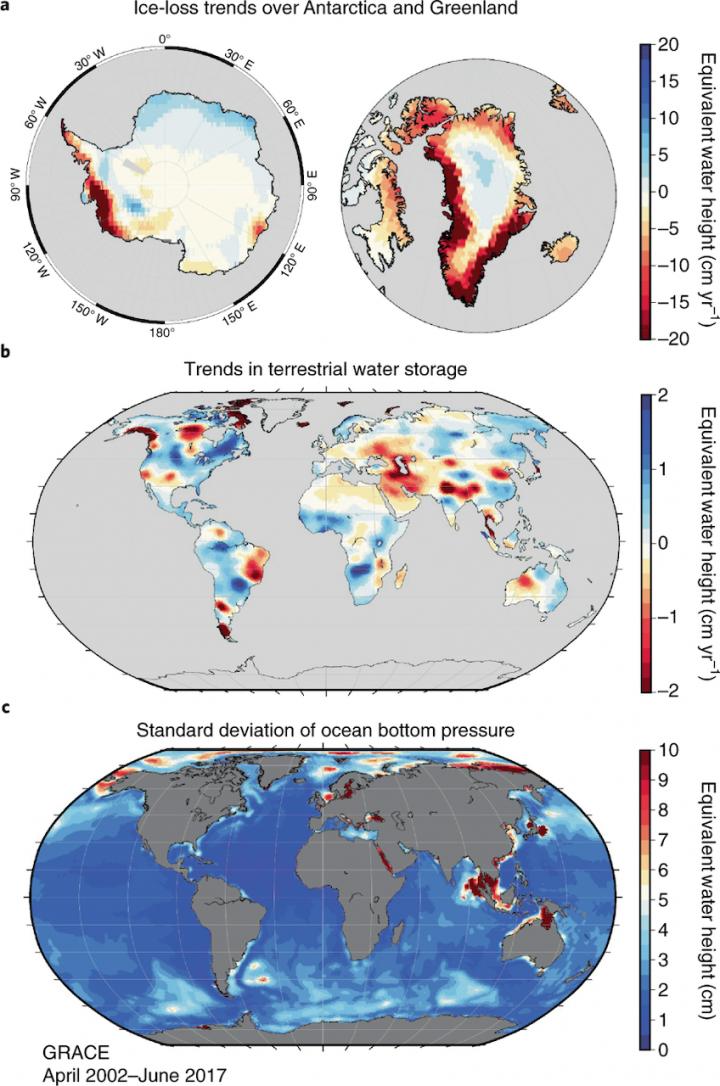
The University of Texas at Austin team that led a twin satellite system launched in 2002 to take detailed measurements of the Earth, called the Gravity Recovery and Climate Experiment (GRACE), reports in the most recent issue of the journal Nature Climate Change on the contributions that their nearly two decades of data have made to our understanding of global climate patterns.
Among the many contributions that GRACE has made:
- GRACE recorded three times the mass of ice lost in the polar and mountainous regions since first beginning measurements — a consequence of global warming.
- GRACE enabled a measure of the quantity of heat added to the ocean and the location for said heat that remains stored in the ocean. GRACE has provided detailed observations, confirming that the majority of the warming occurs in the upper 2,000 meters of the oceans.
- GRACE has observed that of the 37 largest land-based aquifers, 13 have undergone critical mass loss. This loss, due to both a climate-related effect and an anthropogenic (human-induced) effect, documents the reduced availability of clean, fresh water supplies for human consumption.
- The information gathered from GRACE provides vital data for the federal agency United States Drought Monitor and has shed light on the causes of drought and aquifer depletion in places worldwide, from India to California.
Intended to last just five years in orbit for a limited, experimental mission to measure small changes in the Earth’s gravitational fields, GRACE operated for more than 15 years and has provided unprecedented insight into our global water resources, from more accurate measurements of polar ice loss to a better view of the ocean currents and the rise in global sea levels. The mission was a collaboration between NASA and the German Aerospace Centre and was led by researchers in the Center for Space Research in UT’s Cockrell School of Engineering.
By measuring changes in mass that cause deviations in the strength of gravity’s pull on the Earth’s various systems — water systems, ice sheets, atmosphere, land movements and more — the satellites can measure small changes in the Earth system interactions.
“By monitoring the physical components of the Earth’s dynamical system as a whole, GRACE provides a time variable and holistic overview of how our oceans, atmosphere and land surface topography interact,” said Byron Tapley, the Clare Cockrell Williams Centennial Chair Emeritus in the Department of Aerospace Engineering and Engineering Mechanics who established the Center for Space Research at UT in 1981 and who served as principal investigator of the GRACE mission.
The GRACE mission was selected as the first PI-led Earth System Pathfinder Mission, with Tapley and the Center for Space Research at the helm, and it was implemented under a collaboration with the NASA Jet Propulsion Laboratory and the German Geodetic Institute in Potsdam. The mission was implemented under a partnership between NASA and the German Space Agency, but UT faculty members, researchers and students made major contributions to the engineering, concept development and scientific data analysis components of the experiment. Despite being a risky venture operating on minimal funding, the GRACE mission surpassed all expectations and continues to provide a paradigm-shifting set of measurements.
“The concept of using the changing gravimetric patterns on Earth as a means to understanding major changes in the Earth system interactions had been proposed before,” Tapley said. “But we were the first to make it happen at a measurement level that supported the needs of the diverse Earth-science community.”
Now that the GRACE Follow-On mission, which the Center for Space Research will continue to play a role in, has launched successfully, the chance to continue the GRACE record for a second multidecadal measurement of changes in mass across the Earth system is possible. Engineers and scientists anticipate that the longer data interval will allow them to see an even clearer picture of how the planet’s climate patterns behave over time.
###
Media Contact
John Holden
[email protected]