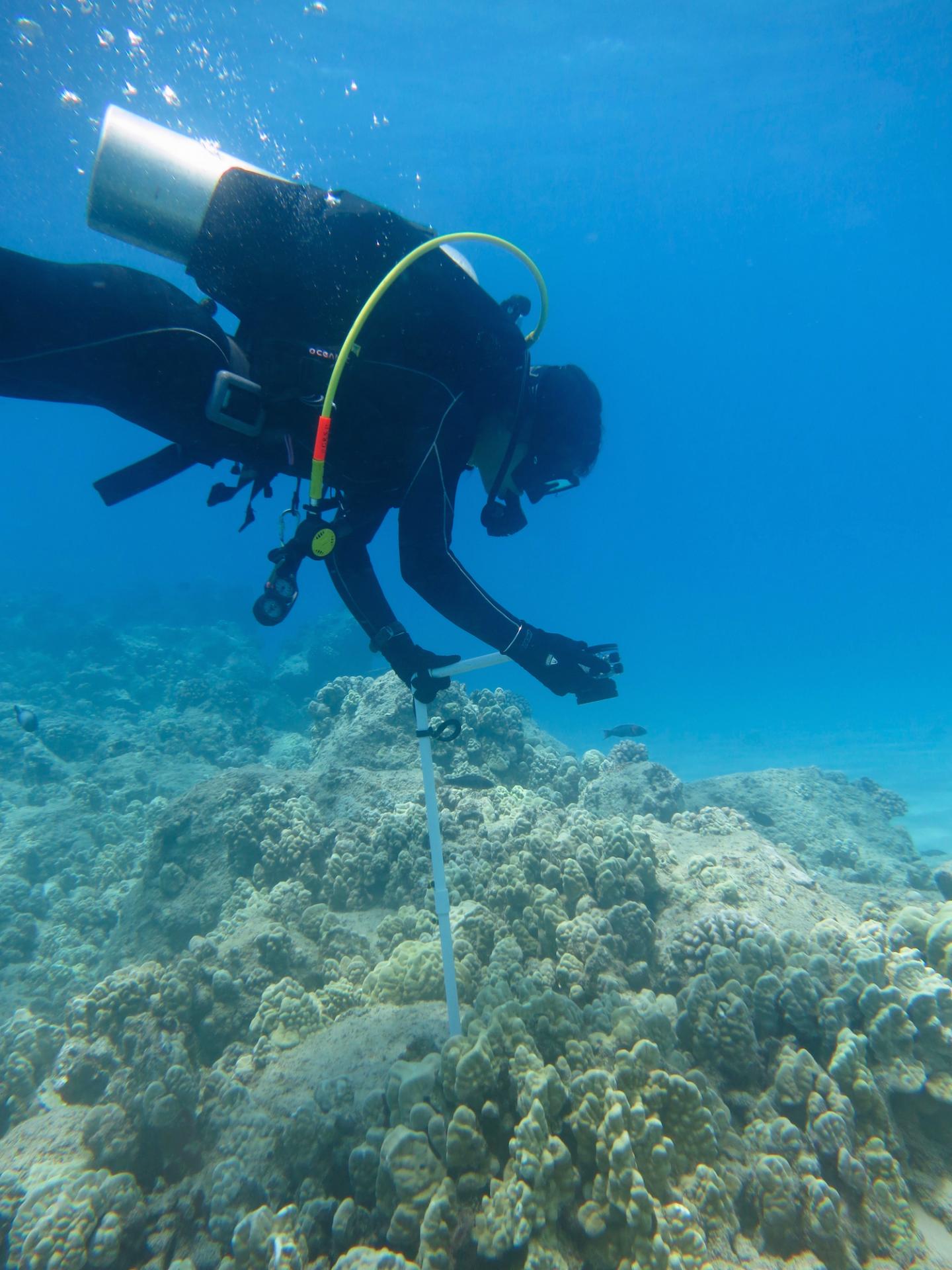
Credit: Kostantinos Stamoulis
Researchers from the University of Hawai’i at Mānoa (UH Mānoa) and the State of Hawai’i Department of Health have developed and applied a new technology in Hawai’i that identifies where coral reef ecosystems and associated fisheries are vulnerable to human activities and where to focus management actions to minimize anthropogenic impacts.
The authors of the newly published study in the journal Ecological Applications identified specific locations on land where improved wastewater management and landscape practices would yield the greatest benefits for downstream reefs in terms of mitigating harm to coral communities and associated reef fish populations.
Human activities on land and in the ocean often have cascading effects on marine ecosystems. Expansion of coastal development, along with wastewater discharge and fertilizers, can harm coral reefs and their fisheries through increases in sediment and nutrient runoff. Consequent reef degradation directly affects ecological resilience, food security, human well-being, and cultural practices in tropical island communities around the world.
The researchers focused on the ahupua’a (land divisions) of Hā?ena on Kaua’i and Ka’?p?lehu on Hawai’i Island, at opposite ends of the main Hawaiian Islands, where native Hawaiian communities are taking action to manage their resources through a place-based management approach.
To determine where management on land can most effectively support current community-led efforts to restore reef health and abundance, the researchers built a fine-scale, linked land-and-sea computer model that integrates existing land-use with coral reef condition and fisheries health. The team then simulated various future coastal development and climate change scenarios to pinpoint areas in each ahupua’a where upgrading cesspools and reducing fertilizer application would provide the greatest benefits to downstream coral reefs.
In every scenario, the tool confirmed that coral reefs on wave-sheltered shores with low circulation are more vulnerable to land-based source pollution under a changing climate, but also revealed that some reef areas on wave-exposed shores are vulnerable at the local scale. This has important implications for future development in these areas and shows that fine scale decision support tools are necessary to reveal spatial nuances between places and inform targeted marine and terrestrial management actions.
Dr. Jade Delevaux and Dr. Kostantinos Stamoulis from UH Mānoa, co-lead authors of the study explain, “This technology can be applied across the main Hawaiian Islands as well as in more data-limited regions worldwide, where satellite data are becoming more freely available. The products of this tool provide a platform for dialogue among decision makers and inform management of linked land and sea areas.”
“Cesspools in coastal areas can be detrimental to the health of coral reefs and nearshore fisheries, which is a huge issue right now,” said Dr. Kawika Winter, manager of the He’eia National Estuarine Research Reserve and a co-author of the study, who also sits onis also a member of the State’s Cesspool Conversion Working Group. “This research will help us to prioritize where we should focus resources when it comes to cesspool conversion in Hawai’i.”
Beyond Hawai’i, these new methods are especially relevant for many indigenous island communities across Oceania seeking to revitalize customary ridge-to-reef management systems and for governments that recognize the need to apply integrated land-sea planning approaches.
Dr. Tamara Ticktin, professor of botany at UH Mānoa, principal investigator on the National Science Foundation grant that funded the research, and co-author of the study, added: “This technology is widely applicable to other Pacific Islands, and is exciting because it demonstrates that resilience of coral reefs to global climate change can be promoted by coordinating local actions across land and sea, thereby empowering local people to become better stewards over their resources.”
###
Media Contact
Marcie Grabowski
[email protected]
Related Journal Article
http://dx.