Discovery is good news for conservation, but action is needed to limit fishing during birthing months
Credit: Leo Chan Gaskins, Duke University
DURHAM, N.C. — The discovery of dozens of pregnant giant devil rays accidentally caught in fishing nets in a village along Mexico’s northern Gulf of California could mean the endangered species has a previously unknown birthing zone in nearby waters, a new Duke University study suggests.
If further research confirms the possibility, authorities and local fishers should work together to devise a plan that minimizes the risk of negative interactions when pregnant rays migrate there each year in and around April, said study author Leo Chan Gaskins, a doctoral student in marine science and conservation at Duke’s Nicholas School of the Environment.
“These animals reach sexual maturity very slowly and they have only one pup per litter, so losing even a small number of pregnant females to by-catch can have dire effects on a local population’s birth potential and long-term survival,” Gaskins said.
The largest of the ray species, giant devil rays (Mobula mobular) can grow to 17 feet long and are known for their acrobatic leaps and deep dives. Large numbers of them are caught and killed as accidental by-catch each year when they become entangled in fishing nets while foraging for krill and other prey in shallow tropical and subtropical waters.
“We still know very little about their global population size, annual movement patterns and reproductive zones, so the discovery and protection of a previously unknown pupping ground would be good news for conservation,” Gaskins said.
He published his peer-reviewed paper April 23 in the journal Ecology.
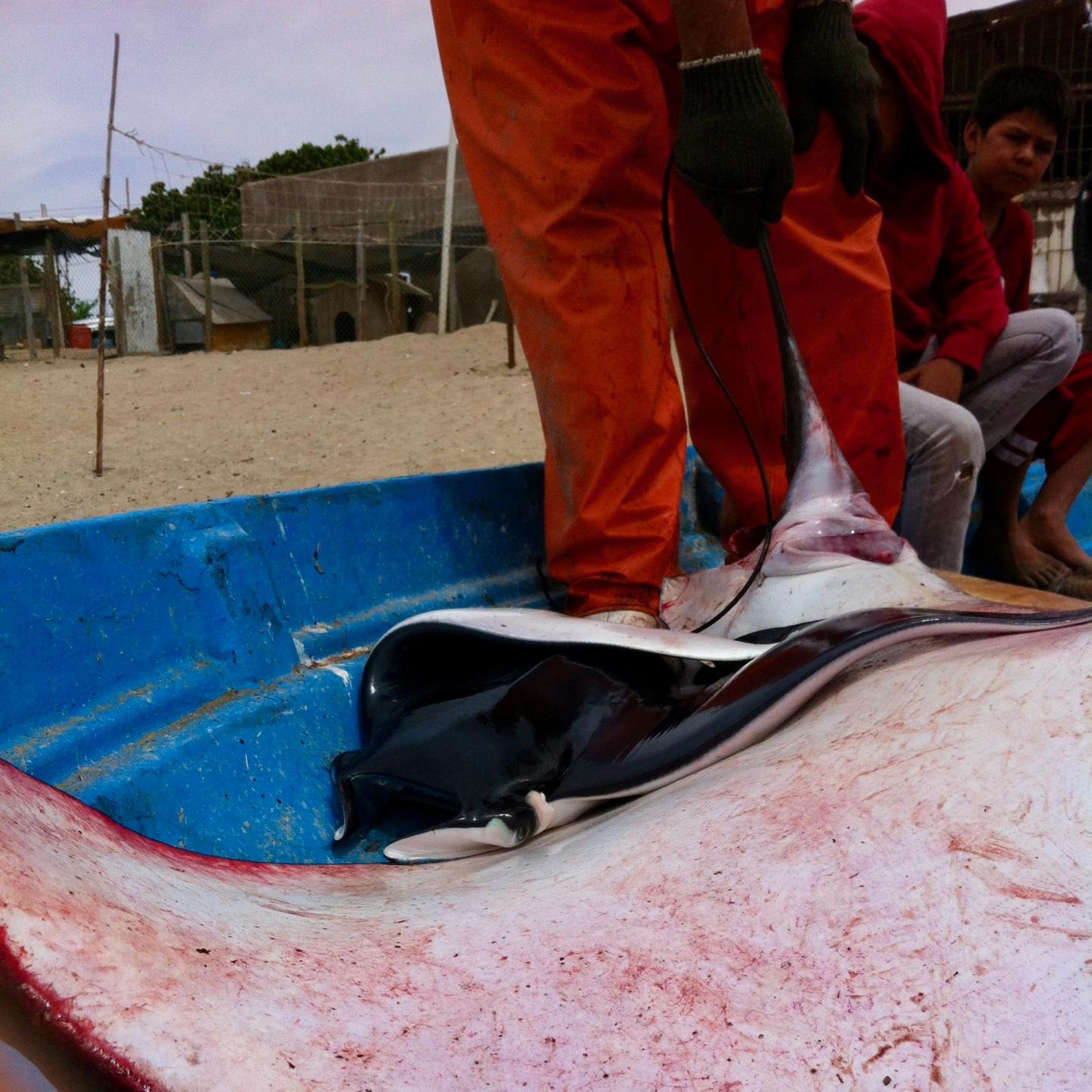
While taking a field course on community-based marine conservation in the Gulf of California as a Duke undergraduate in April 2014, Gaskins observed dozens of dead giant devil rays tangled in gillnets on the beach of a small-scale fishing community in northern Sonora. Because of the animals’ immense size and weight, the fishers were unable to return them to the sea and had been forced to land them.
“Every female ray being cut open was pregnant with one pup. I determined the pups were full-term since I was able to revive one that had just been born into a net. We set it free and it swam away over the breaking waves,” Gaskins recalled.
Measurements of the wing spans of two of the dead adult females and one of the dead pups confirmed his belief that the pups were full-term. Scientists estimate the average wing-to-wing width of female giant devil rays when they reach sexual maturity is 2.18 meters; the two Gaskins measured were 1.97 meters and 2.17 meters. The average measurement of a newborn pup is 1 meter; the one he measured was .91 meters.
“These measurements, along with the fact that each boat landed multiple pregnant rays, suggested that the fishers had unknowingly set their nets in a pupping zone,” he said.
Past studies have shown that giant devil rays use the Gulf of California as a mating and feeding zone in spring and early summer, but the presence of a birthing zone there was unknown.
“It makes sense that a pupping zone would be in an area where food is plentiful,” Gaskins said. “The highest density of these rays’ preferred prey, the krill Nyctiphanes simplex, occurs in the northern and central gulf in April, which coincides with my observation.”
Knowing the locations and timing of the rays’ movements in the gulf as they head to and from the pupping grounds would help local fishers, fishery managers and conservation groups reduce the risk of by-catch, he said.
“This would benefit the fishers and well as the fish,” Gaskins stressed. “Aside from the obvious humane reasons the fishers have for not wanting to harm endangered animals, entangled rays can damage their nets, drive away the desired catch and greatly decrease their earnings. Ray meat is not valuable in the Gulf of California and only brings in about three pesos per kilo.”
In other parts of the world, especially East Asia, giant devil rays are increasingly being targeted and harvested for their gill plates, which are used to brew a pseudo-medicinal tonic called Peng Yu Sai. No market for gill plates exists yet in the Gulf of California fisheries, Gaskins noted, but the prices they can command are extremely high, so putting protection in place now is vital.
###
Gaskins’ research was funded by a National Science Foundation Graduate Research Fellowship (#DGE-2017245336).
Xavier Basurto, associate professor of sustainability science at Duke’s Nicholas School, led the 2014 field course Gaskins took part in. Both scientists are based at Duke’s coastal campus, the Duke University Marine Laboratory, in Beaufort, N.C.
CITATION: “Pregnant Giant Devil Ray (Mobula mobular) Bycatch Reveals Potential Northern Gulf of California Pupping Ground,” Leo Chan Gaskins. Ecology, April 23, 2019. DOI: 10.1002/ecy.2689
Media Contact
Tim Lucas
[email protected]
Original Source
https:/
Related Journal Article
http://dx.