• HOME
  • NEWS
  • EXPLORE
    • CAREER
      • Companies
      • Jobs
    • EVENTS
    • iGEM
      • News
      • Team
    • PHOTOS
    • VIDEO
    • WIKI
  • BLOG
  • COMMUNITY
    • FACEBOOK
    • INSTAGRAM
    • TWITTER
Sunday, February 8, 2026
BIOENGINEER.ORG
No Result
View All Result
  • Login
  • HOME
  • NEWS
  • EXPLORE
    • CAREER
      • Companies
      • Jobs
        • Lecturer
        • PhD Studentship
        • Postdoc
        • Research Assistant
    • EVENTS
    • iGEM
      • News
      • Team
    • PHOTOS
    • VIDEO
    • WIKI
  • BLOG
  • COMMUNITY
    • FACEBOOK
    • INSTAGRAM
    • TWITTER
  • HOME
  • NEWS
  • EXPLORE
    • CAREER
      • Companies
      • Jobs
        • Lecturer
        • PhD Studentship
        • Postdoc
        • Research Assistant
    • EVENTS
    • iGEM
      • News
      • Team
    • PHOTOS
    • VIDEO
    • WIKI
  • BLOG
  • COMMUNITY
    • FACEBOOK
    • INSTAGRAM
    • TWITTER
No Result
View All Result
Bioengineer.org
No Result
View All Result
Home NEWS Science News Cancer

New study explains how inflammation causes gastric cancer

Bioengineer by Bioengineer
April 16, 2019
in Cancer
Reading Time: 3 mins read
0
IMAGE
Share on FacebookShare on TwitterShare on LinkedinShare on RedditShare on Telegram

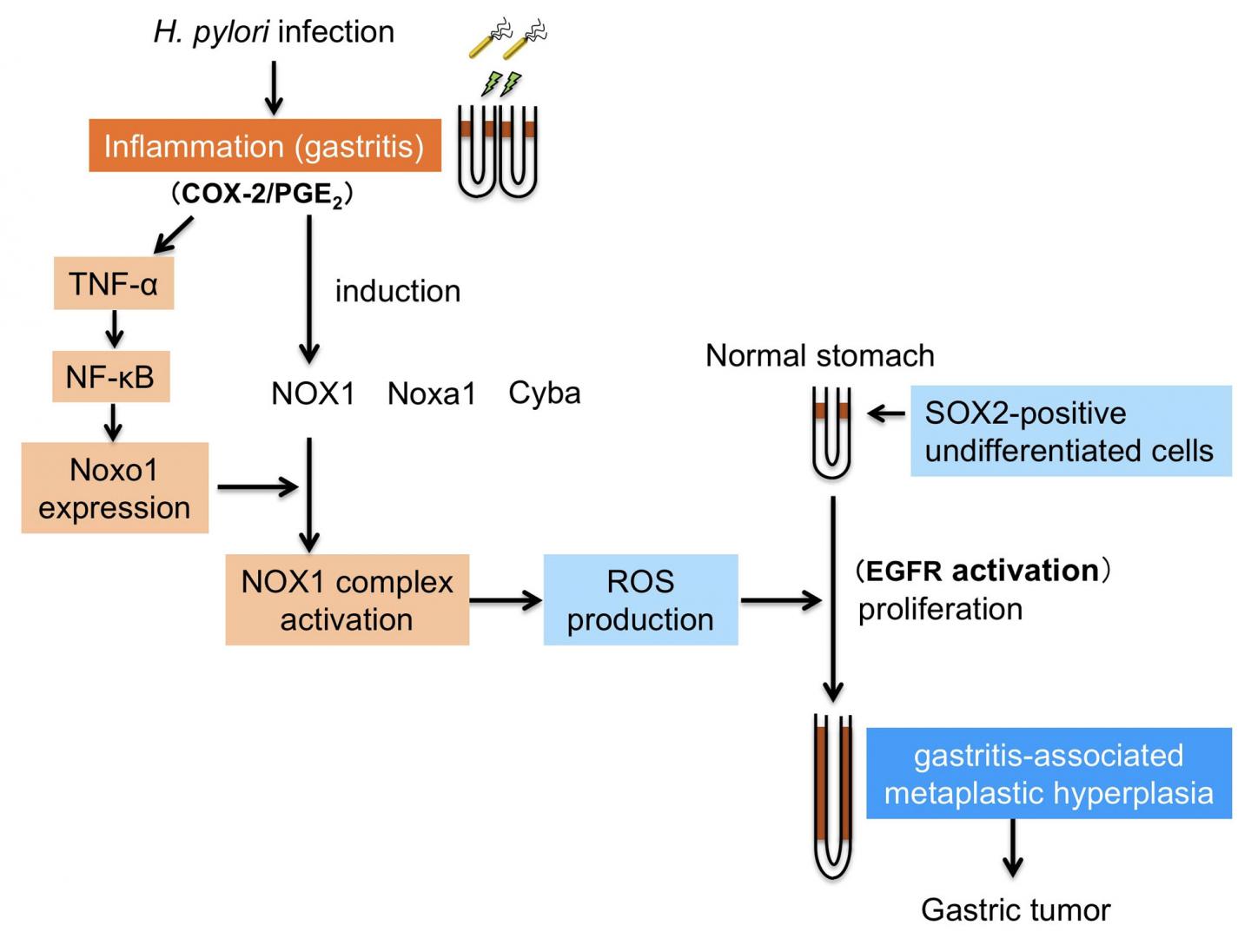
Researchers from Kanazawa University and the Japan Agency for Medical Research and Development show that genes turned on in response to inflammation are a major cause of gastric cancer
IMAGE

Credit: Kanazawa University

Kanazawa, Japan – In 1982, researchers reported a link between chronic gastritis and stomach bacterium Helicobacter pylori, triggering a flurry of research into this newly-identified pathogen. These studies made it clear that in addition to its involvement in gastritis, H. pylori was a significant factor in the development of both peptic ulcers and gastric cancer. But while the link between the bacterium and disease was clear-cut, exactly how H. pylori caused gastric tumors remained the subject of much debate.

Now, almost four decades later, researchers from Kanazawa University and the Japan Agency for Medical Research and Development have finally shown how inflammation caused by H. pylori infection causes the proliferation of gastric epithelial stem cells, leading to gastric tumors.

In a report published recently in cancer genetics journal Oncogene, the researchers describe how they built on previous findings to solve the mystery.

“We previously showed that tumor necrosis factor alpha (TNF-α), a cytokine that causes inflammation, promotes gastric tumor formation by activating a protein called NOXO1,” says lead author of the study Dr Kanae Echizen. “What we didn’t know was exactly how NOXO1 induces tumor formation in the stomach.”

NOXO1 is a component of the NOX1 complex, which produces tissue-damaging molecules called reactive oxygen species (ROS). ROS, or more accurately, the oxidative stress caused by these molecules, can result in mutations in the DNA of stomach cells, leading to tumor formation. Inflammation caused by H. pylori infection also produces ROS, increasing oxidative stress in the stomach.

In the newly-published study, the research team showed that inflammation caused excess production of NOX1-complex proteins in response to signals from NF-κB, a regulatory protein that turns on genes to combat stress or bacterial infection, and which is a major player in the inflammatory response. However, most importantly, they found that NOX1/ROS signaling caused gastric epithelial stem cells to multiply uncontrollably, resulting in tumor formation.

Knowing this, the researchers used a drug to suppress the activity of the NOX1 complex, which immediately halted the growth of gastric cancer cells. Even more excitingly, disruption of Noxo1 in a mouse gastritis model stopped the proliferation of epithelial stem cells.

“We have finally been able to show that inflammation enhances the expression of NOXO1, which induces the proliferation of gastric epithelial stem cells, leading to gastric tumors,” explains Dr Masanobu Oshima, senior author of the study. “Gastric cancer is the fourth most common cancer worldwide and has the second highest mortality rate. If we can disrupt the NOX1/ROS signaling pathway in situ, we may be able to prevent the development of this aggressive disease.”

###

Media Contact
Tomoya Sato
[email protected]

Original Source

https://www.nature.com/articles/s41388-019-0702-0

Related Journal Article

http://dx.doi.org/10.1038/s41388-019-0702-0

Tags: BiochemistrycancerCell BiologyGastroenterologyGeneticsMedicine/HealthMolecular Biology
Share13Tweet8Share2ShareShareShare2

Related Posts

Deep Learning Uncovers Tetrahydrocarbazoles as Potent Broad-Spectrum Antitumor Agents with Click-Activated Targeted Cancer Therapy Approach

February 7, 2026

Newly Discovered Limonoid DHL-11 from Munronia henryi Targets IMPDH2 to Combat Triple-Negative Breast Cancer

February 7, 2026

New Discovery Reveals Why Ovarian Cancer Spreads Rapidly in the Abdomen

February 6, 2026

New Study Finds Americans Favor In-Clinic Screening Over At-Home Tests for Cervical Cancer

February 6, 2026
Please login to join discussion

POPULAR NEWS

  • Robotic Ureteral Reconstruction: A Novel Approach

    Robotic Ureteral Reconstruction: A Novel Approach

    82 shares
    Share 33 Tweet 21
  • Digital Privacy: Health Data Control in Incarceration

    63 shares
    Share 25 Tweet 16
  • Breakthrough in RNA Research Accelerates Medical Innovations Timeline

    53 shares
    Share 21 Tweet 13
  • Mapping Tertiary Lymphoid Structures for Kidney Cancer Biomarkers

    50 shares
    Share 20 Tweet 13

About

We bring you the latest biotechnology news from best research centers and universities around the world. Check our website.

Follow us

Recent News

Attitudes Toward Aging Impact Early Nursing Home Quality

Transforming Healthcare: Just Culture and Restorative Practices

Guiding Patients Through Obesity Diagnosis: A Primer

Subscribe to Blog via Email

Enter your email address to subscribe to this blog and receive notifications of new posts by email.

Join 73 other subscribers
  • Contact Us

Bioengineer.org © Copyright 2023 All Rights Reserved.

Welcome Back!

Login to your account below

Forgotten Password?

Retrieve your password

Please enter your username or email address to reset your password.

Log In
No Result
View All Result
  • Homepages
    • Home Page 1
    • Home Page 2
  • News
  • National
  • Business
  • Health
  • Lifestyle
  • Science

Bioengineer.org © Copyright 2023 All Rights Reserved.