• HOME
  • NEWS
  • EXPLORE
    • CAREER
      • Companies
      • Jobs
    • EVENTS
    • iGEM
      • News
      • Team
    • PHOTOS
    • VIDEO
    • WIKI
  • BLOG
  • COMMUNITY
    • FACEBOOK
    • INSTAGRAM
    • TWITTER
Sunday, December 7, 2025
BIOENGINEER.ORG
No Result
View All Result
  • Login
  • HOME
  • NEWS
  • EXPLORE
    • CAREER
      • Companies
      • Jobs
        • Lecturer
        • PhD Studentship
        • Postdoc
        • Research Assistant
    • EVENTS
    • iGEM
      • News
      • Team
    • PHOTOS
    • VIDEO
    • WIKI
  • BLOG
  • COMMUNITY
    • FACEBOOK
    • INSTAGRAM
    • TWITTER
  • HOME
  • NEWS
  • EXPLORE
    • CAREER
      • Companies
      • Jobs
        • Lecturer
        • PhD Studentship
        • Postdoc
        • Research Assistant
    • EVENTS
    • iGEM
      • News
      • Team
    • PHOTOS
    • VIDEO
    • WIKI
  • BLOG
  • COMMUNITY
    • FACEBOOK
    • INSTAGRAM
    • TWITTER
No Result
View All Result
Bioengineer.org
No Result
View All Result
Home NEWS Science News Biology

Australian Murray River habitat restoration increases native fish populations

Bioengineer by Bioengineer
April 5, 2019
in Biology
Reading Time: 3 mins read
0
IMAGE
Share on FacebookShare on TwitterShare on LinkedinShare on RedditShare on Telegram

IMAGE

Credit: https://esajournals.onlinelibrary.wiley.com/doi/full/10.1002/eap.1882

Dubbed the ‘honeypot effect’ — a team of scientists from around Australia have shown that providing woody habitat, or ‘snags’, for native fish in the Murray River increases their population size.

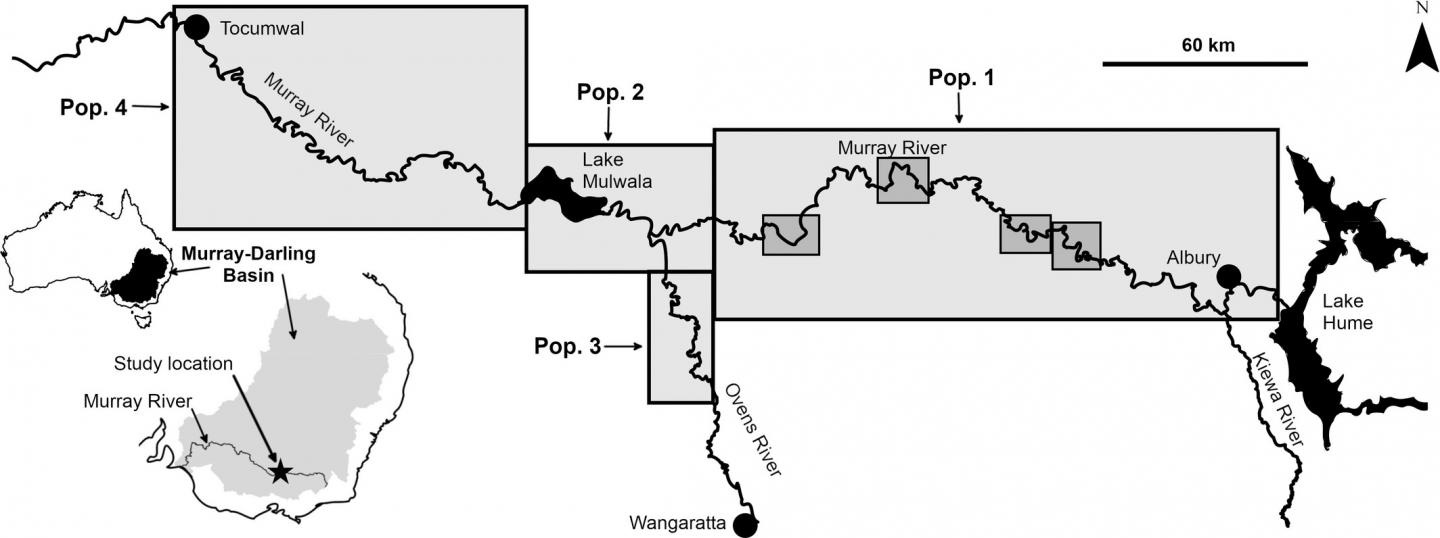
In a paper released today in the scientific journal Ecological Applications, Dr Jarod Lyon from the Arthur Rylah Institute and his team describe studying 110 km of the Murray River over seven years, installing more than 4450 ‘snags’ and analysing more than six million records of tagged fish.

“We found a three-fold increase in the abundance of Murray cod, and a doubling of abundance of golden perch, in the reach of river where habitat restoration was done compared to sites where habitat remained constant”, says Dr Lyon.

“In addition, abundances of the target species in the nearby reference sites remained stable, indicating that the numbers of fish across the whole study area had increased, rather than just the same fishes just moving around.”

A team of scientists from the Arthur Rylah Institute, University of Melbourne, University of Canberra, the Federal Government, and Flinders University employed a range of methods to track the fish populations over time, including electrofishing surveys, mark-recapture, and telemetry tracking.

Collaborator Professor Corey Bradshaw from Flinders University, says relevant government bodies and authorities are more likely to take habitat-restoration options seriously because of the proven effectiveness.

“Restoring degraded freshwater ecosystems like the embattled Murray-Darling Basin is an expensive and colossal task, so knowing that our restoration attempts actually work to increase the number of native fish gives us hope that we can keep these unique species around well into the future.”

Anglers also provided important data by sharing their catch records within a valuable science citizen-science program.

“These results give great confidence to river managers that installing woody habitat really does help native fish populations thrive, and delivers substantial benefits to the communities using them”, says Dr Lyon.

“Under most climate-change scenarios, we are looking at a future where there will be increased pressure on Australia’s limited water resources.”

“We need to look at a range of options for restoring fish populations in our waterways — it will take a mix of interventions to do this, and it is vital for managers to know that we can apply habitat restoration that works.”

The large-scale, long-term study also provides a valuable and useful example of how experts can assess other interventions in our rivers, such as installing fish passage or delivering water for the environment, all of which are designed to support better, healthier, thriving native fish populations.

###

This work was funded by the Murray-Darling Basin Authority’s The Living Murray Program in partnership with New South Wales Fisheries.

The paper, ‘Increased population size of fish in a lowland river following restoration of structural habitat’ by JP Lyon, TJ Bird, J Kearns, S Nicol, Z Tonkin, CR Todd, J O’Mahony, G Hackett, S Raymond, J Lieschke, A Kitchingman, and CJA Bradshaw was published in Ecological Applications and can be accessed at http://doi.org/10.1002/eap.1882

Media Contact
Corey Bradshaw
[email protected]

Related Journal Article

http://dx.doi.org/10.1002/eap.1882

Tags: BiodiversityBiologyCalculations/Problem-SolvingClimate ScienceEarth ScienceEcology/EnvironmentMarine/Freshwater BiologyZoology/Veterinary Science
Share12Tweet8Share2ShareShareShare2

Related Posts

blank

Rice miRNA: Key Regulator in Fungal Interactions

December 3, 2025
Human Impact Alters Leopard and Ungulate Dynamics

Human Impact Alters Leopard and Ungulate Dynamics

December 3, 2025

Adaptive Microsatellite Variants in Indian Yak Populations

December 2, 2025

Guide to Single-Cell RNA Transcriptomics Unveiled

December 2, 2025
Please login to join discussion

POPULAR NEWS

  • New Research Unveils the Pathway for CEOs to Achieve Social Media Stardom

    New Research Unveils the Pathway for CEOs to Achieve Social Media Stardom

    204 shares
    Share 82 Tweet 51
  • Scientists Uncover Chameleon’s Telephone-Cord-Like Optic Nerves, A Feature Missed by Aristotle and Newton

    121 shares
    Share 48 Tweet 30
  • Neurological Impacts of COVID and MIS-C in Children

    107 shares
    Share 43 Tweet 27
  • MoCK2 Kinase Shapes Mitochondrial Dynamics in Rice Fungal Pathogen

    70 shares
    Share 28 Tweet 18

About

We bring you the latest biotechnology news from best research centers and universities around the world. Check our website.

Follow us

Recent News

Boosting Cancer Immunotherapy by Targeting DNA Repair

Evaluating eGFR Equations in Chinese Children

Metformin-Alogliptin Combo vs. Monotherapy in Diabetes

Subscribe to Blog via Email

Enter your email address to subscribe to this blog and receive notifications of new posts by email.

Join 69 other subscribers
  • Contact Us

Bioengineer.org © Copyright 2023 All Rights Reserved.

Welcome Back!

Login to your account below

Forgotten Password?

Retrieve your password

Please enter your username or email address to reset your password.

Log In
No Result
View All Result
  • Homepages
    • Home Page 1
    • Home Page 2
  • News
  • National
  • Business
  • Health
  • Lifestyle
  • Science

Bioengineer.org © Copyright 2023 All Rights Reserved.