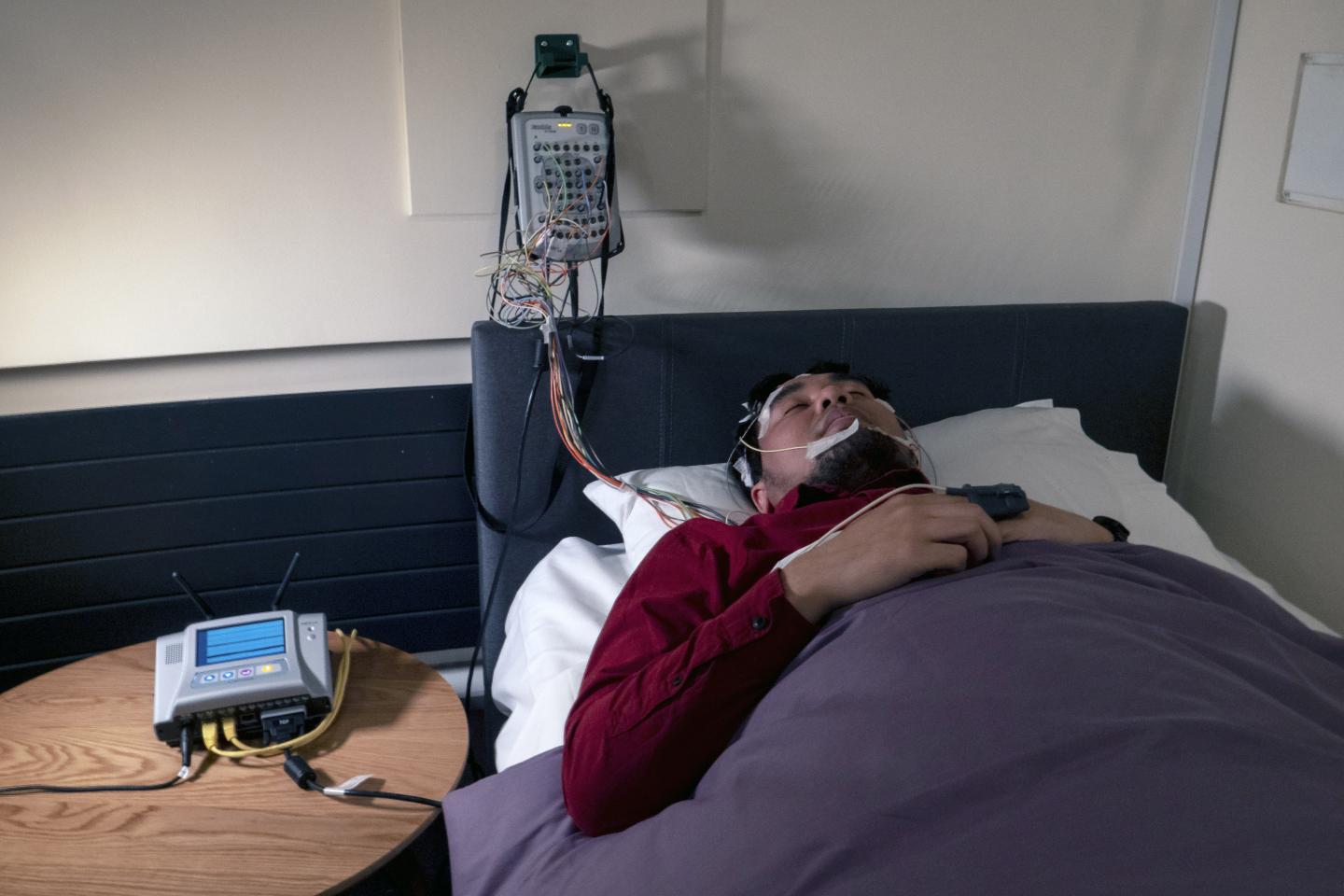
Credit: UEA
Scientists at the University of East Anglia will investigate the link between sleep and dementia at a new state-of-the-art sleep unit opening today (4 April).
Sleep disturbances are common in dementia. But it is not yet known whether Alzheimer’s causes sleep problems, or whether sleep problems could be an early predictor of the disease.
Pioneering research at UEA’s new sleep and brain research unit will investigate this big question.
The research team hope that treating sleep disturbances early on could help slow down the progression of the disease – particularly as there are no other treatments available which do this.
The first study to take place in the unit will investigate whether healthy people who are at increased genetic risk of developing Alzheimer’s could be more vulnerable to sleep loss and how their body clock is affected.
Volunteers spending a night in the unit can expect to stay in a modern hotel-like en-suite room.
But instead of a relaxing break – their every move will be overlooked by a team of sleep specialists. They will also be hooked up to sensors measuring brain activity and take part in thinking, memory, balance, co-ordination, and attention tests throughout their stay.
Lead researcher Dr Alpar Lazar, from UEA’s School of Health Sciences, said: “We live in an ageing society, and sleep disturbances and dementia are two significant health problems in older adults.
“A symptom of Alzheimer’s is poor sleep. Good sleep is central to maintaining cognitive performance – such as attention and memory as well as general brain health.
“Sleep deficits have been shown to be early markers in certain brain disorders.
“But is it Alzheimer’s causing sleep problems, or do sleep problems modulate or contribute to the disease process?
“Recent evidence suggest that sleep could be actively involved in the disease process. Trying to identify the cause of early sleep problems in people who have been recently diagnosed or who have genetic predispositions towards Alzheimer’s and the impact of these sleep problems on the brain will help us determine whether improving sleep could potentially slow down the disease process.
“In this first study, we will look at healthy people who may, or may not, have an increased genetic risk of developing Alzheimer’s disease in the future.
“Volunteers will undertake a screening process, including genetic and psychological testing, wearing a small wrist-worn device to measure sleep and activity at home, and keeping a sleep diary.
“They will then take part in a three-night lab session under one of two conditions -including one night complete sleep deprivation, or taking multiple short naps.
“It may sound gruelling, but we hope it will help us understand more about the links between sleep, the body clock and the genetic risk of Alzheimer’s disease. This will help design future studies investigating specific sleep related interventions that could potentially slow down the progression of the disease.”
Dr Lazar has been awarded a Seed Award in Science from the Wellcome Trust, which helps researchers develop novel ideas. Local businesses including Dovetail Furnishings, Hughes Electrical, Mattressman and Warings Lifestore have donated gifts-in-kind to help furnish the research unit.
###
Media Contact
Lauren Burgess
[email protected]
Original Source
https:/