Feathers revealed in a 125 million-year-old fossil of a bird hatchling shows it came out of the egg running
Credit: @Kaye et al. 2019
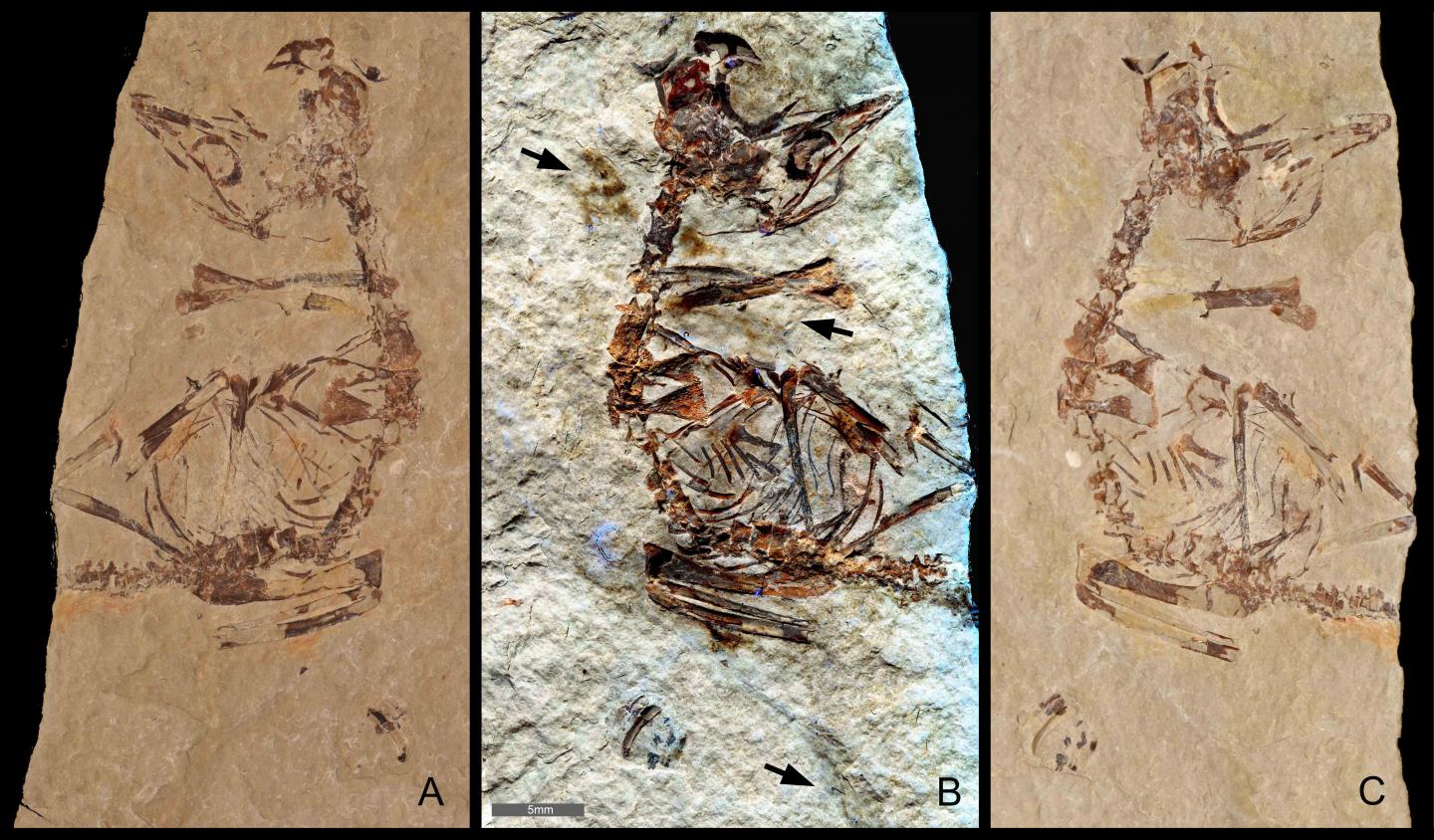
The ~125 million-year-old Early Cretaceous fossil beds of Los Hoyas, Spain have long been known for producing thousands of petrified fish and reptiles (Fig. 1). However, one special fossil stands unique and is one of the rarest of fossils — a nearly complete skeleton of a hatchling bird. Using their own laser imaging technology, Dr Michael Pittman from the Department of Earth Sciences at The University of Hong Kong and Thomas G Kaye from the Foundation for Scientific Advancement in the USA determined the lifestyle of this ~3cm long hatchling bird by revealing the previously unknown feathering preserved in the fossil specimen (Fig. 2).
Chickens and ducks are up and about within hours of hatching, they are “precocial” (Fig. 3). Pigeons and eagles are “altricial”, they stay in the nest and are looked after by their parents. How do you tell if a hatchling came “out of the egg running” or was “naked and helpless in the nest”? Feathers. When precocial birds hatch they have developed down feathers and partly developed large feathers and can keep warm and get around without mum’s help. “Previous studies searched for but failed to find any hints of feathers on the Los Hoyas hatchling. This meant that its original lifestyle was a mystery,” says Dr Pittman.
Michael Pittman and Thomas Kaye brought new technology to the study of Los Hoyas fossils in the form of a high power laser. This made very small chemical differences in the fossils become visible by fluorescing them different colours, revealing previously unseen anatomical details. They recently had tremendous success with the first discovered fossil feather which they disassociated from the famous early bird Archaeopteryx by recovering the chemical signature of its fossil quill, a key part of the feather’s identification that had been previously unverified for ~150 years. The new results on the hatchling bird finally answered the question about its lifestyle as it did indeed have feathers at birth (Figs. 2, 4) and was thus precocial and out of the egg running. The feathers were made of carbon which has low fluorescence using Laser-Stimulated Fluorescence (LSF), but the background matrix did glow making the feathers stand out in dramatic dark silhouette (Fig. 2). “Previous attempts using UV lights and synchrotron beams failed to detect the feathers, underscoring that the laser technology stands alone as a new tool in palaeontology” added Tom Kaye, the study’s lead author.
This discovery via new technology demonstrates that some early birds adopted a precocial breeding strategy just like modern birds. Thus, in the time of the dinosaurs, some enantiornithine bird babies had the means to avoid the dangers of Mesozoic life perhaps by following their parents or moving around themselves. “One of the feathers discovered was of a substantial size and preserves features seen in other hatchlings. It indicates that our hatchling had reasonably well-developed flight feathers at the time of birth”, says Jesús Marugán-Lobón, a co-author from the Universidad Autónoma of Madrid, Spain (Figs. 2B, 4). This and other “illuminating” discoveries are adding to our knowledge of ancient life with details surviving in the fossil record that were never thought possible even a couple decades ago.
###
The paper: ‘Fully fledged enantiornithine hatchling revealed by Laser-Stimulated Fluorescence supports precocial nesting behavior’ by T. Kaye, M. Pittman, J. Marugán-Lobón , H. Martín Abad , J. Sanz & A. Buscalioni in Scientific Reports.
Link to journal article (available after 5pm on 21 March): http://www.
For media enquiries, please contact Ms. Cindy Chan, Associate Director of Communications of HKU Faculty of Science (tel: 3917 5286; email: [email protected]) or Dr Michael Pittman, Research Assistant Professor of HKU Department of Earth Sciences (email: [email protected]).
Video summary: https:/
Image download: https:/
Media Contact
Cindy Chan
[email protected]
Original Source
https:/
Related Journal Article
http://dx.