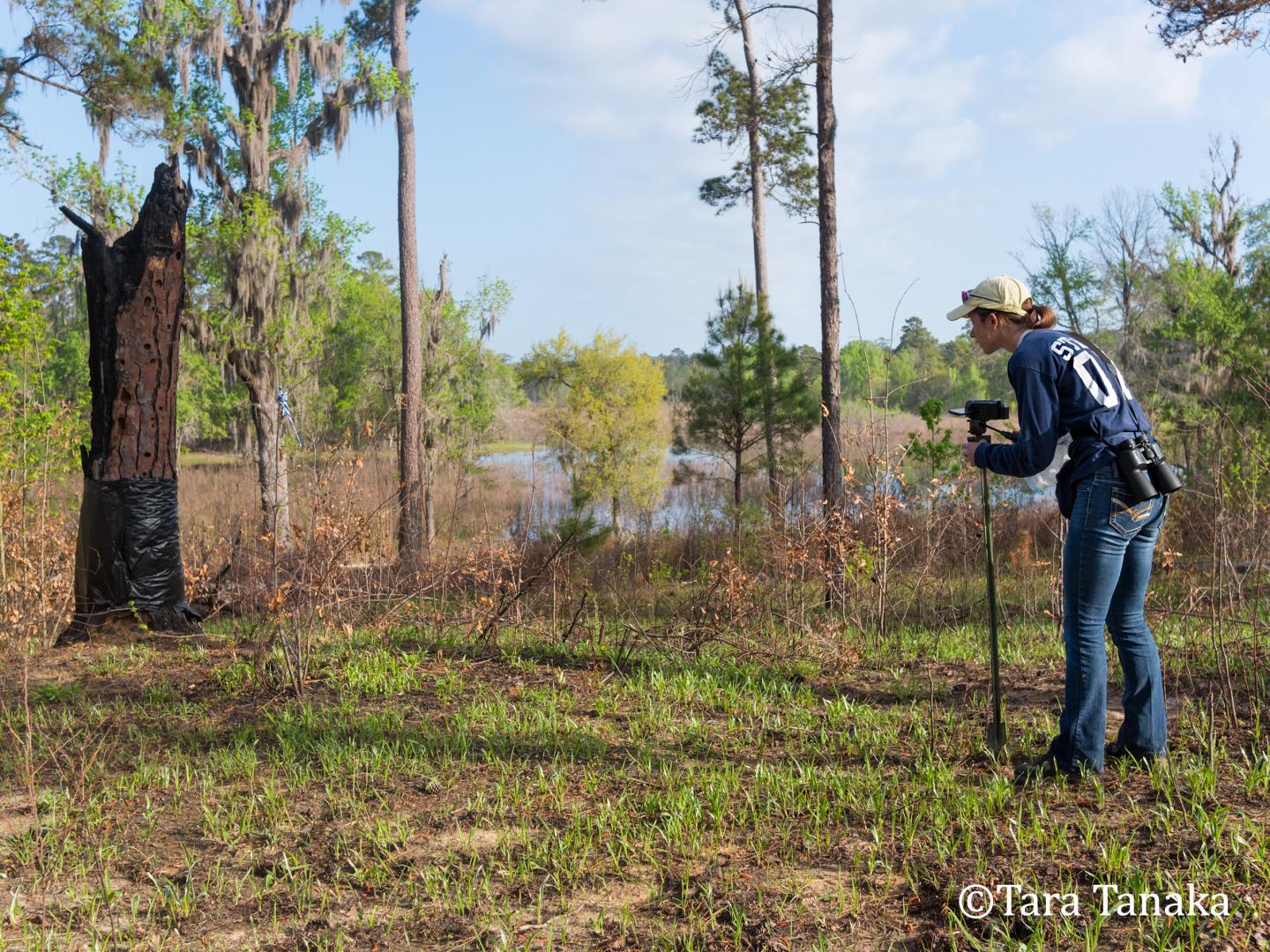
Credit: Tara Tanaka
TALLAHASSEE, Fla. — It’s not uncommon for young adults to pitch in and help out with the care of younger siblings. But it turns out that sometimes birds choose to become avian au pairs rather than raise their own brood.
After a five-year experiment, researchers from Florida State University and the Tallahassee-based Tall Timbers Research Station found that when fewer mates were available for brown-headed nuthatches, these small pine-forest birds opted to stay home and help their parents or other adults raise their offspring.
The study is published in the journal Behavioral Ecology.
Associate Professor of Biological Science Emily DuVal and Jim Cox, a vertebrate ecologist from Tall Timbers and a courtesy faculty member at FSU, had long been interested in how these tiny birds showed cooperation — that is often having non-breeding young adults hang out and help raise chicks. After all, bypassing the chance to reproduce is not typically how nature works.
Researchers have often thought that a shortage of males might be one reason for this behavior. To test this idea, they manipulated the ratio of adult males and females throughout Tall Timbers to see exactly how that might affect breeding and cooperation.
Aided by graduate student Jessica Cusick, Cox and DuVal swapped the chicks among 72 nests to create two areas that had an overabundance of either male or all female nuthatches. They also left some areas in between untouched. After two years of observation, they had a year with no manipulation and then reversed the treatments for each area and drove the ratio of males and females in the opposite direction.
“We’re trying to understand cooperation from perspective of mate limitations,” DuVal said. “Cooperative breeding is a complex social interaction. The idea that you could change such a complex social behavior with a relatively simple manipulation was something we wanted to explore.”
The team found that in these areas where the potential mating population was skewed by the manipulation, more of these birds opted to become helpers rather than live on their own or disperse to the buffer zone where there may be more potential mates.
The helper bird engages in activities such as feeding the young or helping feed the mother while she is nesting. The helper might also help defend the nest.
Typically, male birds are more likely to function as a helper in raising chicks, but in the population affected by the manipulation, researchers found an uptick in cooperation by both sexes.
“We saw a slight increase in female helpers,” said Cox, who is the study’s first author. “It didn’t look like a good year for finding mates when young females emerged from their nests and encountered lots of other females nearby. Instead, they stayed and helped out the birds who did mate.”
This was the first large-scale, experimental evidence that the sex ratio of males and females could affect cooperative breeding, the researchers said.
Not all birds breed cooperatively, but it is commonly found among crows and jays. Birds with such complex social behavior are often long-lived, and this work built on nearly a decade of careful population monitoring by Cox and his Tall Timbers Research Station team to identify nests and breeding pairs.
The researchers also found that many of the nests took on additional helpers. While there is usually only one bird acting as a helper each year, in this case, some nests had three.
###
This research was funded primarily by donations to Tall Timbers, with additional support from the Florida State University Brenda Weems Bennison and Robert B. Short Scholarships.
Media Contact
Kathleen Haughney
@floridastate
850-644-1489
Related Journal Article
http://dx.