• HOME
  • NEWS
  • EXPLORE
    • CAREER
      • Companies
      • Jobs
    • EVENTS
    • iGEM
      • News
      • Team
    • PHOTOS
    • VIDEO
    • WIKI
  • BLOG
  • COMMUNITY
    • FACEBOOK
    • INSTAGRAM
    • TWITTER
Friday, December 12, 2025
BIOENGINEER.ORG
No Result
View All Result
  • Login
  • HOME
  • NEWS
  • EXPLORE
    • CAREER
      • Companies
      • Jobs
        • Lecturer
        • PhD Studentship
        • Postdoc
        • Research Assistant
    • EVENTS
    • iGEM
      • News
      • Team
    • PHOTOS
    • VIDEO
    • WIKI
  • BLOG
  • COMMUNITY
    • FACEBOOK
    • INSTAGRAM
    • TWITTER
  • HOME
  • NEWS
  • EXPLORE
    • CAREER
      • Companies
      • Jobs
        • Lecturer
        • PhD Studentship
        • Postdoc
        • Research Assistant
    • EVENTS
    • iGEM
      • News
      • Team
    • PHOTOS
    • VIDEO
    • WIKI
  • BLOG
  • COMMUNITY
    • FACEBOOK
    • INSTAGRAM
    • TWITTER
No Result
View All Result
Bioengineer.org
No Result
View All Result
Home NEWS Science News Chemistry

Using 3D models to reduce side effects of radiotherapy

Bioengineer by Bioengineer
March 14, 2019
in Chemistry
Reading Time: 2 mins read
0
IMAGE
Share on FacebookShare on TwitterShare on LinkedinShare on RedditShare on Telegram

IMAGE

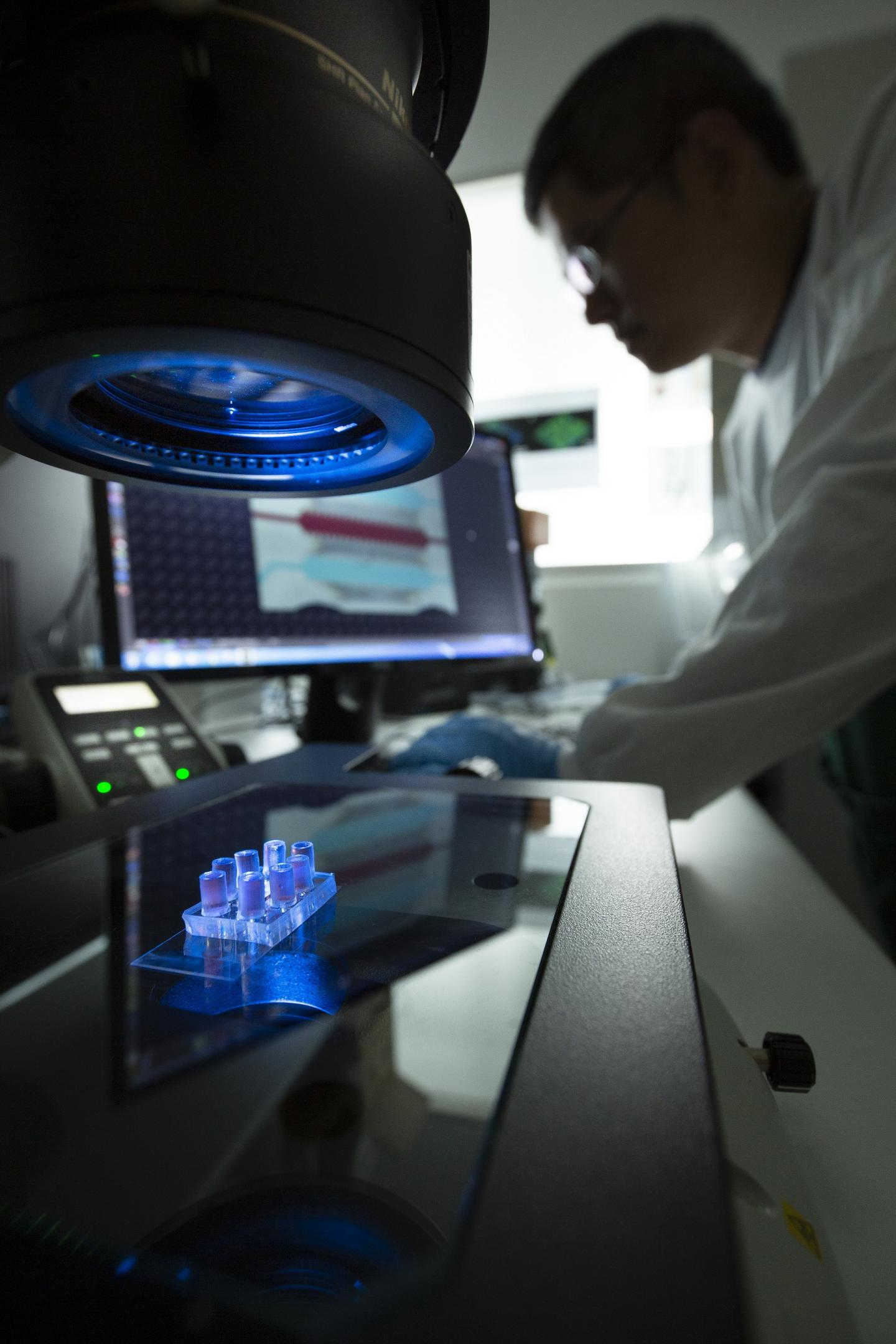
Credit: Joe Vittorio

The debilitating side effects of radiotherapy could soon be a thing of the past thanks to a breakthrough by University of South Australia (UniSA) and Harvard University researchers.

UniSA biomedical engineer Professor Benjamin Thierry is leading an international study using organ-on-a-chip technology to develop 3D models to test the effects of different levels and types of radiation.

A microfluidic cell culture chip closely mimics the structure and function of small blood vessels within a disposable device the size of a glass slide, allowing researchers and clinicians to investigate the impact of radiotherapy on the body’s tissues.

To date, scientists have relied on testing radiotherapy on cells in a two-dimensional environment on a slide.

Professor Thierry, from UniSA’s Future Industries Institute (FII) and the ARC Centre of Excellence in Convergent Bio-Nano Science and Technology (CBNS), says the organ-on-a-chip technology could reduce the need for animal studies and irrelevant invitro work, both of which have major limitations.

“An important finding of the study is that endothelial cells grown in the standard 2D culture are significantly more radiosensitive than cells in the 3D vascular network. This is significant because we need to balance the effect of radiation on tumour tissues while preserving healthy ones,” Prof Thierry says.

The findings, published in Advanced Materials Technologies, will allow researchers to fully investigate how radiation impacts on blood vessels and – soon – all other sensitive organs.

“The human microvasculature (blood vessel systems within organs) is particularly sensitive to radiotherapy and the model used in this study could potentially lead to more effective therapies with fewer side effects for cancer patients,” Prof Thierry says.

More than half of all cancer patients receive radiotherapy at least once in the course of their treatment. While it cures many cancers, the side effects can be brutal and sometimes lead to acute organ failure and long-term cardiovascular disease.

Prof Thierry’s team, including UniSA FII colleague Dr Chih-Tsung Yang and PhD student Zhaobin Guo, are working in close collaboration with the Royal Adelaide Hospital and Harvard University’s Dana-Farber Cancer Institute with the support of the Australian National Fabrication Facility.

“Better understanding the effect of radiotherapy on blood vessels within organs – and more generally on healthy tissues – is important, especially where extremely high doses and types of radiation are used,” Dr Yang says.

The researchers’ next step is to develop body-on-chip models that mimic the key organs relevant to a specific cancer type.

###

Media contact: Professor Benjamin Thierry +618 8302 3689 mobile: +61 411 837 941 email: [email protected]; Candy Gibson UniSA media office +618 8302 0961
mobile: +61 434 605 142 email: [email protected]

Media Contact
Candy Gibson
[email protected]

Related Journal Article

http://dx.doi.org/10.1002/admt.201800726

Tags: BiochemistryBiomedical/Environmental/Chemical EngineeringBiotechnologycancerMedicine/HealthNanotechnology/Micromachines
Share12Tweet8Share2ShareShareShare2

Related Posts

Microenvironment Shapes Gold-Catalysed CO2 Electroreduction

Microenvironment Shapes Gold-Catalysed CO2 Electroreduction

December 11, 2025
Photoswitchable Olefins Enable Controlled Polymerization

Photoswitchable Olefins Enable Controlled Polymerization

December 11, 2025

Cation Hydration Entropy Controls Chloride Ion Diffusion

December 10, 2025

Iridium Catalysis Enables Piperidine Synthesis from Pyridines

December 3, 2025
Please login to join discussion

POPULAR NEWS

  • New Research Unveils the Pathway for CEOs to Achieve Social Media Stardom

    New Research Unveils the Pathway for CEOs to Achieve Social Media Stardom

    204 shares
    Share 82 Tweet 51
  • Scientists Uncover Chameleon’s Telephone-Cord-Like Optic Nerves, A Feature Missed by Aristotle and Newton

    121 shares
    Share 48 Tweet 30
  • Neurological Impacts of COVID and MIS-C in Children

    108 shares
    Share 43 Tweet 27
  • Nurses’ Views on Online Learning: Effects on Performance

    69 shares
    Share 28 Tweet 17

About

We bring you the latest biotechnology news from best research centers and universities around the world. Check our website.

Follow us

Recent News

Gender Differences in Aneurysm Rupture Symptoms Revealed

Boosting Breast Cancer Detection with Advanced AI Techniques

GADD45β Blocks NF-κB Activation via RIPK3 Pathway

Subscribe to Blog via Email

Enter your email address to subscribe to this blog and receive notifications of new posts by email.

Join 69 other subscribers
  • Contact Us

Bioengineer.org © Copyright 2023 All Rights Reserved.

Welcome Back!

Login to your account below

Forgotten Password?

Retrieve your password

Please enter your username or email address to reset your password.

Log In
No Result
View All Result
  • Homepages
    • Home Page 1
    • Home Page 2
  • News
  • National
  • Business
  • Health
  • Lifestyle
  • Science

Bioengineer.org © Copyright 2023 All Rights Reserved.