

• HOME
  • NEWS
  • EXPLORE
    • CAREER
      • Companies
      • Jobs
    • EVENTS
    • iGEM
      • News
      • Team
    • PHOTOS
    • VIDEO
    • WIKI
  • BLOG
  • COMMUNITY
    • FACEBOOK
    • INSTAGRAM
    • TWITTER
Wednesday, January 14, 2026
BIOENGINEER.ORG
No Result
View All Result
  • Login
  • HOME
  • NEWS
  • EXPLORE
    • CAREER
      • Companies
      • Jobs
        • Lecturer
        • PhD Studentship
        • Postdoc
        • Research Assistant
    • EVENTS
    • iGEM
      • News
      • Team
    • PHOTOS
    • VIDEO
    • WIKI
  • BLOG
  • COMMUNITY
    • FACEBOOK
    • INSTAGRAM
    • TWITTER
  • HOME
  • NEWS
  • EXPLORE
    • CAREER
      • Companies
      • Jobs
        • Lecturer
        • PhD Studentship
        • Postdoc
        • Research Assistant
    • EVENTS
    • iGEM
      • News
      • Team
    • PHOTOS
    • VIDEO
    • WIKI
  • BLOG
  • COMMUNITY
    • FACEBOOK
    • INSTAGRAM
    • TWITTER
No Result
View All Result
Bioengineer.org
No Result
View All Result
Home NEWS Science News Biology

New species of stiletto snake capable of sideways strikes discovered in West Africa

Bioengineer by Bioengineer
March 11, 2019
in Biology
Reading Time: 2 mins read
0
IMAGE
Share on FacebookShare on TwitterShare on LinkedinShare on RedditShare on Telegram

IMAGE

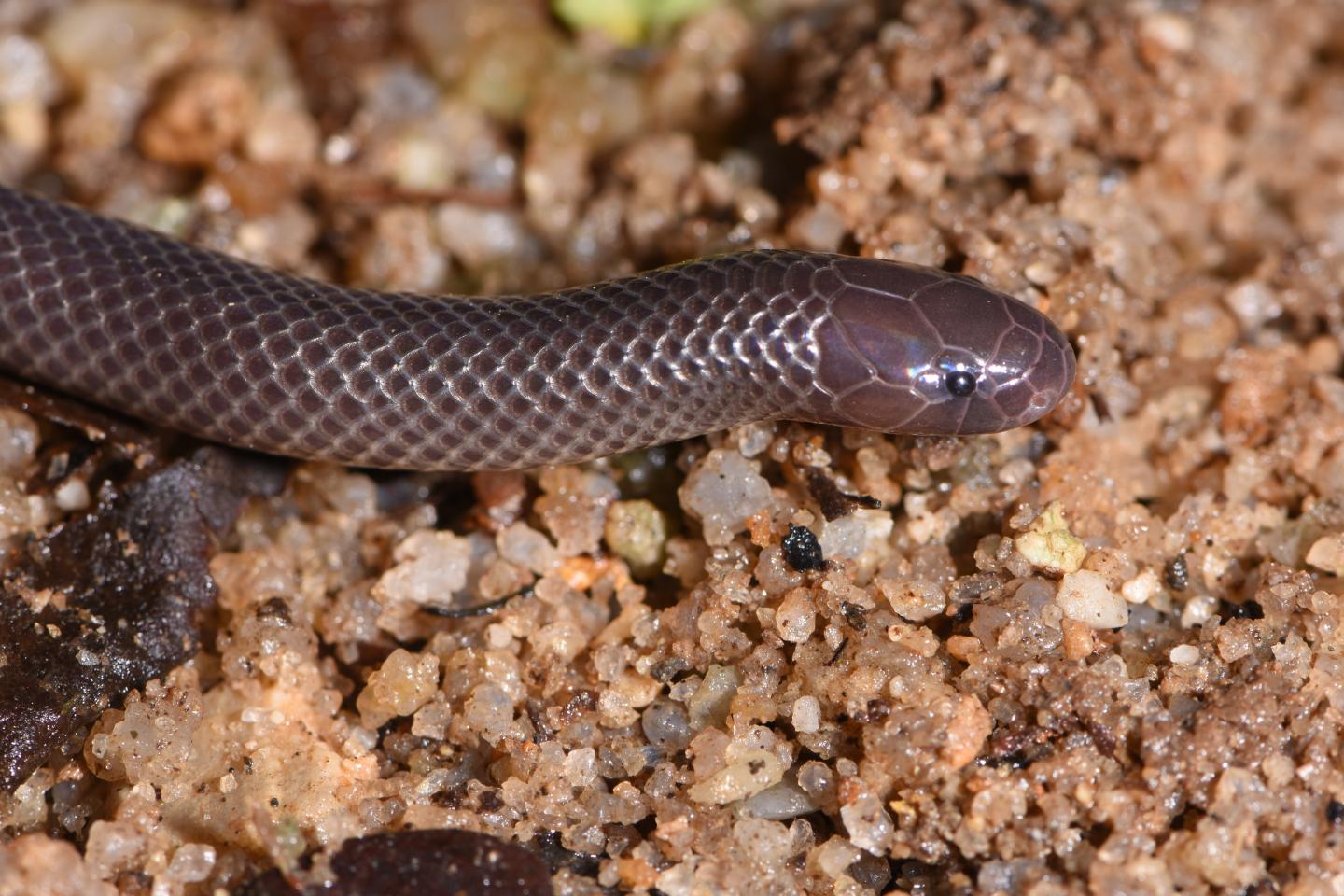
Credit: Mark-Oliver Roedel

Following a series of recent surveys in north-western Liberia and south-eastern Guinea, an international team of researchers found three stiletto snakes which were later identified as a species previously unknown to science.

The discovery, published in the open-access journal Zoosystematics and Evolution by the team of Dr Mark-Oliver Roedel from the Natural History Museum, Berlin, provides further evidence for the status of the western part of the Upper Guinea forest zone as a center of rich and endemic biodiversity.

Curiously, stiletto snakes have unusual skulls and venom delivery system, allowing them to attack and stab sideways with a fang sticking out of the corner of their mouths. While most of these burrowing snakes are not venomous enough to kill a human – even though some are able to inflict serious tissue necrosis – this behaviour makes them impossible to handle using the standard approach of holding them with fingers behind the head. In fact, they can even stab with their mouths closed.

The new species, called Atractaspis branchi or Branch’s Stiletto Snake, was named to honor to the recently deceased South African herpetologist Prof. William Roy (Bill) Branch, a world leading expert on African reptiles.

The new species lives in primary rainforest and rainforest edges in the western part of the Upper Guinea forests. Branch’s Stiletto Snake is most likely endemic to this area, a threatened biogeographic region already known for its unique and diverse fauna.

The first specimen of the new species was collected at night from a steep bank of a small rocky creek in a lowland evergreen rainforest in Liberia. Upon picking it up, the snake tried to hide its head under body loops, bending it at an almost right angle, so that its fangs were partly visible on the sides. Then, it repeatedly stroke. It is also reported to have jumped distances almost as long as its entire body. The other two specimens used for the description of the species were collected from banana, manioc and coffee plantations in south-eastern Guinea, about 27 km apart.

“The discovery of a new and presumably endemic species of fossorial snake from the western Upper Guinea forests thus is not very surprising,” conclude the researchers. “However, further surveys are needed to resolve the range of the new snake species, and to gather more information about its ecological needs and biological properties.”

###

Original source:

Rödel M, Kucharzewski C, Mahlow K, Chirio L, Pauwels OSG, Carlino P, Sambolah G, Glos J (2019) A new stiletto snake (Lamprophiidae, Atractaspidinae, Atractaspis) from Liberia and Guinea, West Africa. Zoosystematics and Evolution 95(1): 107-123. https://doi.org/10.3897/zse.95.31488

Media Contact
Mark-Oliver Roedel
[email protected]

Related Journal Article

http://dx.doi.org/10.3897/zse.95.31488

Tags: BiodiversityBiologyEvolutionPhysiologyPopulation BiologyZoology/Veterinary Science
Share14Tweet8Share2ShareShareShare2

Related Posts

Structural and Functional Differences in Citrus PRR and R Genes

Structural and Functional Differences in Citrus PRR and R Genes

January 14, 2026
Gut Microbiota l-Theanine Boosts Amino Acid Breakdown

Gut Microbiota l-Theanine Boosts Amino Acid Breakdown

January 14, 2026

Accelerated Donkey Breed Classification via SNP Insights

January 14, 2026

Integrative Multi-Omics Links GWAS to Genes in Cattle

January 14, 2026
Please login to join discussion

POPULAR NEWS

  • Enhancing Spiritual Care Education in Nursing Programs

    155 shares
    Share 62 Tweet 39
  • PTSD, Depression, Anxiety in Childhood Cancer Survivors, Parents

    147 shares
    Share 59 Tweet 37
  • Robotic Ureteral Reconstruction: A Novel Approach

    74 shares
    Share 30 Tweet 19
  • Study Reveals Lipid Accumulation in ME/CFS Cells

    52 shares
    Share 21 Tweet 13

About

We bring you the latest biotechnology news from best research centers and universities around the world. Check our website.

Follow us

Recent News

Discovering New PI3Kα Inhibitors for Colon Cancer

Structural and Functional Differences in Citrus PRR and R Genes

Rising Urban Gaps in Road Freight Emissions

Subscribe to Blog via Email

Enter your email address to subscribe to this blog and receive notifications of new posts by email.

Join 71 other subscribers
  • Contact Us

Bioengineer.org © Copyright 2023 All Rights Reserved.

Welcome Back!

Login to your account below

Forgotten Password?

Retrieve your password

Please enter your username or email address to reset your password.

Log In
No Result
View All Result
  • Homepages
    • Home Page 1
    • Home Page 2
  • News
  • National
  • Business
  • Health
  • Lifestyle
  • Science

Bioengineer.org © Copyright 2023 All Rights Reserved.

