• HOME
  • NEWS
  • EXPLORE
    • CAREER
      • Companies
      • Jobs
    • EVENTS
    • iGEM
      • News
      • Team
    • PHOTOS
    • VIDEO
    • WIKI
  • BLOG
  • COMMUNITY
    • FACEBOOK
    • INSTAGRAM
    • TWITTER
Monday, May 18, 2026
BIOENGINEER.ORG
No Result
View All Result
  • Login
  • HOME
  • NEWS
  • EXPLORE
    • CAREER
      • Companies
      • Jobs
        • Lecturer
        • PhD Studentship
        • Postdoc
        • Research Assistant
    • EVENTS
    • iGEM
      • News
      • Team
    • PHOTOS
    • VIDEO
    • WIKI
  • BLOG
  • COMMUNITY
    • FACEBOOK
    • INSTAGRAM
    • TWITTER
  • HOME
  • NEWS
  • EXPLORE
    • CAREER
      • Companies
      • Jobs
        • Lecturer
        • PhD Studentship
        • Postdoc
        • Research Assistant
    • EVENTS
    • iGEM
      • News
      • Team
    • PHOTOS
    • VIDEO
    • WIKI
  • BLOG
  • COMMUNITY
    • FACEBOOK
    • INSTAGRAM
    • TWITTER
No Result
View All Result
Bioengineer.org
No Result
View All Result
Home NEWS Science News Biology

Anti-inflammatory drug is the key to boosting cardiac reprogramming

Bioengineer by Bioengineer
March 6, 2019
in Biology
Reading Time: 2 mins read
0
IMAGE
Share on FacebookShare on TwitterShare on LinkedinShare on RedditShare on Telegram

University of Tsukuba researchers develop high-throughput screening for factors promoting cardiac reprogramming, and identify a non-steroidal anti-inflammatory drug as one such factor in postnatal and adult fibroblasts
IMAGE

Credit: University of Tsukuba

Tsukuba, Japan – Once damaged, the human heart does a poor job of repairing itself, so this is a key priority for treating heart failure. One way of restoring cardiac function is to reprogram non-cardiac body cells such as fibroblasts into heart muscle cells (cardiomyocytes) using a collection of cardiac transcription factors.

This bypasses the need to use stem cells as an intermediate and avoids stimulating the proliferation of existing cardiomyocytes. However, the reprogramming of postnatal and adult fibroblasts is inefficient compared with that of embryonic fibroblasts, and the challenges associated with reprogramming aged cells are unclear.

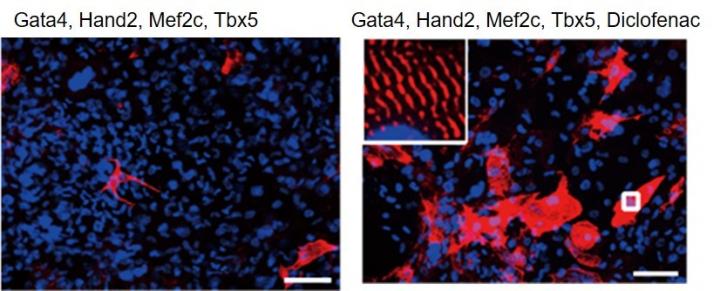
A new study in Nature Communications has advanced this field by using a high-throughput screening approach to identify diclofenac, an FDA-approved drug commonly used to treat inflammation and rheumatic diseases, as a factor promoting cardiac reprogramming in postnatal and adult fibroblasts but not embryonic ones. The finding by researchers at the University of Tsukuba and their research colleagues in a Japan-wide university collaboration also helps define the barriers unique to cellular aging.

Previous methods of identifying cardiac reprogramming factors have been labor intensive and unsuitable for large-scale screening. “As an alternative approach, we developed a high-content technique to screen a chemical library of 8400 compounds,” says co-author Taketaro Sadahiro. “The first round of screening identified 37 potential compounds, which were narrowed down to four in the second round. The most powerful of these four molecules was diclofenac.”

Based on these findings, diclofenac was shown to improve cardiac reprogramming in a dose-dependent manner largely by inhibiting the enzyme COX-2, which is highly expressed in postnatal and adult fibroblasts. Diclofenac also suppressed a host of signaling molecules, including several mediators of inflammation.

The team found that diclofenac functioned during the early stages of cardiac reprogramming, and increased the generation of cardiomyocytes more quickly and efficiently than TGF? and Wnt inhibitors, which are factors known to promote reprogramming.

“Consistent with the importance of inflammation in preventing cardiac reprogramming, our microarray data showed that diclofenac downregulated fibroblast and inflammatory genes, and upregulated cardiac genes,” says corresponding author Masaki Ieda. “Thus, diclofenac was responsible for silencing fibroblast signatures, which occurred prior to cellular reprogramming into cardiomyocytes.”

As well as COX-2, genes associated with inflammation and fibroblasts were also shown to be more highly expressed in postnatal and adult cells compared with embryonic fibroblasts. This indicated that inflammation and fibrogenesis are age-related barriers to cardiac reprogramming. These findings have important implications for the development of new therapies for cardiac regeneration in pediatric and adult patients.

###

Media Contact
Masataka Watanabe
[email protected]

Related Journal Article

http://dx.doi.org/10.1038/s41467-019-08626-y

Tags: CardiologyCell BiologyGeneticsMedicine/HealthMolecular Biology
Share12Tweet8Share2ShareShareShare2

Related Posts

Uncovering C. elegans Immunity via Genetic Screens — Biology

Uncovering C. elegans Immunity via Genetic Screens

May 16, 2026
Single mother must adapt swiftly — the survival of her colony depends on it — Biology

Single mother must adapt swiftly — the survival of her colony depends on it

May 15, 2026

Why Are Nearly Everyone Right-Handed? It Might Be Linked to How We Learned to Walk

May 15, 2026

Excessive Neuronal Activity Initiates Severe Autoimmune Brain Disorder

May 15, 2026
Please login to join discussion

POPULAR NEWS

  • Research Indicates Potential Connection Between Prenatal Medication Exposure and Elevated Autism Risk

    844 shares
    Share 338 Tweet 211
  • New Study Reveals Plants Can Detect the Sound of Rain

    731 shares
    Share 292 Tweet 182
  • Salmonella Haem Blocks Macrophages, Boosts Infection

    62 shares
    Share 25 Tweet 16
  • Breastmilk Balances E. coli and Beneficial Bacteria in Infant Gut Microbiomes

    58 shares
    Share 23 Tweet 15

About

We bring you the latest biotechnology news from best research centers and universities around the world. Check our website.

Follow us

Recent News

Controlling Surrounding Rock Failure in Coal Pillar Retreats

Gut Microbiome Nitrogen Shift Boosts Ulcerative Colitis Treatment

Sharpening Our View of Bacteria

Subscribe to Blog via Email

Enter your email address to subscribe to this blog and receive notifications of new posts by email.

Join 82 other subscribers
  • Contact Us

Bioengineer.org © Copyright 2023 All Rights Reserved.

Welcome Back!

Login to your account below

Forgotten Password?

Retrieve your password

Please enter your username or email address to reset your password.

Log In
No Result
View All Result
  • Homepages
    • Home Page 1
    • Home Page 2
  • News
  • National
  • Business
  • Health
  • Lifestyle
  • Science

Bioengineer.org © Copyright 2023 All Rights Reserved.