• HOME
  • NEWS
  • EXPLORE
    • CAREER
      • Companies
      • Jobs
    • EVENTS
    • iGEM
      • News
      • Team
    • PHOTOS
    • VIDEO
    • WIKI
  • BLOG
  • COMMUNITY
    • FACEBOOK
    • INSTAGRAM
    • TWITTER
Monday, May 11, 2026
BIOENGINEER.ORG
No Result
View All Result
  • Login
  • HOME
  • NEWS
  • EXPLORE
    • CAREER
      • Companies
      • Jobs
        • Lecturer
        • PhD Studentship
        • Postdoc
        • Research Assistant
    • EVENTS
    • iGEM
      • News
      • Team
    • PHOTOS
    • VIDEO
    • WIKI
  • BLOG
  • COMMUNITY
    • FACEBOOK
    • INSTAGRAM
    • TWITTER
  • HOME
  • NEWS
  • EXPLORE
    • CAREER
      • Companies
      • Jobs
        • Lecturer
        • PhD Studentship
        • Postdoc
        • Research Assistant
    • EVENTS
    • iGEM
      • News
      • Team
    • PHOTOS
    • VIDEO
    • WIKI
  • BLOG
  • COMMUNITY
    • FACEBOOK
    • INSTAGRAM
    • TWITTER
No Result
View All Result
Bioengineer.org
No Result
View All Result
Home NEWS Science News Biology

A new technology developed to detect and analyze colorless and transparent biomaterials

Bioengineer by Bioengineer
March 5, 2019
in Biology
Reading Time: 3 mins read
0
IMAGE
Share on FacebookShare on TwitterShare on LinkedinShare on RedditShare on Telegram

IMAGE

Credit: © DGIST

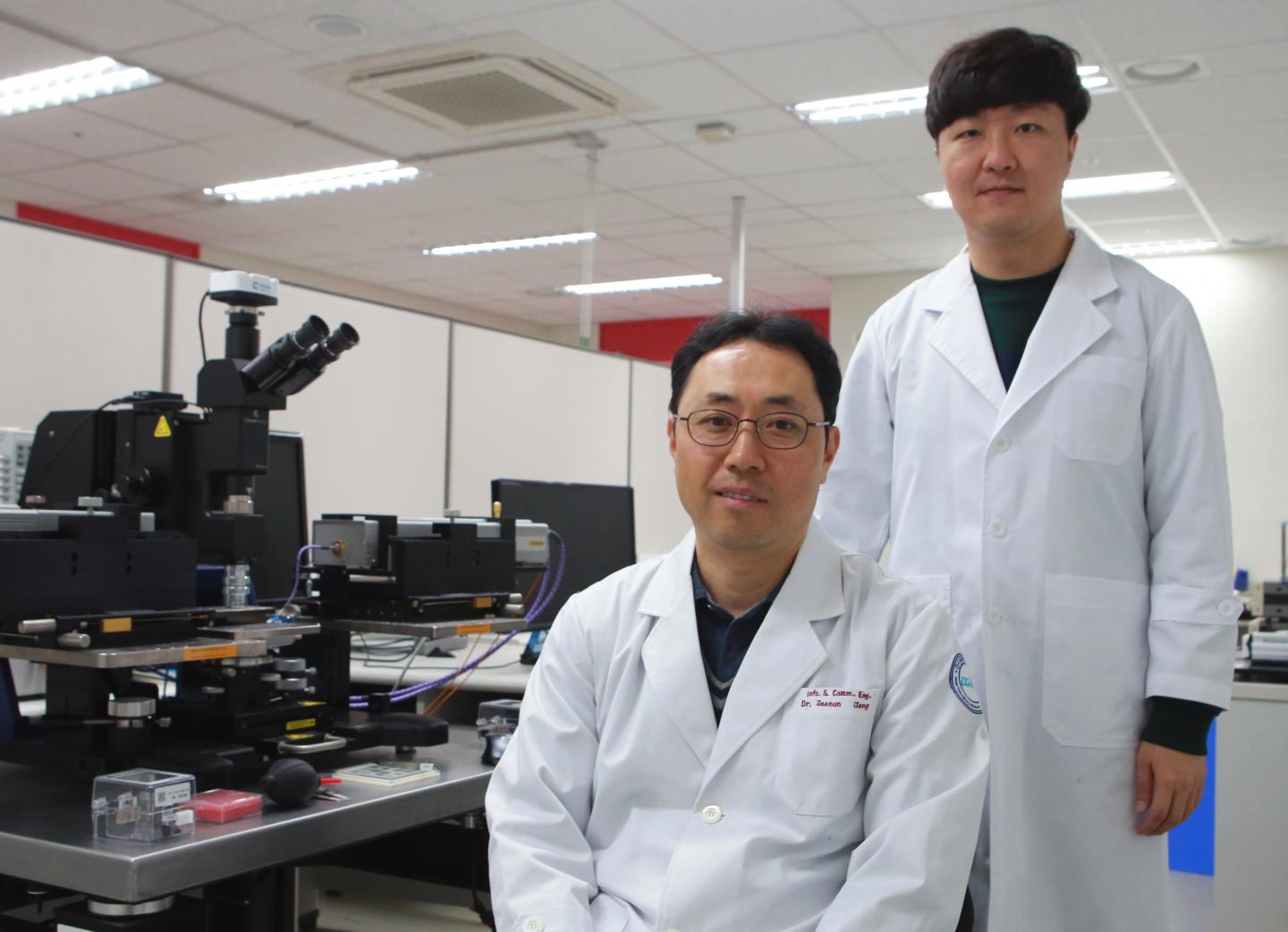
DGIST announced on Wednesday, February 20 that Professor Jae Eun Jang’s team in the Department of Information and Communication Engineering developed a biosensor that expresses biomaterials’ colors using nano structure and applies a new image signal processing technique.

Active R&D has been underway on clarifying relationship with a certain disease and outbreak mechanism through the analysis of biomaterials inside cells or organs. Since biomaterials such as protein are difficult to be observed and analyzed by naked eyes or optical microscopes because they are colorless and transparent within the range of visible rays, a different approach is taken to observe them after secondary processing using a biomarker to show a certain color on biomaterials.

However, development of new technology has been demanded to detect biomaterials without biomarker because biomarker technology may change the characteristics of biomaterials and some of them cannot be taken into biomarker processing.

Professor Jae Eun Jang’s team has conducted a biosensor research using the selective penetrability by the plasmonic nano structure, through a joint research with Professor Che Il Moon’s team in the Department of Brain & Cognitive Sciences and Professor Jae Youn Hwang’s team in the Department of Information and Communication Engineering.

The research team produced a plasmonic nanostructure where uniform nanoholes are regularly arrayed on a metal film. Like a color lens that selectively allows certain light to pass through if regular fine holes are drilled on a metal film, the property around a nano structure changes and the wavelength of selected light also changes, showing a different color. Different colors by substance show when various biomaterials are placed on a nanostructure, which can be seen by the naked eye or microscope.

The research team first obtained biomaterials using a simplified image sensor without an analyzer such as a spectrometer and analyzed biomaterial image data by pixels. They developed an image signal processing technique with high accuracy by proving that color sensitivity by biomaterial change is related to intervals of nano structure arrangement.

Using this technology, the research team successfully obtained the color information of nano structure by biomaterial change through an image sensor, and developed a biosensor that can precisely detect in real- time biomaterials by applying the newly developed signal processing technology.

The biosensor developed by the research team can analyze and detect biomaterials in real time without a secondary processing or analyzer, so it can be used widely in various bioresearch such as analysis of disease mechanism and new drug development. It can also easily be commercialized because it is applicable to the existing analysis method using a microscope.

Professor Jae Eun Jang in the Department of Information and Communication Engineering said “We have developed a core technology that can apply effectively on classifying and tracking essential biomaterials in bioresearch. We expect this to be used actively in brain disease research and treatment through the results of integrated research by nano engineering, electronic engineering, and brain science experts.”

###

This research result was published on February issue of ‘Biosensors & Bioelectronics IF=8.173,’ a world-renowned international journal in biosensor field.

Media Contact
[email protected]
[email protected]

Original Source

https://www.dgist.ac.kr/en/html/sub06/060202.html?mode=V&no=8680c20caf5124446112cf709f2403f6&GotoPage=1

Related Journal Article

http://dx.doi.org/10.1016/j.bios.2018.11.048

Tags: BioinformaticsBiomedical/Environmental/Chemical EngineeringBiotechnologyElectrical Engineering/ElectronicsElectromagneticsHardwareNanotechnology/MicromachinesTechnology/Engineering/Computer Science
Share18Tweet8Share2ShareShareShare2

Related Posts

Ancient Plant Populations Reveal Fresh Insights into Climate Resilience — Biology

Ancient Plant Populations Reveal Fresh Insights into Climate Resilience

May 8, 2026
Rare Brain Disorders in Children Linked to Mutations in Lesser-Known Protein Complex — Biology

Rare Brain Disorders in Children Linked to Mutations in Lesser-Known Protein Complex

May 8, 2026

From Odd Insect to Underwater Predator: The Remarkable Evolution of a Bloodthirsty Fruit Fly

May 8, 2026

SNU Professor Sangwoo Seo’s Team Develops Next-Generation CRISPR Biocontainment Technology to Control Microbial Survival Without DNA Cleavage

May 8, 2026
Please login to join discussion

POPULAR NEWS

  • Research Indicates Potential Connection Between Prenatal Medication Exposure and Elevated Autism Risk

    840 shares
    Share 336 Tweet 210
  • New Study Reveals Plants Can Detect the Sound of Rain

    727 shares
    Share 290 Tweet 181
  • Salmonella Haem Blocks Macrophages, Boosts Infection

    61 shares
    Share 24 Tweet 15
  • Breastmilk Balances E. coli and Beneficial Bacteria in Infant Gut Microbiomes

    57 shares
    Share 23 Tweet 14

About

We bring you the latest biotechnology news from best research centers and universities around the world. Check our website.

Follow us

Recent News

New Post-Hoc Analysis Explores Daily Oral Orforglipron Use in Adults Over 65 with Obesity, Regardless of Diabetes Status

Evaluating Digoxin Use in Patients with Symptomatic Rheumatic Heart Disease

Evaluating the Effectiveness and Safety of Digitalis Glycosides in Treating Heart Failure

Subscribe to Blog via Email

Enter your email address to subscribe to this blog and receive notifications of new posts by email.

Join 82 other subscribers
  • Contact Us

Bioengineer.org © Copyright 2023 All Rights Reserved.

Welcome Back!

Login to your account below

Forgotten Password?

Retrieve your password

Please enter your username or email address to reset your password.

Log In
No Result
View All Result
  • Homepages
    • Home Page 1
    • Home Page 2
  • News
  • National
  • Business
  • Health
  • Lifestyle
  • Science

Bioengineer.org © Copyright 2023 All Rights Reserved.