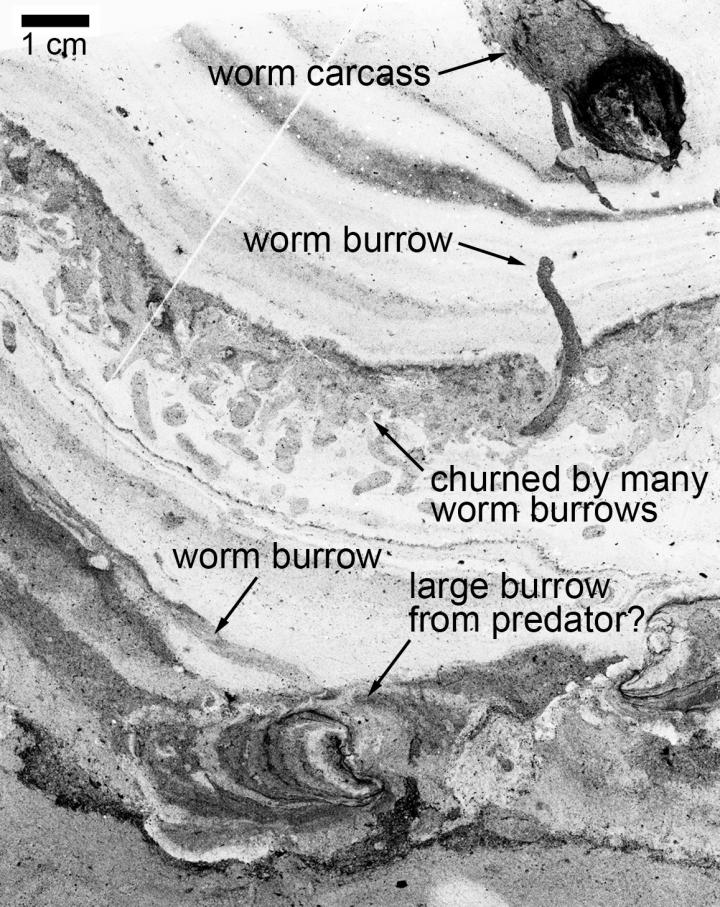
Credit: Professor Brian Pratt, University of Saskatchewan
Prehistoric worms populated the sea bed 500 million years ago–evidence that life was active in an environment thought uninhabitable until now, research by the University of Saskatchewan (USask) shows.
The sea bed in the deep ocean during the Cambrian period was thought to have been inhospitable to animal life because it lacked enough oxygen to sustain it.
But research published in the scientific journal Geology reveals the existence of fossilized worm tunnels dating back to the Cambrian period¬¬ 270 million years before the evolution of dinosaurs.
The discovery, by USask professor Brian Pratt, suggests that animal life in the sediment at that time was more widespread than previously thought.
The worm tunnels–borrows where worms lived and munched through the sediment–are invisible to the naked eye. But Pratt “had a hunch” and sliced the rocks and scanned them to see whether they revealed signs of ancient life.
The rocks came from an area in the remote Mackenzie Mountains of the Northwest Territories in Canada which Pratt found 35 years ago.
Pratt then digitally enhanced images of the rock surfaces so he could examine them more closely. Only then did the hidden ‘superhighway’ of burrows made by several different sizes and types of prehistoric worm emerge in the rock.
Some were barely a millimetre in size and others as large as a finger. The smaller ones were probably made by simple polychaetes–or bristle worms–but one of the large forms was a predator that attacked unsuspecting arthropods and surface-dwelling worms.
Pratt said he was “surprised” by the unexpected discovery.
“For the first time, we saw evidence of large populations of worms living in the sediment – which was thought to be barren,” he said. “There were cryptic worm tunnels – burrows – in the mud on the continental shelf 500 million years ago, and more animals reworking, or bioturbating, the sea bed than anyone ever thought.”
Pratt, a geologist and paleontologist and Fellow of the Geological Society of America, found the tunnels in sedimentary rocks that are similar to the Burgess Shale, a famous fossil-bearing deposit in the Canadian Rockies.
The discovery may prompt a rethink of the level of oxygenation in ancient oceans and continental shelves.
The Cambrian period saw an explosion of life on Earth in the oceans and the development of multi-cellular organisms including prehistoric worms, clams, snails and ancestors of crabs and lobsters. Previously the seas had been inhabited by simple, single-celled microbes and algae.
It has always been assumed that the creatures in the Burgess Shale–known for the richness of its fossils–had been preserved so immaculately because the lack of oxygen at the bottom of the sea stopped decay, and because no animals lived in the mud to eat the carcasses.
Pratt’s discovery, with co-author Julien Kimmig, now of the University of Kansas, shows there was enough oxygen to sustain various kinds of worms in the sea bed.
“Serendipity is a common aspect to my kind of research,” Pratt said. “I found these unusual rocks quite by accident all those years ago. On a hunch I prepared a bunch of samples and when I enhanced the images I was genuinely surprised by what I found,” he said.
“This has a lot of implications which will now need to be investigated, not just in Cambrian shales but in younger rocks as well. People should try the same technique to see if it reveals signs of life in their samples.”
###
The research was funded by the Natural Sciences and Engineering Research Council of Canada.
Professor Pratt is available for interview.
For more information, contact:
Jennifer Thoma
Media Relations Specialist
University of Saskatchewan
306-966-1851
[email protected]
Jen Thoma
Media Relations
Media Contact
Jennifer Thoma
[email protected]
Related Journal Article
http://dx.