• HOME
  • NEWS
  • EXPLORE
    • CAREER
      • Companies
      • Jobs
    • EVENTS
    • iGEM
      • News
      • Team
    • PHOTOS
    • VIDEO
    • WIKI
  • BLOG
  • COMMUNITY
    • FACEBOOK
    • INSTAGRAM
    • TWITTER
Saturday, February 7, 2026
BIOENGINEER.ORG
No Result
View All Result
  • Login
  • HOME
  • NEWS
  • EXPLORE
    • CAREER
      • Companies
      • Jobs
        • Lecturer
        • PhD Studentship
        • Postdoc
        • Research Assistant
    • EVENTS
    • iGEM
      • News
      • Team
    • PHOTOS
    • VIDEO
    • WIKI
  • BLOG
  • COMMUNITY
    • FACEBOOK
    • INSTAGRAM
    • TWITTER
  • HOME
  • NEWS
  • EXPLORE
    • CAREER
      • Companies
      • Jobs
        • Lecturer
        • PhD Studentship
        • Postdoc
        • Research Assistant
    • EVENTS
    • iGEM
      • News
      • Team
    • PHOTOS
    • VIDEO
    • WIKI
  • BLOG
  • COMMUNITY
    • FACEBOOK
    • INSTAGRAM
    • TWITTER
No Result
View All Result
Bioengineer.org
No Result
View All Result
Home NEWS Science News Health

Adipocyte glucocorticoid receptors play a role in developing steroid diabetes

Bioengineer by Bioengineer
February 28, 2019
in Health
Reading Time: 2 mins read
0
IMAGE
Share on FacebookShare on TwitterShare on LinkedinShare on RedditShare on Telegram

Osaka University researchers clarify part of mechanism behind the development of steroid diabetes
IMAGE

Credit: Osaka University

Steroids are used for treating various diseases such as allergic disorders, but they occasionally cause adverse effects, such as steroid diabetes and other metabolic disturbances. Since steroids act throughout the body, how these adverse effects are caused and by which organ are not well understood.

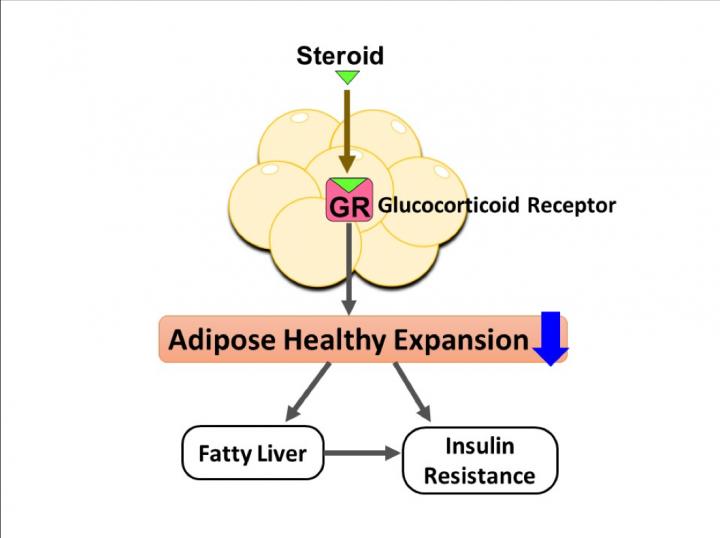
Researchers at Osaka University focused on glucocorticoid receptors (GRs), the receptors for the body’s endogenous steroids, clarifying part of the mechanism behind metabolic disturbances caused by steroids. The results of this research were published in Endocrinology.

The researchers administered steroids to adipocyte-specific GR knockout (AGRKO) mice and found that healthy adipose expansion was induced because lipid accumulation in the liver decreased and insulin sensitivity improved. Next, they examined how healthy adipose expansion was induced using AGRKO mice and found that adipocyte GRs inhibited lipid accumulation in adipose cells, preadipocyte proliferation, and glucose uptake, as well as lipolysis. That is, activation of adipocyte GRs restricted healthy adipose expansion, causing metabolic disturbances such as insulin resistance, liver steatosis, and eventually diabetes.

Corresponding author Yosuke Okuno says, “Our study elucidated how steroids activated adipocytes. Further development of the results of our study will clarify how steroids act on organs, leading to the development of drugs for treating steroid diabetes.”

###

The article, “Adipocyte GR inhibits healthy adipose expansion through multiple mechanisms in Cushing’s syndrome” was published online in Endocrinology at DOI: https://doi.org/10.1210/en.2018-01029 and will be published in print on 1 March 2019.

About Osaka University

Osaka University was founded in 1931 as one of the seven imperial universities of Japan and now has expanded to one of Japan’s leading comprehensive universities. The University has now embarked on open research revolution from a position as Japan’s most innovative university and among the most innovative institutions in the world according to the Nature Index Innovation 2017. The university’s ability to innovate from the stage of fundamental research through the creation of useful technology with economic impact stems from its broad disciplinary spectrum.
Website: https://resou.osaka-u.ac.jp/en/top

Media Contact
Saori Obayashi
[email protected]

Original Source

https://resou.osaka-u.ac.jp/en/research

Related Journal Article

http://dx.doi.org/10.1210/en.2018-01029

Tags: EndocrinologyMedicine/HealthMetabolism/Metabolic Diseases
Share12Tweet8Share2ShareShareShare2

Related Posts

Evaluating Pediatric Emergency Care Quality in Ethiopia

February 7, 2026

TPMT Expression Predictions Linked to Azathioprine Side Effects

February 7, 2026

Improving Dementia Care with Enhanced Activity Kits

February 7, 2026

Decoding Prostate Cancer Origins via snFLARE-seq, mxFRIZNGRND

February 7, 2026
Please login to join discussion

POPULAR NEWS

  • Robotic Ureteral Reconstruction: A Novel Approach

    Robotic Ureteral Reconstruction: A Novel Approach

    82 shares
    Share 33 Tweet 21
  • Digital Privacy: Health Data Control in Incarceration

    63 shares
    Share 25 Tweet 16
  • Study Reveals Lipid Accumulation in ME/CFS Cells

    57 shares
    Share 23 Tweet 14
  • Breakthrough in RNA Research Accelerates Medical Innovations Timeline

    53 shares
    Share 21 Tweet 13

About

We bring you the latest biotechnology news from best research centers and universities around the world. Check our website.

Follow us

Recent News

Evaluating Pediatric Emergency Care Quality in Ethiopia

TPMT Expression Predictions Linked to Azathioprine Side Effects

Improving Dementia Care with Enhanced Activity Kits

Subscribe to Blog via Email

Success! An email was just sent to confirm your subscription. Please find the email now and click 'Confirm' to start subscribing.

Join 73 other subscribers
  • Contact Us

Bioengineer.org © Copyright 2023 All Rights Reserved.

Welcome Back!

Login to your account below

Forgotten Password?

Retrieve your password

Please enter your username or email address to reset your password.

Log In
No Result
View All Result
  • Homepages
    • Home Page 1
    • Home Page 2
  • News
  • National
  • Business
  • Health
  • Lifestyle
  • Science

Bioengineer.org © Copyright 2023 All Rights Reserved.