• HOME
  • NEWS
  • EXPLORE
    • CAREER
      • Companies
      • Jobs
    • EVENTS
    • iGEM
      • News
      • Team
    • PHOTOS
    • VIDEO
    • WIKI
  • BLOG
  • COMMUNITY
    • FACEBOOK
    • INSTAGRAM
    • TWITTER
Wednesday, January 14, 2026
BIOENGINEER.ORG
No Result
View All Result
  • Login
  • HOME
  • NEWS
  • EXPLORE
    • CAREER
      • Companies
      • Jobs
        • Lecturer
        • PhD Studentship
        • Postdoc
        • Research Assistant
    • EVENTS
    • iGEM
      • News
      • Team
    • PHOTOS
    • VIDEO
    • WIKI
  • BLOG
  • COMMUNITY
    • FACEBOOK
    • INSTAGRAM
    • TWITTER
  • HOME
  • NEWS
  • EXPLORE
    • CAREER
      • Companies
      • Jobs
        • Lecturer
        • PhD Studentship
        • Postdoc
        • Research Assistant
    • EVENTS
    • iGEM
      • News
      • Team
    • PHOTOS
    • VIDEO
    • WIKI
  • BLOG
  • COMMUNITY
    • FACEBOOK
    • INSTAGRAM
    • TWITTER
No Result
View All Result
Bioengineer.org
No Result
View All Result
Home NEWS Science News Biology

Method assesses health and size of lizard populations

Bioengineer by Bioengineer
February 21, 2019
in Biology
Reading Time: 1 min read
0
IMAGE
Share on FacebookShare on TwitterShare on LinkedinShare on RedditShare on Telegram

IMAGE

Credit: Ecology & Evolution

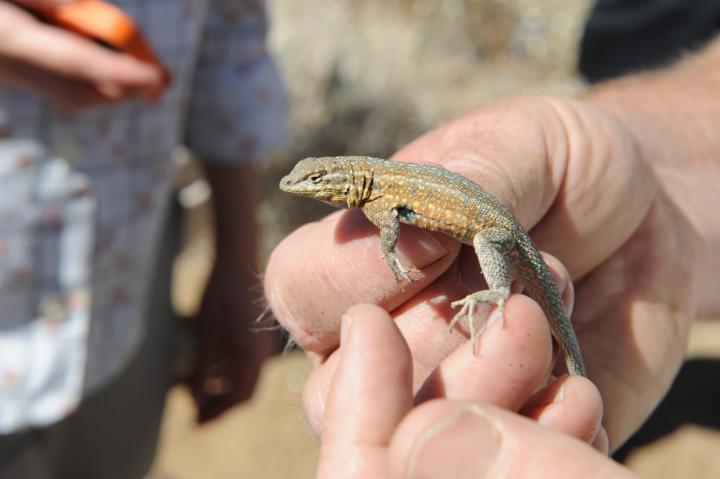
Monitoring programs that survey many wildlife species at the same time across large geographic regions are important for informing conservation decisions, but reptiles are often missing from these efforts because they are difficult to survey. As described in a new Ecology & Evolution study, researchers have now developed a way to provide accurate estimates of lizard populations.

The scientists used their approach at 229 widely-dispersed sites throughout the Mojave Desert in California and estimated a total population size of 80 million for the three most common species of lizards across this 66,830 km2 ecoregion comprising 16% of the total land area of the state.

The results provide a baseline against which to monitor changes in population status and show how the distribution and behavior of lizards vary with differences in vegetation cover, human land use, and temperature. The study also demonstrates how multi-species monitoring programs spanning arid ecoregions can better incorporate information about reptiles.

###

Media Contact
Josh Glickman
[email protected]

Related Journal Article

http://dx.doi.org/10.1002/ece3.4780

Tags: BiologyEcology/EnvironmentEvolutionPopulation Biology
Share12Tweet8Share2ShareShareShare2

Related Posts

Accelerated Donkey Breed Classification via SNP Insights

Accelerated Donkey Breed Classification via SNP Insights

January 14, 2026
Integrative Multi-Omics Links GWAS to Genes in Cattle

Integrative Multi-Omics Links GWAS to Genes in Cattle

January 14, 2026

Astaxanthin’s Role in Easing Exercise Muscle Damage

January 14, 2026

Impact of Sex on Mortality in Sjögren’s Disease

January 14, 2026
Please login to join discussion

POPULAR NEWS

  • Enhancing Spiritual Care Education in Nursing Programs

    155 shares
    Share 62 Tweet 39
  • PTSD, Depression, Anxiety in Childhood Cancer Survivors, Parents

    147 shares
    Share 59 Tweet 37
  • Robotic Ureteral Reconstruction: A Novel Approach

    73 shares
    Share 29 Tweet 18
  • Study Reveals Lipid Accumulation in ME/CFS Cells

    52 shares
    Share 21 Tweet 13

About

We bring you the latest biotechnology news from best research centers and universities around the world. Check our website.

Follow us

Recent News

Pre-Breakfast Hand Bathing Boosts Postoperative Recovery Comfort

Exploring Dorstenia barnimiana’s Antioxidant and Antibacterial Properties

Pre-Breakfast Bathing Boosts Post-Surgery Comfort in Japan

Subscribe to Blog via Email

Enter your email address to subscribe to this blog and receive notifications of new posts by email.

Join 71 other subscribers
  • Contact Us

Bioengineer.org © Copyright 2023 All Rights Reserved.

Welcome Back!

Login to your account below

Forgotten Password?

Retrieve your password

Please enter your username or email address to reset your password.

Log In
No Result
View All Result
  • Homepages
    • Home Page 1
    • Home Page 2
  • News
  • National
  • Business
  • Health
  • Lifestyle
  • Science

Bioengineer.org © Copyright 2023 All Rights Reserved.