

• HOME
  • NEWS
  • EXPLORE
    • CAREER
      • Companies
      • Jobs
    • EVENTS
    • iGEM
      • News
      • Team
    • PHOTOS
    • VIDEO
    • WIKI
  • BLOG
  • COMMUNITY
    • FACEBOOK
    • INSTAGRAM
    • TWITTER
Sunday, January 11, 2026
BIOENGINEER.ORG
No Result
View All Result
  • Login
  • HOME
  • NEWS
  • EXPLORE
    • CAREER
      • Companies
      • Jobs
        • Lecturer
        • PhD Studentship
        • Postdoc
        • Research Assistant
    • EVENTS
    • iGEM
      • News
      • Team
    • PHOTOS
    • VIDEO
    • WIKI
  • BLOG
  • COMMUNITY
    • FACEBOOK
    • INSTAGRAM
    • TWITTER
  • HOME
  • NEWS
  • EXPLORE
    • CAREER
      • Companies
      • Jobs
        • Lecturer
        • PhD Studentship
        • Postdoc
        • Research Assistant
    • EVENTS
    • iGEM
      • News
      • Team
    • PHOTOS
    • VIDEO
    • WIKI
  • BLOG
  • COMMUNITY
    • FACEBOOK
    • INSTAGRAM
    • TWITTER
No Result
View All Result
Bioengineer.org
No Result
View All Result
Home NEWS Science News Science

Powering a pacemaker with a patient’s heartbeat

Bioengineer by Bioengineer
February 20, 2019
in Science
Reading Time: 2 mins read
0
IMAGE
Share on FacebookShare on TwitterShare on LinkedinShare on RedditShare on Telegram

IMAGE

Credit: American Chemical Society


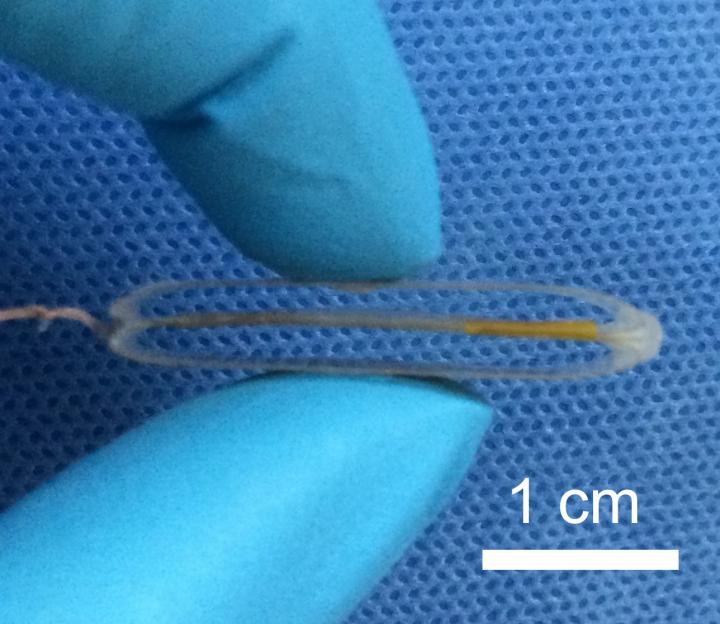
Implantable pacemakers have without doubt altered modern medicine, saving countless lives by regulating heart rhythm. But they have one serious shortcoming: Their batteries last only five to 12 years, at which point they have to be replaced surgically. Now, researchers have surmounted this issue by designing a pacemaker powered by the energy of heartbeats, according to a report in ACS Nano. The device was successfully tested in pigs, which have a similar physiology to humans.

A conventional pacemaker is implanted just under the skin near the collarbone. Its battery and circuitry generate electrical signals that are delivered to the heart via implanted electrodes. Because surgery to replace the battery can lead to complications, including infection and bleeding, various researchers have tried to build pacemakers that use the natural energy of heartbeats as an alternative energy source. However, these experimental devices aren’t powerful enough because of their rigid structure, difficulties with miniaturization and other drawbacks, so Hao Zhang, Bin Yang and colleagues searched for ways to improve the technology.

First, they designed a small, flexible plastic frame. Next they bonded the frame to piezoelectric layers, which generate energy when bent. They implanted the device in pigs and showed that a beating heart could in fact alter the frame’s shape, generating enough power to match the performance of a battery-powered pacemaker. The study is a step toward making a self-powered cardiac pacemaker, the researchers say.

###

The authors acknowledge funding from the 863 Program, the National Natural Science Foundation of China and the Natural Science Foundation of Shanghai.

The paper’s abstract will be available on Feb. 20 at 8 a.m. Eastern time here: http://pubs.acs.org/doi/abs/10.1021/acsnano.8b08567

The American Chemical Society, the world’s largest scientific society, is a not-for-profit organization chartered by the U.S. Congress. ACS is a global leader in providing access to chemistry-related information and research through its multiple databases, peer-reviewed journals and scientific conferences. ACS does not conduct research, but publishes and publicizes peer-reviewed scientific studies. Its main offices are in Washington, D.C., and Columbus, Ohio.

To automatically receive news releases from the American Chemical Society, contact [email protected].

Follow us: Twitter | Facebook

Media Contact
Katie Cottingham
[email protected]
301-775-8455

Tags: Biomedical/Environmental/Chemical EngineeringBiotechnologyCardiologyChemistry/Physics/Materials SciencesNanotechnology/MicromachinesSurgeryTransplantation
Share12Tweet8Share2ShareShareShare2

Related Posts

Five or more hours of smartphone usage per day may increase obesity

July 25, 2019
IMAGE

NASA’s terra satellite finds tropical storm 07W’s strength on the side

July 25, 2019

NASA finds one burst of energy in weakening Depression Dalila

July 25, 2019

Researcher’s innovative flood mapping helps water and emergency management officials

July 25, 2019
Please login to join discussion

POPULAR NEWS

  • Enhancing Spiritual Care Education in Nursing Programs

    154 shares
    Share 62 Tweet 39
  • PTSD, Depression, Anxiety in Childhood Cancer Survivors, Parents

    146 shares
    Share 58 Tweet 37
  • Robotic Ureteral Reconstruction: A Novel Approach

    56 shares
    Share 22 Tweet 14
  • Impact of Vegan Diet and Resistance Exercise on Muscle Volume

    47 shares
    Share 19 Tweet 12

About

We bring you the latest biotechnology news from best research centers and universities around the world. Check our website.

Follow us

Recent News

Empowering Hong Kong Teens: Mental Health Leadership Training

Self-Care and Efficacy in Older Adults’ Health

Risk Factors for Psychological Symptoms in Older Turks

Subscribe to Blog via Email

Success! An email was just sent to confirm your subscription. Please find the email now and click 'Confirm' to start subscribing.

Join 71 other subscribers
  • Contact Us

Bioengineer.org © Copyright 2023 All Rights Reserved.

Welcome Back!

Login to your account below

Forgotten Password?

Retrieve your password

Please enter your username or email address to reset your password.

Log In
No Result
View All Result
  • Homepages
    • Home Page 1
    • Home Page 2
  • News
  • National
  • Business
  • Health
  • Lifestyle
  • Science

Bioengineer.org © Copyright 2023 All Rights Reserved.