• HOME
  • NEWS
  • EXPLORE
    • CAREER
      • Companies
      • Jobs
    • EVENTS
    • iGEM
      • News
      • Team
    • PHOTOS
    • VIDEO
    • WIKI
  • BLOG
  • COMMUNITY
    • FACEBOOK
    • INSTAGRAM
    • TWITTER
Saturday, February 7, 2026
BIOENGINEER.ORG
No Result
View All Result
  • Login
  • HOME
  • NEWS
  • EXPLORE
    • CAREER
      • Companies
      • Jobs
        • Lecturer
        • PhD Studentship
        • Postdoc
        • Research Assistant
    • EVENTS
    • iGEM
      • News
      • Team
    • PHOTOS
    • VIDEO
    • WIKI
  • BLOG
  • COMMUNITY
    • FACEBOOK
    • INSTAGRAM
    • TWITTER
  • HOME
  • NEWS
  • EXPLORE
    • CAREER
      • Companies
      • Jobs
        • Lecturer
        • PhD Studentship
        • Postdoc
        • Research Assistant
    • EVENTS
    • iGEM
      • News
      • Team
    • PHOTOS
    • VIDEO
    • WIKI
  • BLOG
  • COMMUNITY
    • FACEBOOK
    • INSTAGRAM
    • TWITTER
No Result
View All Result
Bioengineer.org
No Result
View All Result
Home NEWS Science News Health

Voluntary control of brainwaves in deep brain of patients with Parkinson's disease

Bioengineer by Bioengineer
February 6, 2019
in Health
Reading Time: 2 mins read
0
IMAGE
Share on FacebookShare on TwitterShare on LinkedinShare on RedditShare on Telegram

Patients with Parkinson’s disease can voluntarily control β waves in their deep brain, representing a new approach toward managing disease-related brain activity
IMAGE

Credit: Osaka University

Parkinson’s disease is associated with abnormal beta wave activity in the subthalamic nucleus (STN), but a direct connection between this activity and movement difficulties has not yet been established.

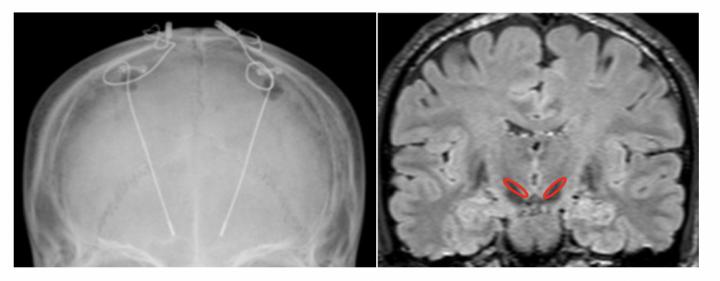
A study group at Osaka University developed a neurofeedback system (Figure 1) which enables patients with Parkinson’s disease to voluntarily control beta wave activity in their deep brain (STN, Figure 2) associated with symptoms of the disorder. The group demonstrated that the patients can control these beta waves voluntary; however, it remains to be determined whether such a system can provide symptom relief. The group’s research results were published in eNeuro.

“In a study of eight patients undergoing a routine replacement of a pulse generator used for deep brain stimulation, we developed a method that could help scientists better understand the relationship between brain activity and disease symptoms,” says senior author Haruhiko Kishima.

In this study, the patients were trained to increase the size of a black circle that changes according to the participants’ real-time beta wave activity. For half of the participants, the size of the black circle was positively correlated with beta wave intensity, and for other half of the participants, the circle was negatively correlated with beta wave intensity. After the 10 minutes of training, the study demonstrated that the patients’ beta waves significantly increased or decreased depending on the circle condition. Using the real-time feedback system, the patients can voluntarily control their beta waves.

Corresponding author Takufumi Yanagisawa says, “Although we did not observe an improvement in patients’ symptoms, our study represents a new approach toward managing disease-related brain activity that could lead to the development of new treatments.”

###

The article, “Real-Time Neurofeedback to Modulate β-Band Power in the Subthalamic Nucleus in Parkinson’s Disease Patients” was published in eNeuro at DOI: https://doi.org/10.1523/ENEURO.0246-18.2018.

About Osaka University

Osaka University was founded in 1931 as one of the seven imperial universities of Japan and now has expanded to one of Japan’s leading comprehensive universities. The University has now embarked on open research revolution from a position as Japan’s most innovative university and among the most innovative institutions in the world according to Reuters 2015 Top 100 Innovative Universities and the Nature Index Innovation 2017. The university’s ability to innovate from the stage of fundamental research through the creation of useful technology with economic impact stems from its broad disciplinary spectrum.

Website: https://resou.osaka-u.ac.jp/en/top

Media Contact
Saori Obayashi
[email protected]
81-661-055-886

Original Source

https://resou.osaka-u.ac.jp/en/research/2018/20181218_1

Related Journal Article

http://dx.doi.org/10.1523/ENEURO.0246-18.2018

Tags: Medicine/HealthneurobiologyParkinson
Share12Tweet8Share2ShareShareShare2

Related Posts

Phage-Antibiotic Combo Beats Resistant Peritoneal Infection

February 7, 2026

Boosting Remote Healthcare: Stepped-Wedge Trial Insights

February 7, 2026

Barriers and Boosters of Seniors’ Physical Activity in Karachi

February 7, 2026

Evaluating Pediatric Emergency Care Quality in Ethiopia

February 7, 2026
Please login to join discussion

POPULAR NEWS

  • Robotic Ureteral Reconstruction: A Novel Approach

    Robotic Ureteral Reconstruction: A Novel Approach

    82 shares
    Share 33 Tweet 21
  • Digital Privacy: Health Data Control in Incarceration

    63 shares
    Share 25 Tweet 16
  • Study Reveals Lipid Accumulation in ME/CFS Cells

    57 shares
    Share 23 Tweet 14
  • Breakthrough in RNA Research Accelerates Medical Innovations Timeline

    53 shares
    Share 21 Tweet 13

About

We bring you the latest biotechnology news from best research centers and universities around the world. Check our website.

Follow us

Recent News

Phage-Antibiotic Combo Beats Resistant Peritoneal Infection

Boosting Remote Healthcare: Stepped-Wedge Trial Insights

Barriers and Boosters of Seniors’ Physical Activity in Karachi

Subscribe to Blog via Email

Enter your email address to subscribe to this blog and receive notifications of new posts by email.

Join 73 other subscribers
  • Contact Us

Bioengineer.org © Copyright 2023 All Rights Reserved.

Welcome Back!

Login to your account below

Forgotten Password?

Retrieve your password

Please enter your username or email address to reset your password.

Log In
No Result
View All Result
  • Homepages
    • Home Page 1
    • Home Page 2
  • News
  • National
  • Business
  • Health
  • Lifestyle
  • Science

Bioengineer.org © Copyright 2023 All Rights Reserved.