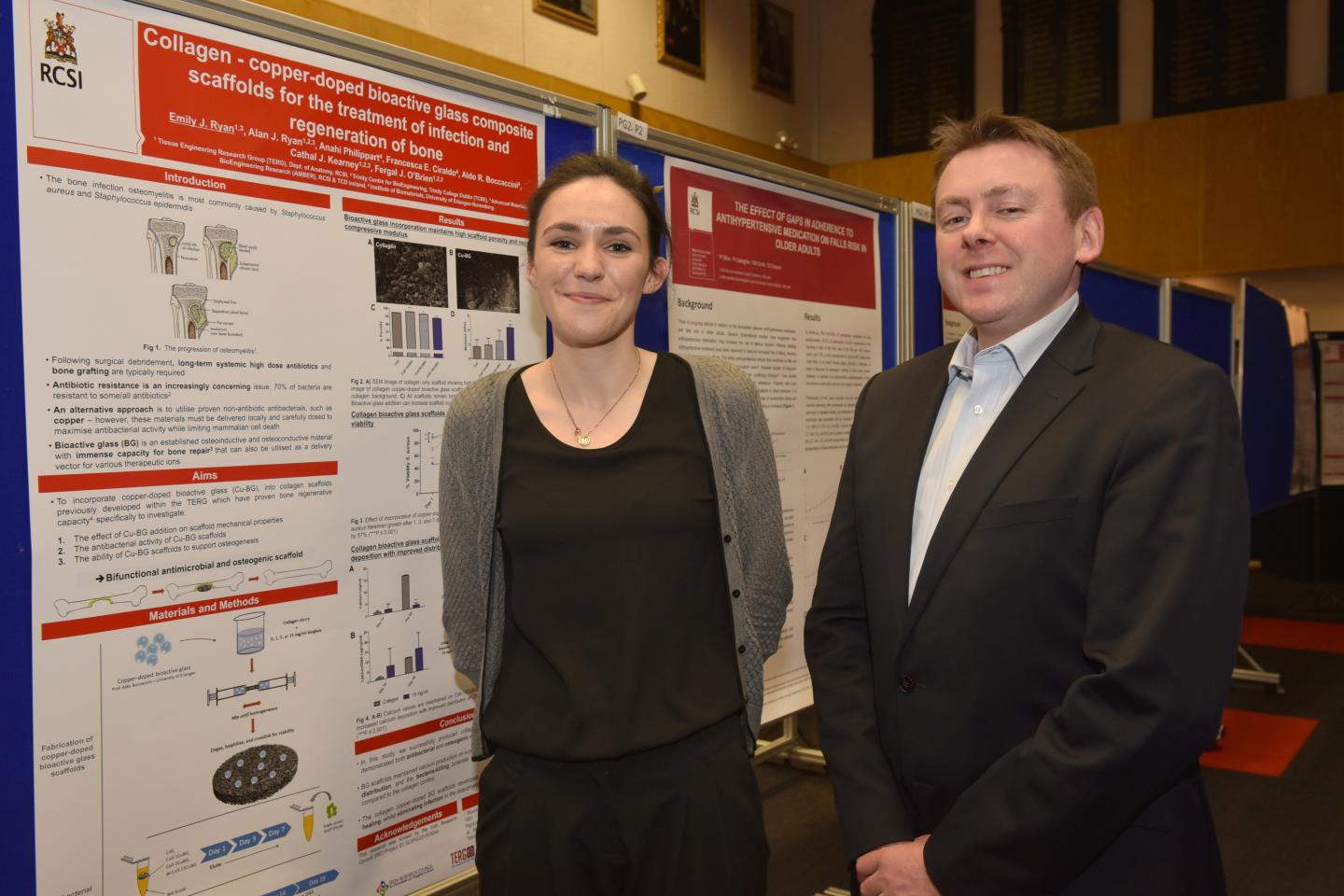
Credit: RCSI
Wednesday, 30 January 2019: A team of researchers led by RCSI (Royal College of Surgeons in Ireland), have developed a new treatment for the particularly difficult-to-treat bone infection, osteomyelitis.
Funded by Irish Research Council, European Research Council and AMBER, the SFI (Science Foundation Ireland) research centre for materials science, the study is published in Biomaterials, the No. 1 ranked scientific journal in the field.
The new treatment has developed a one-step solution that kills bacteria and promotes bone growth without using antibiotics. To do this, researchers combined copper particles with bioactive glass – a type of glass used for bone repair – and incorporated it into an implant designed specifically for bone repair.
The copper-doped bioactive glass in the porous scaffold implant attracts blood vessels and bone cells, which accelerates bone repair. The copper ions in the implant also prevent bacteria growth. The ability of a single implant to improve blood flow and enhance bone healing as well as inhibit infection without antibiotic treatment is a significant advancement over most existing treatments.
“Osteomyelitis is notoriously difficult to treat. Further work on the back of this research could lead to the complete development of a single-stage, off-the-shelf treatment. This in turn could reduce the need for antibiotics and bone grafting – thus also addressing issues with antibiotic resistance” said first author Emily Ryan, a recently qualified PhD student in the RCSI Department of Anatomy.
People can develop this bone infection from broken bones, severe tooth decay and deep puncture wounds, among other causes. In the worst cases, osteomyelitis can result in amputations or be fatal.
The current treatment for osteomyelitis:
- Usually involves weeks of high-dose antibiotic therapy,
- Often requires removing infected bone tissue through surgery,
- May require bone grafting,
- Has a failure rate of up to 30%.
“We are looking forward to developing and testing this treatment for osteomyelitis and for other infections too. This platform system could be further modified and used to deliver a variety of other non-antibiotic antimicrobial metal ion-doped minerals,” said Principal Investigator, Prof Fergal O’Brien, Professor of Bioengineering & Regenerative Medicine in the RCSI Department of Anatomy, Head of the Tissue Engineering Research Group and Deputy Director of the AMBER Research Centre.
###
An international, interdisciplinary collaboration carried out the research. Among the collaborators were Dr Cathal Kearney, also from the RCSI Department of Anatomy, Tissue Engineering Research Group and AMBER, and Prof Aldo R. Boccaccini, Professor of Biomaterials and Head of the Institute of Biomaterials at the Department of Materials Science and Engineering at the University of Erlangen-Nuremberg, Germany. Prof Boccaccini is a world-leading innovator in the area of bio-glasses, ceramics and polymer/glass composites for biomedical, functional and/or structural applications.
RCSI is ranked among the top 250 (top 2%) of universities worldwide in the Times Higher Education World University Rankings (2019) and its research is ranked first in Ireland for citations. It is an international not-for-profit health sciences institution, with its headquarters in Dublin, focused on education and research to drive improvements in human health worldwide. RCSI has been awarded Athena Swan Bronze accreditation for positive gender practice in higher education.
Media Contact
Michael Sullivan
[email protected]
353-014-025-126
Related Journal Article
http://dx.