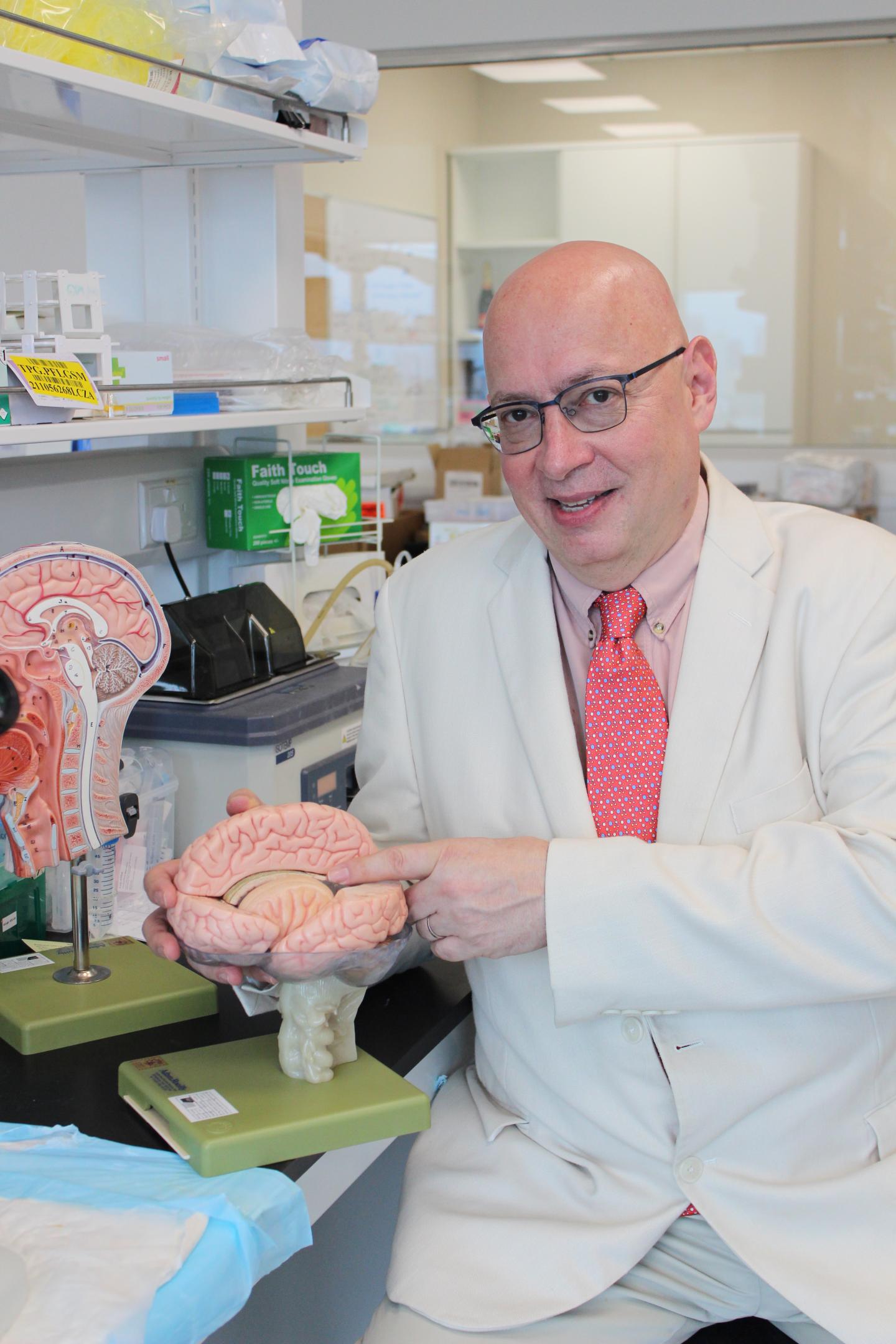
Credit: NTU Singapore
Researchers from Singapore and South Korea have uncovered new details of a brain pathway that can cause impulsive behaviours.
Using mice, the research team led by Professor George Augustine from Nanyang Technological University, Singapore (NTU Singapore), discovered that impulsive behaviour is triggered when the brain signalling chemical dopamine is passed to an unexpected area of their brain.
The full route that dopamine signals take to produce an impulsive action has not previously been understood. To trace its pathway, Prof Augustine and his team used mice that had a specific set of dopamine receptors (“D2 receptors”) genetically removed, effectively making their brains unable to detect dopamine signals.
The researchers artificially activated these receptors in specific parts of the brain, and the mice displayed impulsive behaviour when the signal was picked up by the amygdala – an almond-like structure deep in the brain.
What came next surprised the researchers: the amygdala’s dopamine receptors in turn passed on the ‘dopamine baton’ to neurons that connect it with the ‘bed nucleus of the stria terminalis’ or BNST, a brain area not previously known to be involved in this pathway.
The BNST is a complex brain structure that orchestrates emotional and behavioural responses to stress. Its position in the pathway for impulsive behaviour is a new potential target for pharmaceutical developers, which could in turn lead to new treatments to manage this and other neuropsychiatric disorders.
“We have shown for the first time that impulsive behaviour in mice is only triggered when dopamine signals are received and passed on to an unexpected part of the brain – from the amygdala to the BNST,” said Prof Augustine, a neuroscientist at NTU Singapore’s Lee Kong Chian School of Medicine (LKCMedicine).
“This research shows that the amygdala serves as a key staging post in the dopamine pathway that triggers impulsive behaviour and confirms the role dopamine plays in regulating impulsivity,” he said.
The research published in Proceedings of the National Academy of Sciences of the United States of America (PNAS), last November, was conducted by Professor Augustine in collaboration with Professor Ja-Hyun Baik and colleagues from the Korea University. Researchers from Korea Institute of Science and Technology, and Institute of Molecular and Cell Biology in Singapore under the Agency for Science, Technology and Research (A*STAR) were also part of the team.
Commenting on the discovery, Assoc Prof Ong Say How, Senior Consultant and Chief, Department of Developmental Psychiatry, Institute of Mental Health Singapore, who was not involved in the research, said:
“This new finding potentially could usher in novel pharmacological treatments that specifically target the Dopamine D2 receptors located in the central amygdala and the BNST region, bringing about reductions in impulsivity and impulsive behaviours commonly seen in wide-ranging psychiatric conditions and disorders including conduct, anti-social and impulsive-control disorders. Reductions in impulsivity also imply more fore-planning and less risk-taking behaviours that often lead to accidental injuries as well as social, financial and legal problems later in life.”
Prof Augustine plans to investigate further into the properties of the amygdala-to-BNST pathway, in order to pave the way for developing therapeutic strategies for controlling impulsive and compulsive behaviour.
“Through identification of a novel brain circuit for impulsivity we hope to encourage new research into treatment options for other neuropsychiatric disorders such as bipolar and attention deficit hyperactivity disorders (ADHD), and even depression,” added Prof Augustine.
###
Note to Editor
Paper titled “Dopamine D2 receptor-mediated circuit from the central amygdala to the bed nucleus of the stria terminalis regulates impulsive behaviour” published in PNAS on 6 November 2018.
Media contact:
Nur Amin Shah
Manager, Media Relations
Corporate Communications Office
Nanyang Technological University
Email: [email protected]
About Nanyang Technological University, Singapore
A research-intensive public university, Nanyang Technological University, Singapore (NTU Singapore) has 33,000 undergraduate and postgraduate students in the Engineering, Business, Science, Humanities, Arts, & Social Sciences, and Graduate colleges. It also has a medical school, the Lee Kong Chian School of Medicine, set up jointly with Imperial College London.
NTU is also home to world-class autonomous institutes – the National Institute of Education, S Rajaratnam School of International Studies, Earth Observatory of Singapore, and Singapore Centre for Environmental Life Sciences Engineering – and various leading research centres such as the Nanyang Environment & Water Research Institute (NEWRI) and Energy Research Institute @ NTU (ERI@N).
Ranked 12th in the world, NTU has been placed the world’s top young university for the past five years. The University’s main campus is frequently listed among the Top 15 most beautiful university campuses in the world and it has 57 Green Mark-certified (equivalent to LEED-certified) building projects comprising more than 230 buildings, of which 95% are certified Green Mark Platinum. Apart from its main campus, NTU also has a campus in Singapore’s healthcare district.
For more information, visit http://www.
Media Contact
Amin Shah
[email protected]
65-659-04714
Original Source
https:/