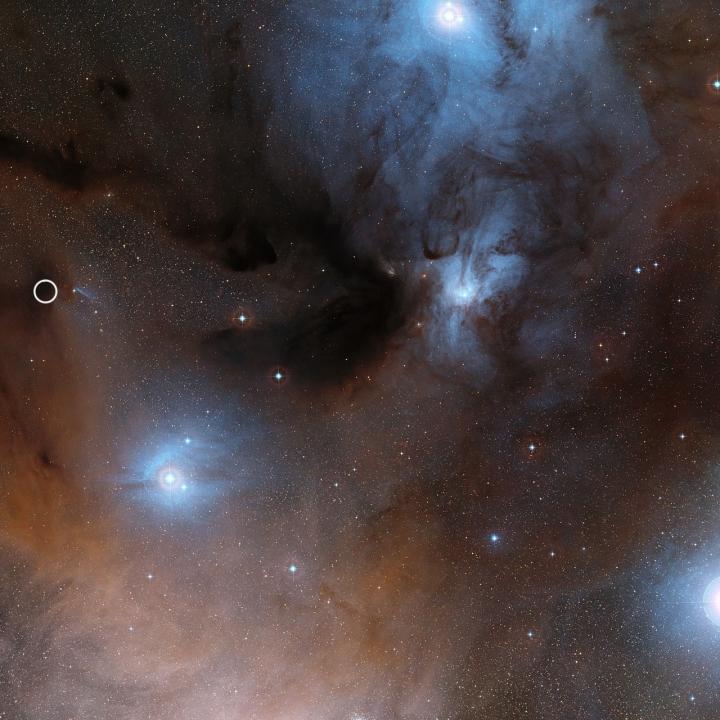
Credit: ESO/Digitized Sky Survey 2. Acknowledgement: Davide De Martin
An organic molecule detected in the material from which a star forms could shed light on how life emerged on Earth, according to new research led by Queen Mary University of London.
The researchers report the first ever detection of glycolonitrile (HOCH2CN), a pre-biotic molecule which existed before the emergence of life, in a solar-type protostar known as IRAS16293-2422 B.
This warm and dense region contains young stars at the earliest stage of their evolution surrounded by a cocoon of dust and gas – similar conditions to those when our Solar System formed.
Detecting pre-biotic molecules in solar-type protostars enhances our understanding of how the solar system formed as it indicates that planets created around the star could begin their existence with a supply of the chemical ingredients needed to make some form of life.
This finding, published in the journal Monthly Notices of the Royal Astronomical Society: Letters, is a significant step forward for pre-biotic astrochemistry since glycolonitrile is recognised as a key precursor towards the formation of adenine, one of the nucleobases that form both DNA and RNA in living organisms.
IRAS16293-2422 B is a well-studied protostar in the constellation of Ophiuchus, in a region of star formation known as rho Ophiuchi, about 450 light-years from Earth.
The research was also carried out with the Centro de Astrobiología in Spain, INAF-Osservatorio Astrofisico di Arcetri in Italy, the European Southern Observatory, and the Harvard-Smithsonian Center for Astrophysics in the USA.
Lead author Shaoshan Zeng, from Queen Mary University of London, said: “We have shown that this important pre-biotic molecule can be formed in the material from which stars and planets emerge, taking us a step closer to identifying the processes that may have led to the origin of life on Earth.”
The researchers used data from the Atacama Large Millimeter/submillimetre Array (ALMA) telescope in Chile to uncover evidence for the presence of glycolonitrile in the material from which the star is forming – known as the interstellar medium.
With the ALMA data, they were able to identify the chemical signatures of glycolonitrile and determine the conditions in which the molecule was found. They also followed this up by using chemical modelling to reproduce the observed data which allowed them to investigate the chemical processes that could help to understand the origin of this molecule.
This follows the earlier detection of methyl isocyanate in the same object by researchers from Queen Mary. Methyl isocyanate is what is known as an isomer of glycolonitrile – it is made up of the same atoms but in a slightly different arrangement, meaning it has different chemical properties.
###
The research was partially funded by Queen Mary University of London and the UK Science and Technology Facilities Council.
- Research paper: ‘First detection of the pre-biotic molecule glycolonitrile (HOCH2CN) in the interstellar medium’. S. Zeng, D. Quénard, I. Jiménez-Serra, J. Martín-Pintado, V. M. Rivilla, L. Testi and R. Martín-Doménech. MNRAS Letters.
- The research makes use of data from ALMA, a partnership of the European Organisation for Astronomical Research in the Southern Hemisphere (ESO), National Science Foundation (NSF), USA and National Institutes of Natural Sciences (Japan), together with the National Research Council (NRC) (Canada), the Ministry of Science and Technology (NSC) and Taiwan-American Occultation Survey (ASIAA, Taiwan), and the Korea Astronomy and Space Science Institute (KASI), in co-operation with the Republic of Chile.
- The UK’s access to ALMA is maintained thanks to the Science and Technology Facilities Council (STFC)’s subscription to ESO.
Media Contact
Rupert Marquand
[email protected]
44-020-788-23004
Related Journal Article
http://dx.