• HOME
  • NEWS
  • EXPLORE
    • CAREER
      • Companies
      • Jobs
    • EVENTS
    • iGEM
      • News
      • Team
    • PHOTOS
    • VIDEO
    • WIKI
  • BLOG
  • COMMUNITY
    • FACEBOOK
    • INSTAGRAM
    • TWITTER
Thursday, January 15, 2026
BIOENGINEER.ORG
No Result
View All Result
  • Login
  • HOME
  • NEWS
  • EXPLORE
    • CAREER
      • Companies
      • Jobs
        • Lecturer
        • PhD Studentship
        • Postdoc
        • Research Assistant
    • EVENTS
    • iGEM
      • News
      • Team
    • PHOTOS
    • VIDEO
    • WIKI
  • BLOG
  • COMMUNITY
    • FACEBOOK
    • INSTAGRAM
    • TWITTER
  • HOME
  • NEWS
  • EXPLORE
    • CAREER
      • Companies
      • Jobs
        • Lecturer
        • PhD Studentship
        • Postdoc
        • Research Assistant
    • EVENTS
    • iGEM
      • News
      • Team
    • PHOTOS
    • VIDEO
    • WIKI
  • BLOG
  • COMMUNITY
    • FACEBOOK
    • INSTAGRAM
    • TWITTER
No Result
View All Result
Bioengineer.org
No Result
View All Result
Home NEWS Science News Health

Researcher gets $2.85 million grant to discover ways to enhance bone strength

Bioengineer by Bioengineer
January 18, 2019
in Health
Reading Time: 2 mins read
0
IMAGE
Share on FacebookShare on TwitterShare on LinkedinShare on RedditShare on Telegram

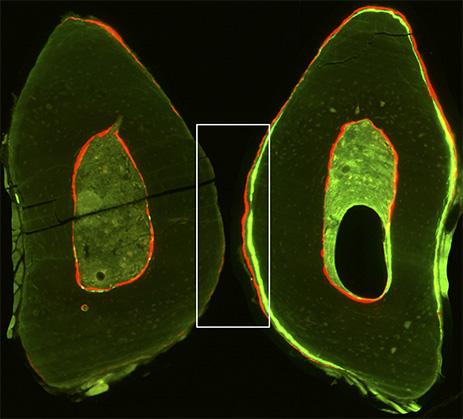
IMAGE

Credit: School of Health and Human Sciences


INDIANAPOLIS — A $2.85 million National Institute of Arthritis and Musculoskeletal and Skin Diseases-funded study at IUPUI will advance understanding of how bone cells sense and respond to mechanical force, one of the cues the skeleton relies on to regulate its strength.

Additionally, the study will inform the design of novel strategies to offset the negative effects of a commonly used drug, gabapentin. Chronic use of this drug, which is prescribed for conditions such as epilepsy and peripheral neuropathy, is associated with increased risk of breaking a bone and slowing down of the healing of broken bones.

The grant awarded to William Thompson, an assistant professor of physical therapy, is the first R01 grant received by a faculty member in the School of Health and Human Sciences at IUPUI since the school was restructured from the School of Physical Education and Tourism Management and the School of Health and Rehabilitation Sciences in fall 2018. R01 grants are the largest grants issued by the National Institutes of Health to individual investigators.

The skeleton is highly sensitive to mechanical force, where disuse or disease leads to bone loss, fractures and major morbidities, Thompson said.

Osteocytes are cells located deep within bones and represent the most abundant and mechanosensitive cells of the skeleton. These cells are optimally positioned to sense and respond to force and to direct the activity of other bone cells. But how force is directly transmitted from the bone tissue to the membrane of the embedded osteocyte cells is unknown, Thompson said.

“In previous studies, we found that the mineralized or hard tissue of bone connects to channels located on the cells within bone. These connections enable the bone cells to sense when there is force pushing on the bone, similar to a pull-chain style light switch. When you tug on the pull chain the switch opens and electricity flows to the filaments to “activate” the light,” he said. “In the newly funded work, we will determine the mechanisms by which these newly discovered connections influence bone formation in response to mechanical force, revealing methods to target these structures to enhance bone strength and prevent fractures.”

That cell surface sub-unit is the receptor for the drug gabapentin.

“This work will not only investigate the foundational mechanisms through which osteocytes sense force, but will also inform the design of strategies to offset the negative effects of gabapentin on bone that reduce bone strength,” Thompson said.

###

Media Contact
Rich Schneider
[email protected]
317-371-9288

Original Source

https://news.iu.edu/stories/2019/01/iupui/releases/17-study-grant-bone-strength-prevent-fractures-gabapentin-osteocyte.html?utm_source=www.iupui.edu/index.html&utm_medium=web&utm_campaign=framework&utm_term=ticker&utm_content=Researcher%2520gets%2520

Tags: Medicine/Health
Share12Tweet8Share2ShareShareShare2

Related Posts

New Genes and Factors Linked to Colorectal Cancer

January 15, 2026

Microbiota Drives T Cell Plasticity, Tumor Control

January 15, 2026

Exploring Callistemon Fruit Extracts’ Cancer-Fighting Abilities

January 15, 2026

Age-Related Tradeoffs in Mouse Disease Tolerance

January 15, 2026
Please login to join discussion

POPULAR NEWS

  • Enhancing Spiritual Care Education in Nursing Programs

    155 shares
    Share 62 Tweet 39
  • PTSD, Depression, Anxiety in Childhood Cancer Survivors, Parents

    147 shares
    Share 59 Tweet 37
  • Robotic Ureteral Reconstruction: A Novel Approach

    75 shares
    Share 30 Tweet 19
  • Study Reveals Lipid Accumulation in ME/CFS Cells

    53 shares
    Share 21 Tweet 13

About

We bring you the latest biotechnology news from best research centers and universities around the world. Check our website.

Follow us

Recent News

New Genes and Factors Linked to Colorectal Cancer

Microbiota Drives T Cell Plasticity, Tumor Control

Exploring Callistemon Fruit Extracts’ Cancer-Fighting Abilities

Subscribe to Blog via Email

Enter your email address to subscribe to this blog and receive notifications of new posts by email.

Join 71 other subscribers
  • Contact Us

Bioengineer.org © Copyright 2023 All Rights Reserved.

Welcome Back!

Login to your account below

Forgotten Password?

Retrieve your password

Please enter your username or email address to reset your password.

Log In
No Result
View All Result
  • Homepages
    • Home Page 1
    • Home Page 2
  • News
  • National
  • Business
  • Health
  • Lifestyle
  • Science

Bioengineer.org © Copyright 2023 All Rights Reserved.