

• HOME
  • NEWS
  • EXPLORE
    • CAREER
      • Companies
      • Jobs
    • EVENTS
    • iGEM
      • News
      • Team
    • PHOTOS
    • VIDEO
    • WIKI
  • BLOG
  • COMMUNITY
    • FACEBOOK
    • INSTAGRAM
    • TWITTER
Tuesday, January 13, 2026
BIOENGINEER.ORG
No Result
View All Result
  • Login
  • HOME
  • NEWS
  • EXPLORE
    • CAREER
      • Companies
      • Jobs
        • Lecturer
        • PhD Studentship
        • Postdoc
        • Research Assistant
    • EVENTS
    • iGEM
      • News
      • Team
    • PHOTOS
    • VIDEO
    • WIKI
  • BLOG
  • COMMUNITY
    • FACEBOOK
    • INSTAGRAM
    • TWITTER
  • HOME
  • NEWS
  • EXPLORE
    • CAREER
      • Companies
      • Jobs
        • Lecturer
        • PhD Studentship
        • Postdoc
        • Research Assistant
    • EVENTS
    • iGEM
      • News
      • Team
    • PHOTOS
    • VIDEO
    • WIKI
  • BLOG
  • COMMUNITY
    • FACEBOOK
    • INSTAGRAM
    • TWITTER
No Result
View All Result
Bioengineer.org
No Result
View All Result
Home NEWS Science News Health

The new green alternative for drug production

Bioengineer by Bioengineer
January 8, 2019
in Health
Reading Time: 2 mins read
0
IMAGE
Share on FacebookShare on TwitterShare on LinkedinShare on RedditShare on Telegram

IMAGE

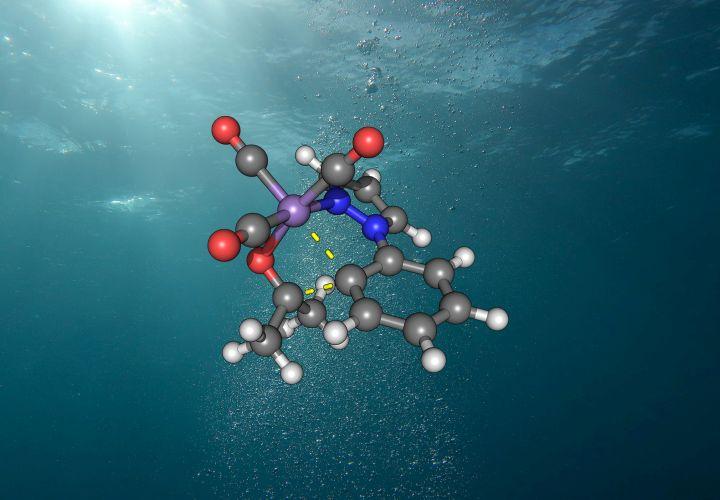
Credit: University of Göttingen


For the production of drugs, pesticides and smartphone displays, most of the processes are cost-intensive and generate a large amount of waste. Scientists at the University of Göttingen have now succeeded in developing a resource-saving “green” alternative. The results were published in Nature Catalysis.

The environmentally friendly strategy developed by Professor Lutz Ackermann and his team at the Institute of Organic and Biomolecular Chemistry at the University of Göttingen offers major advantages over existing methods. The naturally occurring non-toxic metal manganese is employed instead of noble transition metals such as palladium or platinum. Traditionally, organic solvents, which are highly flammable and toxic, were also used. In contrast, the new approach makes use of environmentally-friendly water. This is possible because a manganese-carbon bond is formed in the reaction. This bond is considerably more stable than comparable bonds between carbon and the highly reactive metals lithium or magnesium.

“The new process makes it possible to cleave a single strong carbon-carbon bond, of which organic compounds contain a large number, and convert it into the desired product,” says Ackermann. In order to achieve the results, experimental laboratory investigations were combined with computer-aided calculations. “This allowed us to gain detailed insight into the exact mode of action of the catalyst. And this in turn enables us to use the process to manufacture other materials.”

###

Original publication: Hui Wang, Isaac Choi, Torben Rogge, Nikolaos Kaplaneris and Lutz Ackermann, Versatile and robust C-C activation by chelation-assisted manganese catalysis. Nature Catalysis (2018). Doi: https://doi.org/10.1038/s41929-018-0187-1

Contact:

Professor Lutz Ackermann

Institute of Organic and Biomolecular Chemistry

University of Göttingen

Tammannstraße 2, 37077 Göttingen

Tel: +49 551 39-33201

Email: [email protected]

Web: http://www.ackermann.chemie.uni-goettingen.de

Media Contact
Melissa Sollich
[email protected]
49-551-392-6228

Original Source

http://www.uni-goettingen.de/en/3240.html?id=5294

Related Journal Article

http://dx.doi.org/10.1038/s41929-018-0187-1

Tags: BiochemistryBiomedical/Environmental/Chemical EngineeringBiotechnologyChemistry/Physics/Materials SciencesMedicine/HealthPharmaceutical ChemistryPharmaceutical Sciences
Share12Tweet8Share2ShareShareShare2

Related Posts

TREM2’s Role in Parkinson’s: Timing and Therapy

January 13, 2026

Evaluating AI Scribes: Frameworks and Outcomes

January 13, 2026

Survey Reveals Healthcare Providers’ Views on Enzyme Therapy

January 13, 2026

Nursing Competence in Hunan’s Traditional Medicine Hospitals

January 13, 2026
Please login to join discussion

POPULAR NEWS

  • Enhancing Spiritual Care Education in Nursing Programs

    154 shares
    Share 62 Tweet 39
  • PTSD, Depression, Anxiety in Childhood Cancer Survivors, Parents

    146 shares
    Share 58 Tweet 37
  • Robotic Ureteral Reconstruction: A Novel Approach

    72 shares
    Share 29 Tweet 18
  • Study Reveals Lipid Accumulation in ME/CFS Cells

    51 shares
    Share 20 Tweet 13

About

We bring you the latest biotechnology news from best research centers and universities around the world. Check our website.

Follow us

Recent News

Limnospira indica Boosts Plant Microbiota, Growth

TREM2’s Role in Parkinson’s: Timing and Therapy

CDR2 Gene Variant Enhances Lung Disease Resistance in Xiang Pigs

Subscribe to Blog via Email

Enter your email address to subscribe to this blog and receive notifications of new posts by email.

Join 71 other subscribers
  • Contact Us

Bioengineer.org © Copyright 2023 All Rights Reserved.

Welcome Back!

Login to your account below

Forgotten Password?

Retrieve your password

Please enter your username or email address to reset your password.

Log In
No Result
View All Result
  • Homepages
    • Home Page 1
    • Home Page 2
  • News
  • National
  • Business
  • Health
  • Lifestyle
  • Science

Bioengineer.org © Copyright 2023 All Rights Reserved.

