• HOME
  • NEWS
  • EXPLORE
    • CAREER
      • Companies
      • Jobs
    • EVENTS
    • iGEM
      • News
      • Team
    • PHOTOS
    • VIDEO
    • WIKI
  • BLOG
  • COMMUNITY
    • FACEBOOK
    • INSTAGRAM
    • TWITTER
Thursday, June 25, 2026
BIOENGINEER.ORG
No Result
View All Result
  • Login
  • HOME
  • NEWS
  • EXPLORE
    • CAREER
      • Companies
      • Jobs
        • Lecturer
        • PhD Studentship
        • Postdoc
        • Research Assistant
    • EVENTS
    • iGEM
      • News
      • Team
    • PHOTOS
    • VIDEO
    • WIKI
  • BLOG
  • COMMUNITY
    • FACEBOOK
    • INSTAGRAM
    • TWITTER
  • HOME
  • NEWS
  • EXPLORE
    • CAREER
      • Companies
      • Jobs
        • Lecturer
        • PhD Studentship
        • Postdoc
        • Research Assistant
    • EVENTS
    • iGEM
      • News
      • Team
    • PHOTOS
    • VIDEO
    • WIKI
  • BLOG
  • COMMUNITY
    • FACEBOOK
    • INSTAGRAM
    • TWITTER
No Result
View All Result
Bioengineer.org
No Result
View All Result
Home NEWS Science News Biology

The first case of a Portuguese beetle living exclusively in groundwater

Bioengineer by Bioengineer
January 8, 2019
in Biology
Reading Time: 2 mins read
0
IMAGE
Share on FacebookShare on TwitterShare on LinkedinShare on RedditShare on Telegram

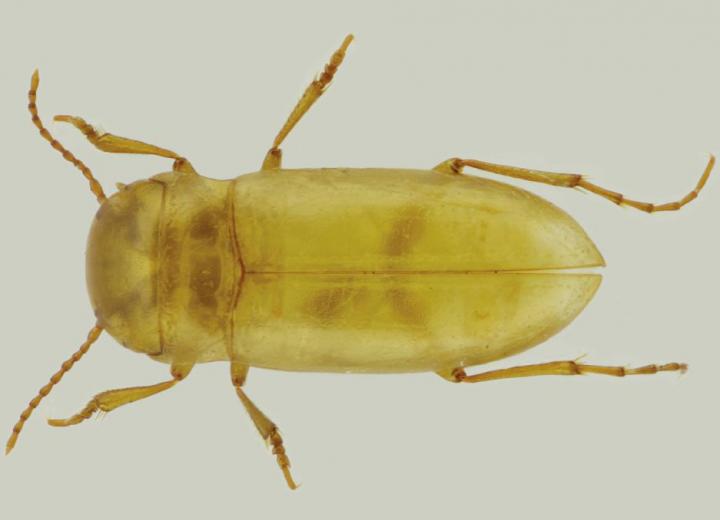
New to science, the species was named after Pluto, the ruler of the underworld in Greek mythology
IMAGE

Credit: Ignacio Ribera


A diving beetle demonstrating various adaptations to the life underground, including depigmentation and evolutionary loss of eyes, was discovered at the bottom of a clay pound in the cave Soprador do Carvalho, Portugal. The species turned out to be the very first in the whole order of beetles (Coleoptera) to be known exclusively from the underground waters of the country.

Despite not being able to find any other specimens during their study – save for the single female, the team of Dr Ignacio Ribera, Institute of Evolutionary Biology (Spain) and Prof Ana Sofia P. S. Reboleira, University of Copenhagen (Denmark) identified the beetle as new to science, thanks to its unambiguous morphology in combination with molecular data.

Aptly named Iberoporus pluto in reference to the ruler of the underworld in Greek mythology Pluto, the species was recently described in the open-access journal ZooKeys.

With a uniformly pale orange body measuring 2.8 mm in length and 1.1 mm in its widest part, the beetle is larger than the rest species known in its genus, and its appendages are longer and more slender. While blindness and depigmentation are clear adaptation to life away from sunlight, the elongated limbs and antennae reflect poor swimming abilities needed in a subterranean habitat. Going for 4 km in horizontal direction, Soprador do Carvalho is the largest in the Dueça cave system, located in the north-eastern part of the Sicó karst area in central Portugal. In recent years, the cave is being explored for tourism.

“The knowledge of the subterranean fauna from Portugal has significantly increased over the last decade, with the description of a high number of obligate subterranean species (tripling their number) and the establishment of new biogeographic patterns,” explain the authors of the study. “A high number of these species are stygobiont (i.e. confined to groundwater), mostly from wells in the north of the country, where evapotranspiration is higher.”

###

Original source:

Ribera I, Reboleira ASPS (2019) The first stygobiont species of Coleoptera from Portugal, with a molecular phylogeny of the Siettitia group of genera (Dytiscidae, Hydroporinae, Hydroporini, Siettitiina). ZooKeys 813: 21-38. https://doi.org/10.3897/zookeys.813.29765

Media Contact
Dr Ignacio Ribera
[email protected]

Related Journal Article

http://dx.doi.org/10.3897/zookeys.813.29765

Tags: BiodiversityBiologyEcology/EnvironmentEntomologyEvolutionPhysiologyPopulation BiologyZoology/Veterinary Science
Share12Tweet8Share2ShareShareShare2

Related Posts

Natural Hallucinogens: Evolution’s Ecological Tools, Not Mere Chemical Byproducts

June 25, 2026

This Famous Butterfly Revealed: Three Distinct Species Hidden in One

June 25, 2026

Scientists Attack Soybean Cyst Nematode by Starving Its Food Source

June 25, 2026

Decoding the Secret Code of a Crucial Immune Sensor

June 24, 2026
Please login to join discussion

POPULAR NEWS

  • Saying Goodbye to PGY-6: Pediatric Fellowship Realities

    103 shares
    Share 41 Tweet 26
  • Multi-Hospital Study Reveals Long Covid Burden Is Twice as High as Current Estimates

    92 shares
    Share 36 Tweet 23
  • Detection of EDCs in Breast Milk and Infant Urine Up to Six Months Highlights Early Exposure Risks

    77 shares
    Share 31 Tweet 19
  • New Drug Candidate Developed at McMaster Shows Potential for Treating Brain Cancer

    58 shares
    Share 23 Tweet 15

About

We bring you the latest biotechnology news from best research centers and universities around the world. Check our website.

Follow us

Recent News

Tracking Lanthanide-Labeled Microplastics in Plants

POSTECH Researchers Slash Cost of Reconstituted Cell-Free Systems by 95%

AI and Physics Collaborate to Design Advanced Hydrogen Storage Materials

Subscribe to Blog via Email

Enter your email address to subscribe to this blog and receive notifications of new posts by email.

Join 82 other subscribers
  • Contact Us

Bioengineer.org © Copyright 2023 All Rights Reserved.

Welcome Back!

Login to your account below

Forgotten Password?

Retrieve your password

Please enter your username or email address to reset your password.

Log In
No Result
View All Result
  • Homepages
    • Home Page 1
    • Home Page 2
  • News
  • National
  • Business
  • Health
  • Lifestyle
  • Science

Bioengineer.org © Copyright 2023 All Rights Reserved.