An analysis of thousands of children’s books published in the last 60 years suggests that, while a higher proportion of books now feature female protagonists, male protagonists remain overrepresented. Stella Lourenco of Emory University, U.S., and colleagues present these findings in the open-access journal PLOS ONE on December 15, 2021 and explore the factors associated with representation.
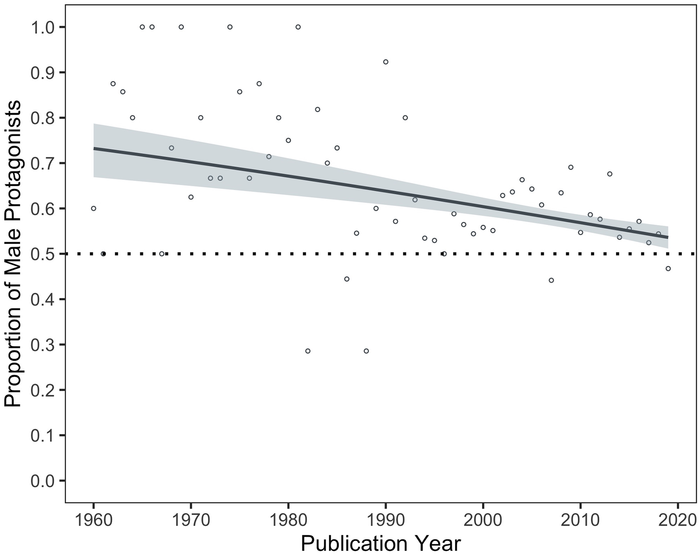
Credit: Image Credit: Casey et al., 2021, PLOS ONE, CC-BY 4.0 (https://creativecommons.org/licenses/by/4.0/)
An analysis of thousands of children’s books published in the last 60 years suggests that, while a higher proportion of books now feature female protagonists, male protagonists remain overrepresented. Stella Lourenco of Emory University, U.S., and colleagues present these findings in the open-access journal PLOS ONE on December 15, 2021 and explore the factors associated with representation.
A large body of evidence points to a bias in male versus female representation among protagonists in children’s books published prior to 2000. However, evidence is lacking as to whether that bias has persisted. In addition, it has been unclear which factors, such as author gender, may be associated with male versus female protagonists.
To help clarify whether gender bias still exists in American children’s literature, the authors conducted a statistical analysis of the frequency of male versus female protagonists in 3,280 books, aimed for audiences aged 0 to 16 years and published between 1960 and 2020. They selected books that can be purchased online in the United States, either as hard copies or as digital books, and primarily written in English (<1% written in multiple languages). To enable direct comparison of the rates of appearance of male versus female central characters, they focused on books featuring a single central protagonist, and also only included books for which the gender of the book author was identifiable and matched for all authors if there was more than one.
The analysis found that, since 1960, the proportion of female central protagonists has increased—and is still increasing—but books published since 2000 still feature a disproportionate number of male central protagonists.
The researchers also found associations between the ratio of male versus female protagonists and several relevant factors. Specifically, they found that gender bias is higher for fiction featuring non-human characters than for fiction with human characters. Meanwhile, non-fiction books have a greater degree of gender bias than fiction books, especially when the characters are human.
Books by male authors showed a decline in bias since 1960, but only in books written for younger audiences. Books by female authors also declined in bias over time, ultimately with more female than male central protagonists featured in books for older children and in books with human characters.
These findings could help guide efforts toward more equitable gender representation in children’s books, which could impact child development and societal attitudes. Future research could build on this work by considering reading rates of specific books, as well as books with non-binary characters.
The authors add: “Although male protagonists remain overrepresented in books written for children (even post-2000), the present study found that the male-to-female ratio of protagonists varied according to author gender, age of the target audience, character type, and book genre. In other words, some authors and types of books were more equitable in the gender representation of protagonists in children’s books.”
Journal
PLoS ONE
DOI
10.1371/journal.pone.0260566
Method of Research
Observational study
Subject of Research
Not applicable
Article Title
Sixty years of gender representation in children’s books: Conditions associated with overrepresentation of male versus female protagonists
Article Publication Date
15-Dec-2021
COI Statement
The authors have declared that no competing interests exist.