• HOME
  • NEWS
  • EXPLORE
    • CAREER
      • Companies
      • Jobs
    • EVENTS
    • iGEM
      • News
      • Team
    • PHOTOS
    • VIDEO
    • WIKI
  • BLOG
  • COMMUNITY
    • FACEBOOK
    • INSTAGRAM
    • TWITTER
Tuesday, July 14, 2026
BIOENGINEER.ORG
No Result
View All Result
  • Login
  • HOME
  • NEWS
  • EXPLORE
    • CAREER
      • Companies
      • Jobs
        • Lecturer
        • PhD Studentship
        • Postdoc
        • Research Assistant
    • EVENTS
    • iGEM
      • News
      • Team
    • PHOTOS
    • VIDEO
    • WIKI
  • BLOG
  • COMMUNITY
    • FACEBOOK
    • INSTAGRAM
    • TWITTER
  • HOME
  • NEWS
  • EXPLORE
    • CAREER
      • Companies
      • Jobs
        • Lecturer
        • PhD Studentship
        • Postdoc
        • Research Assistant
    • EVENTS
    • iGEM
      • News
      • Team
    • PHOTOS
    • VIDEO
    • WIKI
  • BLOG
  • COMMUNITY
    • FACEBOOK
    • INSTAGRAM
    • TWITTER
No Result
View All Result
Bioengineer.org
No Result
View All Result
Home NEWS Science News Biology

5G wireless may lead to inaccurate weather forecasts

Bioengineer by Bioengineer
September 24, 2020
in Biology
Reading Time: 2 mins read
0
IMAGE
Share on FacebookShare on TwitterShare on LinkedinShare on RedditShare on Telegram

Rutgers study is the first to model impact of 5G radiation “leakage” on forecasting
IMAGE

Credit: Mohammad Yousefvand

Upcoming 5G wireless networks that will provide faster cell phone service may lead to inaccurate weather forecasts, according to a Rutgers study on a controversial issue that has created anxiety among meteorologists.

“Our study – the first of its kind that quantifies the effect of 5G on weather prediction error – suggests that there is an impact on the accuracy of weather forecasts,” said senior author Narayan B. Mandayam, a Distinguished Professor at the Wireless Information Network Laboratory (WINLAB), who also chairs the Department of Electrical and Computer Engineering in the School of Engineering at Rutgers University-New Brunswick.

The peer-reviewed study was published this month at the 2020 IEEE 5G World Forum, sponsored by the Institute of Electrical and Electronics Engineers. Fifth-generation cellular wireless technology (5G) stems from new, smarter ways to use the higher (mmWave) frequencies for mobile communications. This technology will revolutionize internet communication and telecommunication. It has faster connection times, increases the number of devices that can connect to a network and will be more widely available over the next two to three years, according to IEEE.

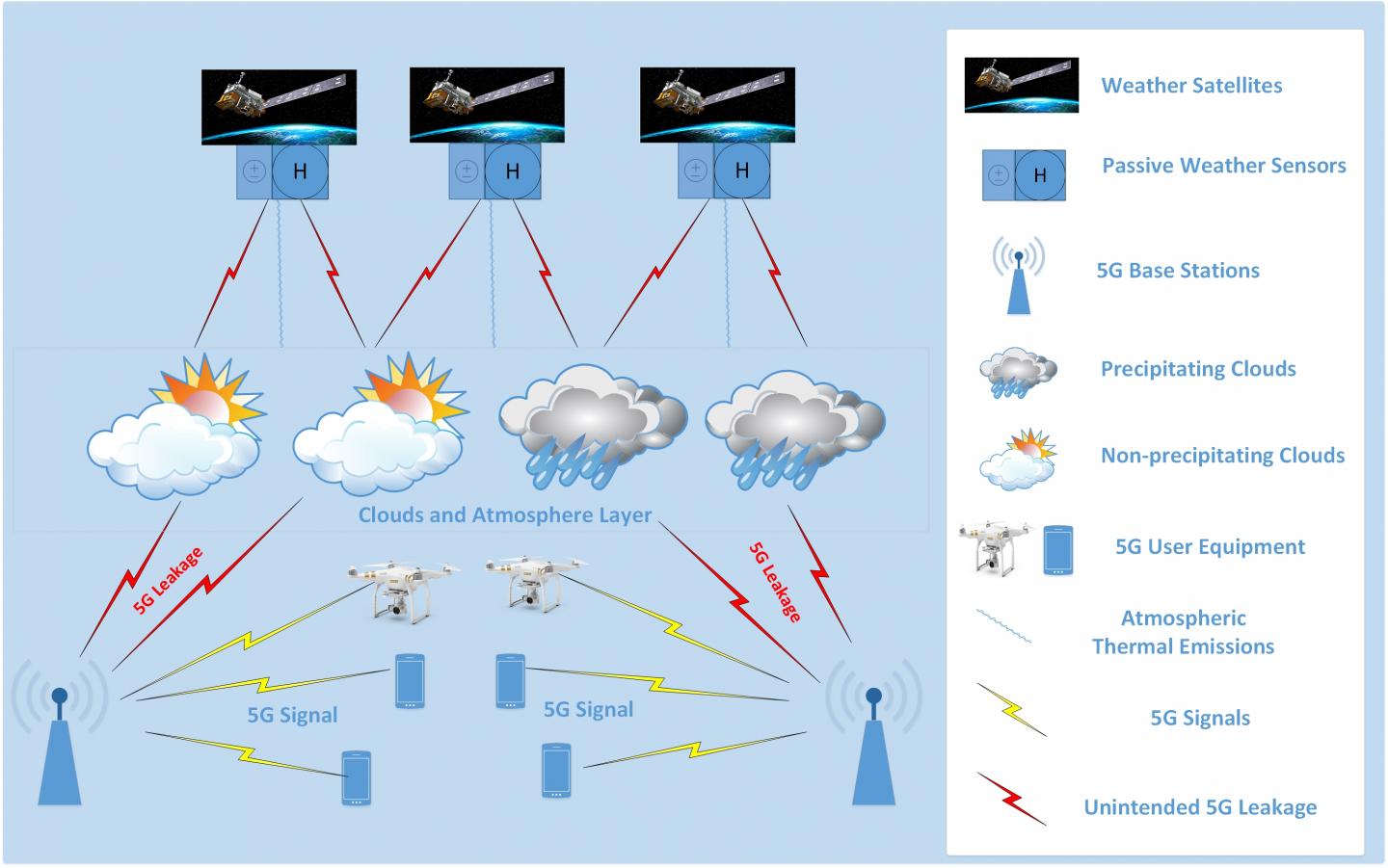
The Rutgers study used computer modeling to examine the impact of 5G “leakage” – unintended radiation from a transmitter into an adjacent frequency band or channel – on forecasting the deadly 2008 Super Tuesday Tornado Outbreak in the South and Midwest.

The signals from the 5G frequency bands potentially could leak into the band used by weather sensors on satellites that measure the amount of water vapor in the atmosphere and affect weather forecasting and predictions. Meteorologists rely on satellites for the data needed to forecast weather.

Based on modeling, 5G leakage power of -15 to -20 decibel Watts (a decibel Watt is a unit of power that describes the strength of radio waves) affected the accuracy of forecasting of precipitation (by up to 0.9 millimeters) during the tornado outbreak and temperatures near ground level (by up to 2.34 degrees Fahrenheit).

“It can be argued that the magnitude of error found in our study is insignificant or significant, depending on whether you represent the 5G community or the meteorological community, respectively,” Mandayam said. “One of our takeaways is that if we want leakage to be at levels preferred by the 5G community, we need to work on more detailed models as well as antenna technology, dynamic reallocation of spectrum resources and improved weather forecasting algorithms that can take into account 5G leakage.”

The lead author is Mohammad Yousefvand, a Rutgers electrical engineering doctoral student. Co-authors include Professor Chung-Tse Michael Wu in the Department of Electrical and Computer Engineering, Professor Ruo-Qian (Roger) Wang in the Department of Civil and Environmental Engineering and Joseph Brodie, director of atmospheric research in the Rutgers Center for Ocean Observing Leadership.

###

Media Contact
Todd Bates
[email protected]

Original Source

https://www.rutgers.edu/news/5g-wireless-may-lead-inaccurate-weather-forecasts

Tags: Climate ChangeEarth ScienceEcology/EnvironmentHydrology/Water ResourcesMarine/Freshwater BiologyOceanographyTemperature-Dependent PhenomenaWeather/Storms
Share13Tweet8Share2ShareShareShare2

Related Posts

Enhancing bacteria to accelerate environmental cleanup processes

Enhancing bacteria to accelerate environmental cleanup processes

July 14, 2026
New Insights into Immune Checkpoints’ Role in Controlling Inflammation

New Insights into Immune Checkpoints’ Role in Controlling Inflammation

July 14, 2026

UMA Scientists Enhance Morphine’s Pain-Relief Effectiveness

July 14, 2026

Adolescent Brain Responses to Faces Could Forecast Social Development

July 13, 2026
Please login to join discussion

POPULAR NEWS

  • New Drug Candidate Developed at McMaster Shows Potential for Treating Brain Cancer

    58 shares
    Share 23 Tweet 15
  • Detection of EDCs in Breast Milk and Infant Urine Up to Six Months Highlights Early Exposure Risks

    77 shares
    Share 31 Tweet 19
  • Experimental Therapy Simultaneously Destroys Prostate Tumor Cells and Reactivates Antitumor Immunity

    46 shares
    Share 18 Tweet 12
  • 高齢者の骨粗鬆症治療の持続性比較

    51 shares
    Share 20 Tweet 13

About

We bring you the latest biotechnology news from best research centers and universities around the world. Check our website.

Follow us

Recent News

Deep Learning Detects REM Sleep Disorder and Parkinson’s Early via fMRI

Durable Silver Plating Developed for Extended Use

Engineered Bifidobacterium offers promise for oral cancer vaccine delivery

Subscribe to Blog via Email

Enter your email address to subscribe to this blog and receive notifications of new posts by email.

Join 85 other subscribers
  • Contact Us

Bioengineer.org © Copyright 2023 All Rights Reserved.

Welcome Back!

Login to your account below

Forgotten Password?

Retrieve your password

Please enter your username or email address to reset your password.

Log In
No Result
View All Result
  • Homepages
    • Home Page 1
    • Home Page 2
  • News
  • National
  • Business
  • Health
  • Lifestyle
  • Science

Bioengineer.org © Copyright 2023 All Rights Reserved.