Credit: Schulich Medicine & Dentistry, Western University
New technology developed at Western University is providing an improved way for radiation oncologists to deliver treatment to women with gynaecological cancers, including vaginal, cervical and uterine cancer.
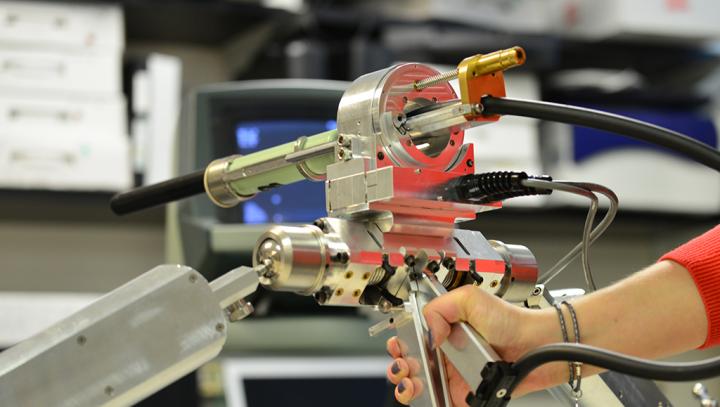
By transforming a conventional ultrasound probe, already found in most clinics, the technology can provide a 360-degree, three-dimensional view of surgical tools and surrounding tissue and organs. It provides a clearer and more accurate picture in the operating room for clinicians who need to precisely insert needles into the tumour for a procedure called interstitial brachytherapy, a type of targeted radiation therapy that uses intense energy to kill cancer cells in the tumour from the inside out.
“The problem with the procedure the way it is now is that doctors don’t have a great way of seeing where those needles are going while they are placing them,” said Jessica Rodgers, a PhD Candidate at Western’s Schulich School of Medicine & Dentistry and lead author on a feasibility study of the technology. “If they can’t place the needles precisely, they may not be placed optimally for giving treatment and may be impinging on organs that are nearby that you don’t want to over irradiate.”
The study’s principal investigator, Aaron Fenster, PhD, is a professor at Schulich Medicine & Dentistry and a Scientist at Robarts Research Institute who has been developing 3D ultrasound technology for over three decades. He says this technology has potential to be practice-changing.
“The short term goal is to reduce complication rates – ensure that the needles don’t go into the bladder, or the rectum, which creates complications, and in addition, something we are hypothesizing, is if the needles are placed correctly they will provide an improved dose pattern distribution to the tumour and surrounding tissue,” he said.
Before the introduction of this technology, clinicians would use pre-operative imaging to place the needles using ‘feel’ while a patient is under anesthesia. They would then check the needle placement afterward with CT once the patient is awake. In partnership with Lawson Health Research Institute, the new technology was tested by radiation oncologists on six patients at London Health Sciences Centre (LHSC), with very promising results.
“This technology provides the operator live feedback and visualization of the needle placement in real time, and allows for needles to be adjusted while the patient is still asleep,” said Dr. Vikram Velker a professor at Schulich Medicine & Dentistry, Lawson Health Research Institute researcher and radiation oncologist at LHSC.
Dr. David D’Souza, also an LHSC radiation oncologist who tested the technology says it is like having a backup camera on your car.
“Interstitial needles allow a radioactive source to go directly into the tumour tissue resulting in a better dose of radiation, which is hoped to translate into better chances of eradicating the cancer. The 360 3D ultrasound is an additional tool to guide the placement of the needles in an accurate manner,” said Dr. D’Souza who is also a professor at Schulich Medicine & Dentistry and Lawson researcher.
One of the other benefits of using ultrasound technology is the accessibility and wide application globally in places where resources are more scarce.
“Access to high-end imaging systems like CT and MRI to diagnose and treat diseases is difficult in some places in the world. So for that reason, we’ve been focusing on ultrasound which is widely available everywhere in the world and can be used for a variety of applications,” said Fenster.
###
The feasibility study was published this week in the Journal of Medical Imaging. https:/
Video of the researchers demonstrating the technology can be found here: https:/
MEDIA CONTACT: Crystal Mackay, Media Relations Officer, Schulich School of Medicine & Dentistry, Western University, t. 519.661.2111 ext. 80387, c. 519.933.5944, [email protected] @CrystalMackay
ABOUT WESTERN
Western University delivers an academic experience second to none. Since 1878, The Western Experience has combined academic excellence with life-long opportunities for intellectual, social and cultural growth in order to better serve our communities. Our research excellence expands knowledge and drives discovery with real-world application. Western attracts individuals with a broad worldview, seeking to study, influence and lead in the international community.
ABOUT THE SCHULICH SCHOOL OF MEDICINE & DENTISTRY
The Schulich School of Medicine & Dentistry at Western University is one of Canada’s preeminent medical and dental schools. Established in 1881, it was one of the founding schools of Western University and is known for being the birthplace of family medicine in Canada. For more than 130 years, the School has demonstrated a commitment to academic excellence and a passion for scientific discovery.
Media Contact
Crystal Mackay
[email protected]
Original Source
https:/
Related Journal Article
http://dx.