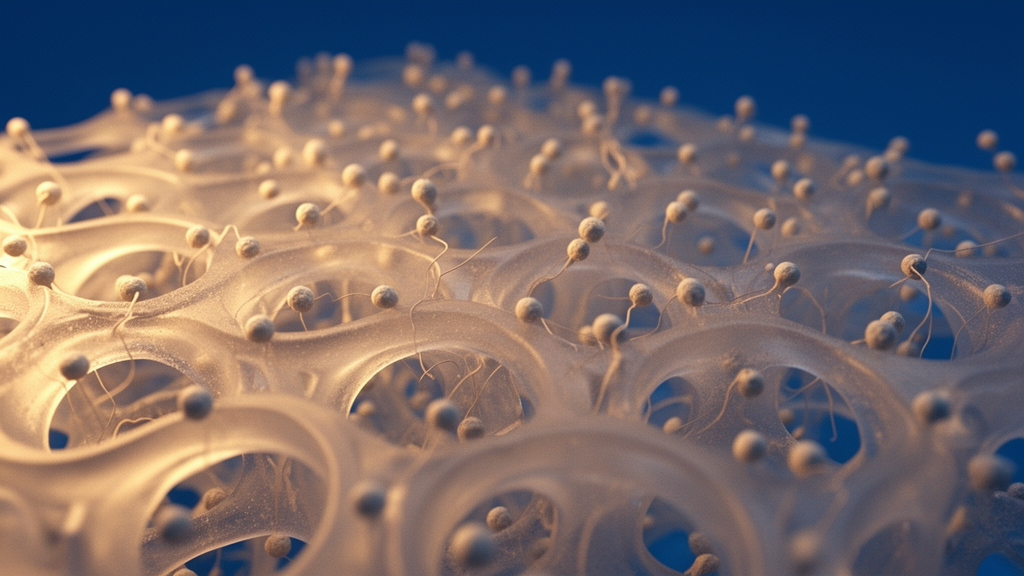
Researchers have successfully fabricated multifunctional composite scaffolds with a complex gyroid architecture using liquid crystal display three-dimensional printing, combining a polylactic acid matrix with poly(vinylidene fluoride), hydroxyapatite, and 45S5 bioactive glass for potential bone tissue engineering applications. Published in the journal Biomedical Materials and Devices, the investigation demonstrates that integrating bioactive ceramic particles and an electroactive polymer directly into a photocurable resin produces structurally sound scaffolds while preserving printability and functional integrity. Across a series of rigorous characterization procedures, the research team identified that the polylactic acid framework remained predominantly amorphous following ultraviolet-induced photocuring, while the embedded poly(vinylidene fluoride) achieved an electroactive beta-phase content approaching fifty percent. These structural and chemical characteristics suggest that the multifunctional material platform can mimic the mechanical and bioelectrical environments typical of natural bone tissue. However, the study serves as an initial material screening and benchmarking investigation, emphasizing physical and chemical characterization prior to in vitro cell studies or clinical trials.
The development of advanced biomaterials for bone regeneration requires synthetic constructs capable of providing adequate mechanical support while simultaneously presenting bioactive surfaces that promote cell adhesion, proliferation, and osteogenic differentiation. Although polylactic acid represents one of the most frequently utilized biodegradable polymers across biomedical engineering and additive manufacturing, neat polylactic acid suffers from intrinsic shortcomings, including limited biological activity, weak intrinsic mechanical properties, and a complete absence of electroactive behavior. To address these functional limitations, researchers have investigated the incorporation of inorganic fillers and functional polymers into printable resin systems. Combining ceramic agents that mimic the mineral phase of natural bone with piezoelectric polymers capable of generating electrical microcurrents under mechanical stress offers an innovative strategy to engineer dynamic tissue scaffolds.
To construct the composite formulations, the authors synthesized custom bioceramic particles using precise wet chemical and thermal routes before preparing the multi-component printing resin. Hydroxyapatite powder, exhibiting an average particle size of 10.23 micrometers, was synthesized by wet chemical precipitation through the dropwise addition of orthophosphoric acid into a calcium hydroxide suspension under controlled temperature and pH conditions, followed by aging for twenty-four hours and subsequent calcination at 1100 degrees Celsius. In parallel, 45S5 bioactive glass, with an average particle diameter of 11.60 micrometers, was produced via a high-temperature melting process involving sodium carbonate, dibasic sodium phosphate, calcium carbonate, and silica, followed by thermal shock quenching and thermal processing at 1400 degrees Celsius for four hours to yield the targeted oxide composition of 45 weight percent silicon dioxide, 24.5 weight percent sodium oxide, 24.5 weight percent calcium oxide, and 6 weight percent phosphorus pentoxide.
The preparation of the photocurable composite resin required precise dissolution and blending procedures to guarantee uniform dispersion and prevent premature filler sedimentation within the liquid matrix. Poly(vinylidene fluoride) powder was initially dissolved in N,N-dimethylformamide at a ten weight percent concentration under continuous stirring at 65 degrees Celsius for ninety minutes to generate a clear polymer solution. This solution was subsequently incorporated dropwise into a commercial transparent polylactic acid photocurable resin pre-loaded with hydroxyapatite and 45S5 bioactive glass powders maintained at 40 degrees Celsius. The final experimental mixture comprised 97 weight percent polylactic acid resin, 1.5 weight percent poly(vinylidene fluoride), 1.0 weight percent hydroxyapatite, and 0.5 weight percent bioactive glass. Three-dimensional printing was executed on an Anycubic Photon Mono liquid crystal display device using a computer-designed seven-millimeter cubic gyroid geometry featuring a five-millimeter unit cell size and an engineered porosity of 67.1 percent, operating with a layer thickness of 0.050 millimeters and exposure times of 40 seconds for base layers and 3.5 seconds for subsequent layers.
Real-time photopolymerization kinetics evaluated via in situ Fourier transform infrared spectroscopy revealed crucial insights into the chemical crosslinking process under 405-nanometer ultraviolet irradiation. Because polylactic acid itself lacks photoreactive groups, the photopolymerization reaction proceeded exclusively through radical-mediated conversion of acrylate double bonds within the resin formulation, as monitored by tracking the decrease in the carbon-carbon stretching peak at 1636 inverse centimeters relative to the stable carbonyl reference peak at 1720 inverse centimeters. Surprisingly, the presence of poly(vinylidene fluoride) increased the final conversion of the acrylate double bonds by approximately sixty to seventy percent compared to the neat resin, reaching saturation within approximately thirty seconds of light exposure. The research team attributed this enhanced curing efficiency to altered local molecular mobility and light scattering induced by dispersed polymer domains. Crucially, the absence of curing inhibition verified that residual N,N-dimethylformamide from the dissolution stage did not disrupt radical polymer crosslinking after thermal stirring, isopropyl alcohol washing, and post-cure chamber treatment.
Morphological and crystallographic evaluations demonstrated effective incorporation and structural distribution of the individual filler materials across the three-dimensional matrix. X-ray diffraction patterns of printed neat polylactic acid displayed a broad characteristic hump between 14 and 24 degrees two-theta with a primary peak centered at 19.9 degrees, confirming the predominantly amorphous structure of the polymer network following additive manufacturing. In contrast, composite specimens exhibited distinct crystalline reflections corresponding to poly(vinylidene fluoride) at 20.4 and 36.1 degrees, alongside well-defined hydroxyapatite diffraction peaks at 25.9, 31.92, 32.9, 46.7, and 49.5 degrees. Scanning electron microscopy showed that while neat specimens exhibited granular layer textures with an average deposition thickness of 17.45 micrometers, composite scaffolds displayed localized phase separation and poly(vinylidene fluoride)-rich domains driven by strong dipole-dipole interactions between polar carbon-fluorine bonds. Energy-dispersive X-ray spectroscopy confirmed the presence of fluorine from poly(vinylidene fluoride) and calcium and phosphorus from hydroxyapatite throughout the bulk matrix, whereas low bioactive glass loading limited elemental detection.
Spectroscopic quantification of polymer phases proved especially critical for confirming the electroactive potential of the printed scaffolds. Fourier transform infrared analysis revealed notable changes in band intensities across the 3100 to 3600 inverse centimeter region associated with resin hydroxyl groups, reflecting substantial intermolecular interactions between the polylactic acid matrix and incorporated fillers, including dipole interactions between polylactic acid carbonyls and fluorinated polymer chains. Utilizing absorption bands at 763 and 840 inverse centimeters within the Beer-Lambert mathematical framework, the researchers quantified the piezoelectric beta-phase fraction of poly(vinylidene fluoride). In binary polylactic acid blends containing only poly(vinylidene fluoride), the beta-phase fraction reached 48.13 percent, whereas in the quaternary composite incorporating both hydroxyapatite and bioactive glass, the electroactive beta-phase content rose to 49.86 percent.
Rheological characterization using parallel-plate rotational shear measurements indicated that the addition of solid and polymeric fillers fundamentally altered the fluid dynamics of the uncured resin. Unfilled polylactic acid resin displayed high initial viscosity at low shear rates, demonstrating classic pseudoplastic and shear-thinning behavior arising from extensive polymer chain entanglement. Upon introducing the multi-component filler package, the formulations exhibited a noticeable transition toward near-Newtonian viscosity, maintaining stable flow across varying shear rates. Well-dispersed ceramic particles and polymer aggregates appeared to disrupt intermolecular chain interactions and form transient networks that aligned smoothly along the shear flow field. In practical manufacturing terms, this rheological stabilization substantially enhanced layer recoating performance inside the liquid crystal display vat, allowing fresh resin layers to redistribute rapidly and uniformly across preceding cured surfaces. Consequently, the improved resin leveling minimized layer defects, suppressed excessive staircasing distortions, and ensured superior geometric fidelity across complex gyroid internal channels.
Differential scanning calorimetry provided complementary data regarding the thermal stability and crystallization dynamics of the fabricated specimens during temperature cycling from minus 50 to 220 degrees Celsius. Integration of normalized heat flow thermograms from the second heating cycle revealed a minor downward shift in the glass transition temperature, moving from 57.8 degrees Celsius in neat polylactic acid down to 57.4 degrees in bioactive glass blends and 56.5 degrees Celsius in the fully formulated quaternary composite. This moderate reduction in glass transition reflected the plasticizing contribution of low-transition fillers alongside restricted chain mobility near particle interfaces. Concurrently, the overall degree of polymer crystallinity decreased dramatically from approximately 29 percent in neat printed specimens to approximately 12 percent in the four-component composite scaffolds. Because 45S5 bioactive glass maintained an amorphous nature and hydroxyapatite did not exhibit melting transitions within the evaluated temperature window, these inorganic phases effectively hindered matrix crystallization during rapid thermal processing.
Mechanical compression tests conducted on cylindrical specimens in accordance with standard ASTM D695-23 parameters highlighted the structural performance and trade-offs of the composite system. The maximum compressive strength experienced a minor reduction of 5.46 percent, declining from 166.6 megapascals in neat polylactic acid to 157.5 megapascals in the quaternary composite, while Young’s modulus shifted from 1.75 gigapascals to 0.75 gigapascals and yield stress dropped from 40 to 16 megapascals due to microscale stress-concentration sites around embedded particles. Surface mechanical testing via Shore A durometry demonstrated statistically significant hardness variations across formulations, with one-way analysis of variance yielding a p-value of 0.00374, driven by the exceptional rigidity of bioactive glass compared to softer fluoropolymer domains. The authors noted that future investigations must establish biological safety through cytotoxicity assays, cell adhesion studies, and long-term bioresorption tracking under standardized physiological conditions.
Subject of Research: 3D printing and material characterization of multifunctional polylactic acid bone tissue scaffolds
Article Title: 3D-Printed Multifunctional PLA Scaffolds with Polyvinylidene Fluoride, Hydroxyapatite, and 45S5 Bioactive Glass
Article References: Pasqual, J. A. R., da Silva, A. P. B., Guerra, N. B., & Schmitt, C. C. (2026). 3D-Printed Multifunctional PLA Scaffolds with Polyvinylidene Fluoride, Hydroxyapatite, and 45S5 Bioactive Glass. Biomedical Materials & Devices. https://doi.org/10.1007/s44174-026-00753-7
Image Credits: AI Generated
DOI: 10.1007/s44174-026-00753-7
Keywords: 3D printing, liquid crystal display printing, polylactic acid, polyvinylidene fluoride, hydroxyapatite, 45S5 bioactive glass, gyroid scaffold, bone tissue engineering, piezoelectricity, beta-phase PVDF, photopolymerization kinetics, bioceramics, rheology, compressive strength, Shore A hardness, differential scanning calorimetry, X-ray diffraction, biomaterials
News Source: Denise Maddox. (November 23, 2026). 3D-Printed Gyroid PLA Scaffolds Achieve Electroactive Beta-Phase for Bone Regeneration. Scienmag.