Genoa/Pisa (Italy), 30 August 2022 – Artificial pneumatic muscles consisting of 3D-printed structures that can extend and contract as required: this is the innovative design of the GRACE actuators devised by researchers from the Istituto Italiano di Tecnologia (IIT, Italian Institute of Technology) in Genoa and the Scuola Superiore Sant’Anna (SSSA, Sant’Anna School of Advanced Studies) in Pisa. The work has been described in Science Robotics and the researchers showcased the actuators’ versatility in an initial demonstration, a pneumatic hand comprising 18 different GRACEs, manufactured in a single printing process.
Credit: IIT-Istituto Italiano di Tecnologia
Genoa/Pisa (Italy), 30 August 2022 – Artificial pneumatic muscles consisting of 3D-printed structures that can extend and contract as required: this is the innovative design of the GRACE actuators devised by researchers from the Istituto Italiano di Tecnologia (IIT, Italian Institute of Technology) in Genoa and the Scuola Superiore Sant’Anna (SSSA, Sant’Anna School of Advanced Studies) in Pisa. The work has been described in Science Robotics and the researchers showcased the actuators’ versatility in an initial demonstration, a pneumatic hand comprising 18 different GRACEs, manufactured in a single printing process.
The creation of artificial muscles is a very ambitious goal in the field of robotics, because in nature, muscle tissue has complex characteristics that permit highly versatile movements, from rapid, powerful contractions to small and precise changes in body shape, such as those of human facial expressions. Although individual muscle fibres can only contract, it is their specific arrangement in complex muscle architectures that enables articulate deformations such as bending, twisting and antagonistic movements.
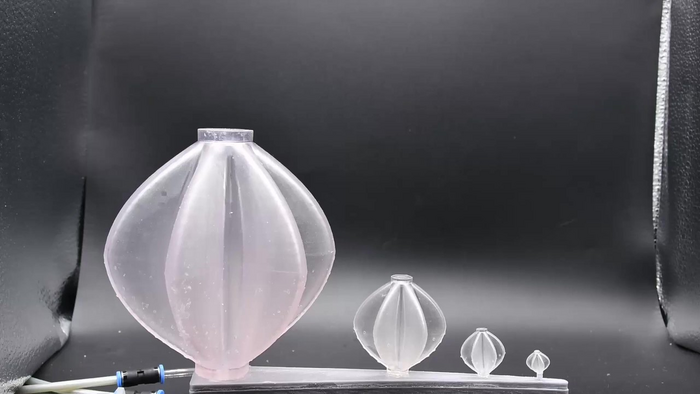
The research team worked on this problem by starting from the individual pneumatic actuators. Each actuator can expand, extend and contract simply by means of its geometric shape, resembling a spindle with pleats, comprising a single unit that can be 3D printed and manufactured using different materials and in different sizes. Various GRACEs – an acronym for GeometRy-based Actuators able to Contract and Elongate – can be printed ready assembled in complex architectures, in order to provide the types of movement required.
“Their size is limited purely by the manufacturing technology used,” commented Corrado De Pascali, first author of the study and a PhD student at IIT’s Bioinspired Soft Robotics laboratory in Genoa and at SSSA’s BioRobotics Institute in Pisa. “They can be built in different sizes, and we can vary their performance, both in terms of deformation and strength, and manufacture them using various materials and technology, even already built into the structures to be fabricated”.
The researchers demonstrated the GRACEs’ characteristics by printing a pneumatic hand, using a commercial 3D printer, in a single printing process. The material used was a soft resin and it comprises 18 GRACEs of different sizes and shapes, so that with a pressure of a few tenths of a bar it is possible to bend the fingers, twist the palm and rotate the wrist. The hand weighs about 100 grams and is comparable in size to a human hand.
The actuators are designed so that they can support over 1,000 times their weight depending on the material used to make them. In fact, the forces generated and the pressures required can be increased or reduced by using materials with higher or lower rigidity, as well as by modifying the thickness of the membrane making up these actuators while maintaining the same contraction and extension performance.
GRACE actuators have characteristics ideal for application in various robotic solutions, using simple techniques at very low costs. Their ease of manufacture also makes them replicable outside research laboratories, such as in the fab labs available to makers.
These results were obtained as part of the studies on animal musculature envisaged by the European FET (Future and Emerging Technologies) project Proboscis coordinated by Lucia Beccai, and as part of the research on robotics inspired by living organisms performed by IIT’s Bioinspired Soft Robotics coordinated by Barbara Mazzolai in Genoa, and in collaboration with SSSA’s BioRobotics Institute in Pisa.
Journal
Science Robotics
DOI
10.1126/scirobotics.abn4155
Method of Research
Experimental study
Subject of Research
Not applicable
Article Title
3D-printed biomimetic artificial muscles using soft actuators that contract and elongate
Article Publication Date
27-Jul-2022