• HOME
  • NEWS
  • EXPLORE
    • CAREER
      • Companies
      • Jobs
    • EVENTS
    • iGEM
      • News
      • Team
    • PHOTOS
    • VIDEO
    • WIKI
  • BLOG
  • COMMUNITY
    • FACEBOOK
    • INSTAGRAM
    • TWITTER
Monday, May 18, 2026
BIOENGINEER.ORG
No Result
View All Result
  • Login
  • HOME
  • NEWS
  • EXPLORE
    • CAREER
      • Companies
      • Jobs
        • Lecturer
        • PhD Studentship
        • Postdoc
        • Research Assistant
    • EVENTS
    • iGEM
      • News
      • Team
    • PHOTOS
    • VIDEO
    • WIKI
  • BLOG
  • COMMUNITY
    • FACEBOOK
    • INSTAGRAM
    • TWITTER
  • HOME
  • NEWS
  • EXPLORE
    • CAREER
      • Companies
      • Jobs
        • Lecturer
        • PhD Studentship
        • Postdoc
        • Research Assistant
    • EVENTS
    • iGEM
      • News
      • Team
    • PHOTOS
    • VIDEO
    • WIKI
  • BLOG
  • COMMUNITY
    • FACEBOOK
    • INSTAGRAM
    • TWITTER
No Result
View All Result
Bioengineer.org
No Result
View All Result
Home NEWS Science News Chemistry

$345K NSF grant to fund research to modify paper electronics to make them stretchable

Bioengineer by Bioengineer
June 16, 2020
in Chemistry
Reading Time: 2 mins read
0
IMAGE
Share on FacebookShare on TwitterShare on LinkedinShare on RedditShare on Telegram

IMAGE

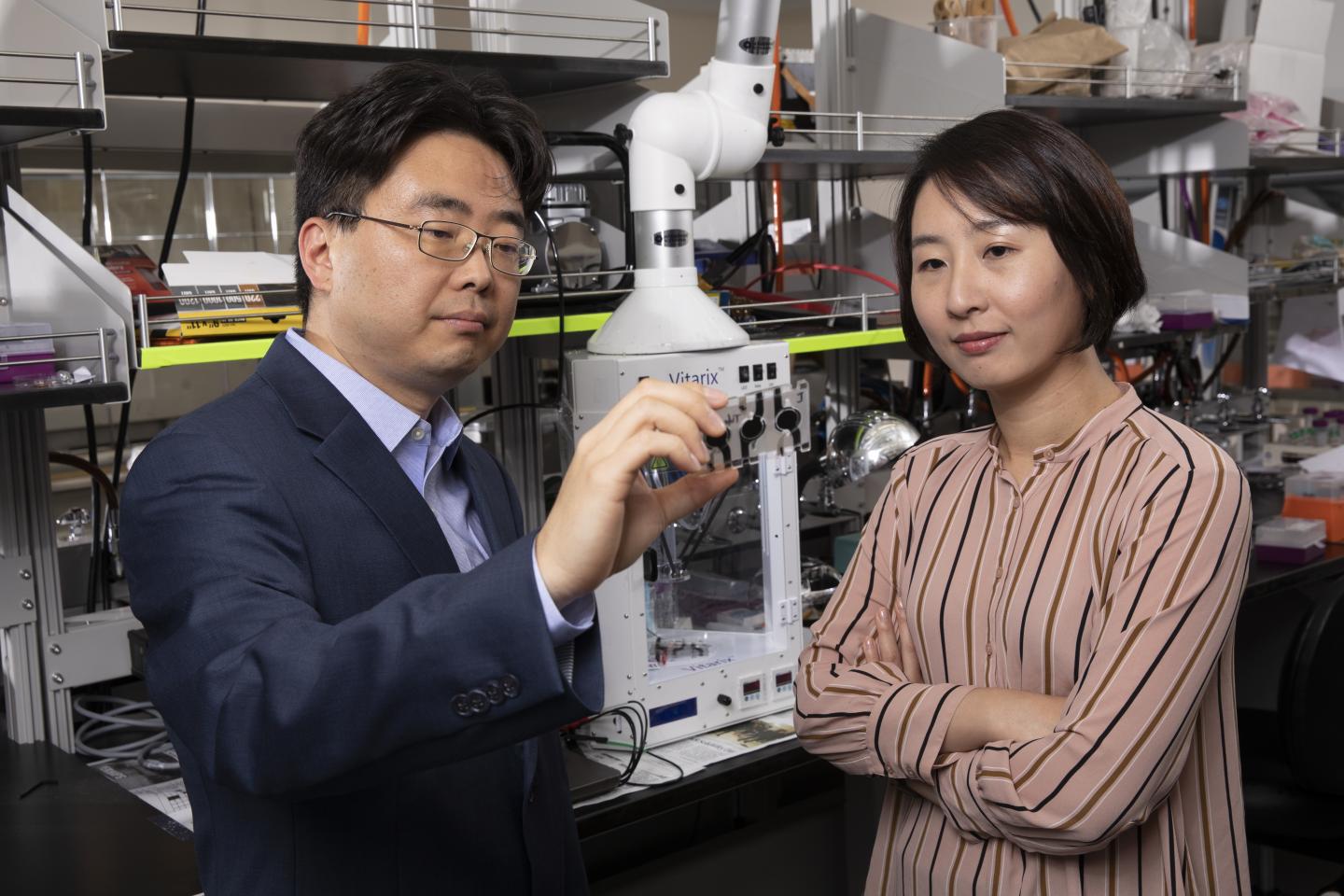
Credit: Binghamton University, State University of New York

A three-year, $345,000 grant from the National Science Foundation will fund research at Binghamton University, State University of New York that seeks to modify paper’s mechanical properties while still retaining its advantages.

In the last decade, paper-based electronics — also known as “papertronics” — have evolved into an eco-friendly alternative because of physical and chemical characteristics such as their light weight, biocompatibility, biodegradability, low-cost manufacturing and foldability.

One thing that current papertronics can’t do, however, is stretch. That can limit its usefulness for biomedical applications both outside and inside the human body.

Leading the research will be Ahyeon Koh, assistant professor of biomedical engineering and Seokheun “Sean” Choi, associate professor of electrical and computer engineering. Last year, the two faculty members received a $452,000 NSF grant to create a power source from human sweat using the metabolisms of sweat-eating bacteria.

The researchers see this new papertronics project as a way to bring together their two areas of expertise.

“Dr. Choi is a pioneer in paper electronics, and I am working on developing soft electronics,” Koh said. “Soft electronics have their own advantages and could be the future of bioelectronics, but they also have limitations. We want to bridge these two areas into one platform of stretchable paper electronics.”

In their research proposal, Koh and Choi outline three main objectives:

  • Create a nanofiber with a core of strechable polydimethylsiloxane (PDMS) — a silicone-based and biologically inert material widely used for flexible and stretchable electronics — and a sheath of cellulose. The fiber will be spun into a mesh that will be tested for mechanically and biochemically compatible bioelectronics.
  • Test the stretchable paper’s physical, chemical and mechanical properties to discover which fiber diameter and core or sheath thickness works best for the electronics. Conventional printing technologies will be tested to develop the stretchable paper into functional electronics.
  • Integrate Choi’s extensive work on paper-based fuel cells powered by microbial interactions so that the electronics have the tiny but necessary electrical charge.

“I believe this stretchable paper will be much better than other materials like textiles in terms of mass fabrication, because we can use any paper manufacturing processes such as roll-to-roll printing, screen printing and dipping,” Choi said. “Many functional inks have nanoparticles or synthetic polymers that can be integrated into the paper for specific functions.”

Koh considers this research as a necessary first step to developing stretchable papertronics: “Once we complete these projects, we will evolve into more specific medical or environmental applications. First we want to provide the fundamentals so that every other scientist can jump in and gain the advantages of these new materials.”

Koh and Choi’s grant, titled “Stretchable Papertronics,” is NSF Award #2020486.

###

Media Contact
John Brhel
[email protected]

Tags: Biomedical/Environmental/Chemical EngineeringChemistry/Physics/Materials SciencesElectrical Engineering/ElectronicsMaterialsTechnology/Engineering/Computer Science
Share12Tweet8Share2ShareShareShare2

Related Posts

Sharpening Our View of Bacteria — Chemistry

Sharpening Our View of Bacteria

May 18, 2026
New Drexel Study Reveals Key to Keeping Students on Track in Physics Learning — Chemistry

New Drexel Study Reveals Key to Keeping Students on Track in Physics Learning

May 15, 2026

Reversible Glue Technology Powers Up with Electric Activation

May 15, 2026

Sweet as Honey: Unveiling a New Heat Transport Regime in Ultrathin Semiconductors

May 15, 2026
Please login to join discussion

POPULAR NEWS

  • Research Indicates Potential Connection Between Prenatal Medication Exposure and Elevated Autism Risk

    844 shares
    Share 338 Tweet 211
  • New Study Reveals Plants Can Detect the Sound of Rain

    731 shares
    Share 292 Tweet 182
  • Salmonella Haem Blocks Macrophages, Boosts Infection

    62 shares
    Share 25 Tweet 16
  • Breastmilk Balances E. coli and Beneficial Bacteria in Infant Gut Microbiomes

    58 shares
    Share 23 Tweet 15

About

We bring you the latest biotechnology news from best research centers and universities around the world. Check our website.

Follow us

Recent News

Controlling Surrounding Rock Failure in Coal Pillar Retreats

Gut Microbiome Nitrogen Shift Boosts Ulcerative Colitis Treatment

Sharpening Our View of Bacteria

Subscribe to Blog via Email

Enter your email address to subscribe to this blog and receive notifications of new posts by email.

Join 82 other subscribers
  • Contact Us

Bioengineer.org © Copyright 2023 All Rights Reserved.

Welcome Back!

Login to your account below

Forgotten Password?

Retrieve your password

Please enter your username or email address to reset your password.

Log In
No Result
View All Result
  • Homepages
    • Home Page 1
    • Home Page 2
  • News
  • National
  • Business
  • Health
  • Lifestyle
  • Science

Bioengineer.org © Copyright 2023 All Rights Reserved.