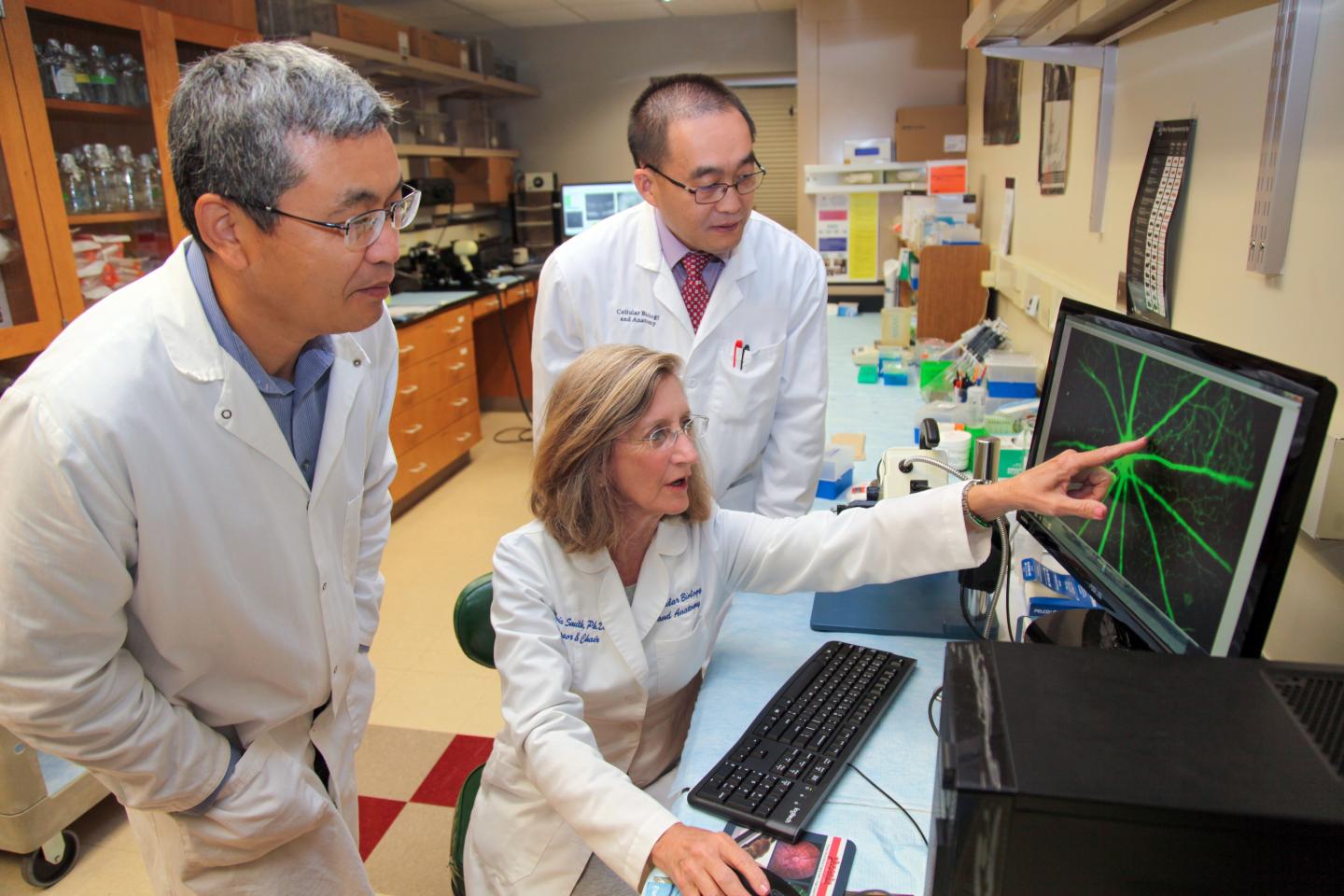
Credit: Kim Ratliff, Augusta University Photographer
AUGUSTA, Ga. (Sept. 11, 2020) – A $3 million National Eye Institute grant is enabling the critical infrastructure necessary to grow research initiatives in major vision-robbing conditions at the Medical College of Georgia and Augusta University.
The NEI center core grant, or P30 grant, comes at a time of critical development for the James and Jean Culver Vision Discovery Institute at Augusta University, and is key to the sustainability of future growth, says Dr. Sylvia Smith, chair of the MCG Department of Cellular Biology and Anatomy and director of the Culver VDI. Smith, a NEI-funded retinal cell biologist, is principal investigator on the new P30 grant.
The Culver VDI currently includes 32 faculty members from MCG, the Dental College of Georgia, the College of Allied Health Sciences and The Graduate School at AU as well as the University of Georgia Experimental Therapeutics Program. Areas of focus in the institute include disorders affecting the retina, cornea and lens, including diabetic retinopathy, glaucoma and the retinopathy that affects premature babies.
The grant provides support for organization of the critical expertise and infrastructure needed by these individual vision scientists, enables more efficient collaboration between them and their colleagues across the country, and encourages more collaborative projects with investigators in other fields with overlapping interests. The infrastructure support is also a powerful recruitment tool for additional vision scientists, Smith says.
“This growing group of scientists has always been a highly collaborative and collegial group, happy to share their expertise and equipment, but the grant enables us to formalize and expand our sharing more efficiently and effectively,” Smith says.
The new grant will not support purchase of new equipment, Smith says, rather enables the logical clustering of the significant equipment AU has made available to individual vision investigators with a system in place to schedule equipment usage, train and assist investigators and laboratory personnel in its usage, troubleshoot problems and oversee equipment maintenance.
The three new modules include Visual Function Assessment, Histology and Imaging and Gene Expression/Proteomics.
Each module is directed by a more senior investigator and co-directed by a newer NEI-funded scientist with interest and expertise in the services offered. The grant pays a small percentage of the directors’ salaries and provides some salary support for essential module personnel as well.
“What we have now is the manpower to help guide people,” Smith says.
###
Module leadership includes Visual Function Assessment, led by Smith and co-directed by Dr. Amany Tawfik, associate professor, Dental College of Georgia Department of Oral Biology and Diagnostic Sciences; Histology and Imaging, led by Dr. Xingjun Fan, associate professor, MCG Department of Cellular Biology and Anatomy, and co-directed by Dr. Shruti Sharma, associate professor, MCG Department of Ophthalmology; and Gene Expression/Proteomics led by Dr. Yutao Liu, associate professor, MCG Department of Cellular Biology and Anatomy, and co-directed by Dr. Ashok Sharma, associate professor, MCG Department of Population Health Sciences.
An internal advisory group includes MCG vision scientists Drs. Ruth Caldwell, Manuela Bartoli, Pamela Martin and Mitch Watsky.
Culver VDI faculty currently have 17 NEI RO1 research grants to fund their individual studies. Eight RO1s, the National Institutes of Health’s oldest grant mechanism for providing funding for health-related research and development, are required to qualify for a P30 grant.
MCG has a longstanding history of strong vision scientists, but a concerted recruitment effort began in 2008 with the establishment of the Culver VDI, Smith says.
The late Dr. James F. Culver was the first ophthalmologist for the aerospace program, an inaugural member of the National Eye Advisory Council and a 1945 MCG graduate.
Vision impairment or blindness affects more than 2 billion people worldwide, according to the World Health Organization.
Media Contact
Toni Baker
[email protected]