• HOME
  • NEWS
  • EXPLORE
    • CAREER
      • Companies
      • Jobs
    • EVENTS
    • iGEM
      • News
      • Team
    • PHOTOS
    • VIDEO
    • WIKI
  • BLOG
  • COMMUNITY
    • FACEBOOK
    • INSTAGRAM
    • TWITTER
Sunday, October 4, 2026
BIOENGINEER.ORG
No Result
View All Result
  • Login
  • HOME
  • NEWS
  • EXPLORE
    • CAREER
      • Companies
      • Jobs
        • Lecturer
        • PhD Studentship
        • Postdoc
        • Research Assistant
    • EVENTS
    • iGEM
      • News
      • Team
    • PHOTOS
    • VIDEO
    • WIKI
  • BLOG
  • COMMUNITY
    • FACEBOOK
    • INSTAGRAM
    • TWITTER
No Result
View All Result
Bioengineer.org
No Result
View All Result
Home NEWS Science News Chemistry

2D molecular crystals modulating electronic properties of organic semiconductors

Bioengineer by Bioengineer
May 20, 2020
in Chemistry
Reading Time: 3 mins read
0
IMAGE
Share on FacebookShare on TwitterShare on LinkedinShare on RedditShare on Telegram

IMAGE

Credit: ©Science China Press

Organic field-effect transistors (OFETs) are the heart of plastic electronics. Doping has been proven to improve the performance of OFETs effectively. There are two major ways of doping OSCs.

The first strategy is bulk doping. Bulk doping involves the solution phase blending or vapor phase co-deposition of the dopants with the host OSCs. However, bulk doping introduces structural defects and energetic disorders in the host material, which reduces the mobility of the organic semiconductors.

The second strategy is surface doping. Surface doping is achieved by the deposition of dopants on surfaces of the host OSCs. Compared with bulk doping, the dopants are not incorporated into the lattice of the host, and thus the induction of structural defects and energetic disorders by common bulk doping are eliminated.

As a result, surface doping is considered as a useful strategy for nondestructive doping of OSCs. Up to now, dopants of various structures have been applied in surface doping. However, most of the dopants are polycrystalline thin films and their thicknesses are not well controlled, Therefore, the performance improvements of OSCs are restricted.
Two-dimensional molecular crystals (2DMCs) are periodically arranged monolayer or few-layered organic molecules held together by weak interactions (e.g., hydrogen bonds, π-π interactions, van der Waals forces) in a 2D plane. They are continuous ultrathin films with long-range order.

Moreover, the thickness of the 2DMCs can be tuned at monolayer level, enabling highly controllable doping of OSCs at mono-layer precision. As a result, 2DMCs are potentially favorable materials as dopants for surface doping.

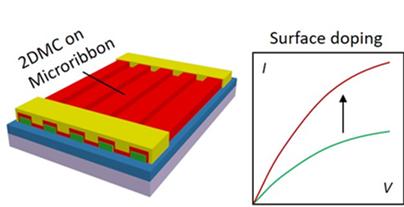
Very recently, Dr. Rongjin Li and colleagues in Tianjin University reported a highly effective and highly controllable surface doping strategy based on 1D/2D composite single crystal to boost the mobility and to modulate the threshold voltage of OFETs.

Taking advantage of the molecular scale thickness of the 2DMC dopants, tight attachment to the surface of the host OSCs is ensured and efficient doping is achieved. More importantly, the molecular scale thickness of the 2DMC with controllable layers ensures precise doping of the host material at monolayer precision.

In their study, 1D organic single-crystalline microribbons of TIPS-pentacene were adopted as an example OSC. Compared with the pristine materials, the average mobility of OFETs based on 1D/2D composite single crystals increased from 1.31 cm2/V* s to 4.71 cm2/V* s, corresponding to an increase of 260%. Meanwhile, a substantial reduction of the threshold voltage from -18.5 V to -1.8 V was achieved. The maximum mobility of 5.63 cm2/V* s was higher than the vast majority of reported mobilities for TIPS-pentacene so far as we know. Moreover, high on/off ratios of up to 108 were retained. Surface doping by 2DMCs provides a highly efficient and highly controllable strategy to modulate the optoelectronic properties of OSCs for various applications.

###

See the article: Zhang Y, Yang S, Zhu X, Zhai F, Feng Y, Feng W, Zhang X, Li R, Hu W. Highly efficient modulation of the electronic properties of organic semiconductors by surface doping with 2D molecular crystals. Sci China Chem., 2020, DOI:10.1007/s11426-020-9765-8.

http://engine.scichina.com/doi/10.1007/s11426-020-9765-8

Media Contact
Rongjin Li
[email protected]

Related Journal Article

http://dx.doi.org/10.1007/s11426-020-9765-8

Tags: Chemistry/Physics/Materials Sciences
Share12Tweet8Share2ShareShareShare2

Related Posts

Banana Peels Turn Into Catalysts That Boost Bio-Oil From Sewage Sludge

Banana Peels Turn Into Catalysts That Boost Bio-Oil From Sewage Sludge

October 4, 2026
Squeezing Polypropylene Flips Its Insulation From Rubbery to Glassy Conduction

Squeezing Polypropylene Flips Its Insulation From Rubbery to Glassy Conduction

October 4, 2026

Sulfated Seaweed Polymer Helps Gels Protect Anthocyanins Until the Gut

October 4, 2026

Nickel and Lithium Doping Face Off in Zinc Oxide Films for Supercapacitors

October 4, 2026
Please login to join discussion

POPULAR NEWS

  • Alloys That Shrink Their Own Grains: New PIX Mechanism Refines Metals With Heat Alone

    Alloys That Shrink Their Own Grains: New PIX Mechanism Refines Metals With Heat Alone

    29 shares
    Share 12 Tweet 7
  • Endurance Exercise Reshapes the Liver in Males and Females Through Distinct Molecular Routes

    29 shares
    Share 12 Tweet 7
  • Single Transcription Factor PU.1 Rapidly Converts Fibroblasts into Macrophage-Lineage Cells

    29 shares
    Share 12 Tweet 7
  • New Scale Measures How Ready Nurse Educators Really Are for the AI Era

    29 shares
    Share 12 Tweet 7

About

We bring you the latest biotechnology news from best research centers and universities around the world. Check our website.

Follow us

Recent News

Alloys That Shrink Their Own Grains: New PIX Mechanism Refines Metals With Heat Alone

Endurance Exercise Reshapes the Liver in Males and Females Through Distinct Molecular Routes

Single Transcription Factor PU.1 Rapidly Converts Fibroblasts into Macrophage-Lineage Cells

Subscribe to Blog via Email

Success! An email was just sent to confirm your subscription. Please find the email now and click 'Confirm' to start subscribing.

Join 85 other subscribers
  • Contact Us

Bioengineer.org © Copyright 2023 All Rights Reserved.

Welcome Back!

Login to your account below

Forgotten Password?

Retrieve your password

Please enter your username or email address to reset your password.

Log In
No Result
View All Result
  • Homepages
    • Home Page 1
    • Home Page 2
  • News
  • National
  • Business
  • Health
  • Lifestyle
  • Science

Bioengineer.org © Copyright 2023 All Rights Reserved.