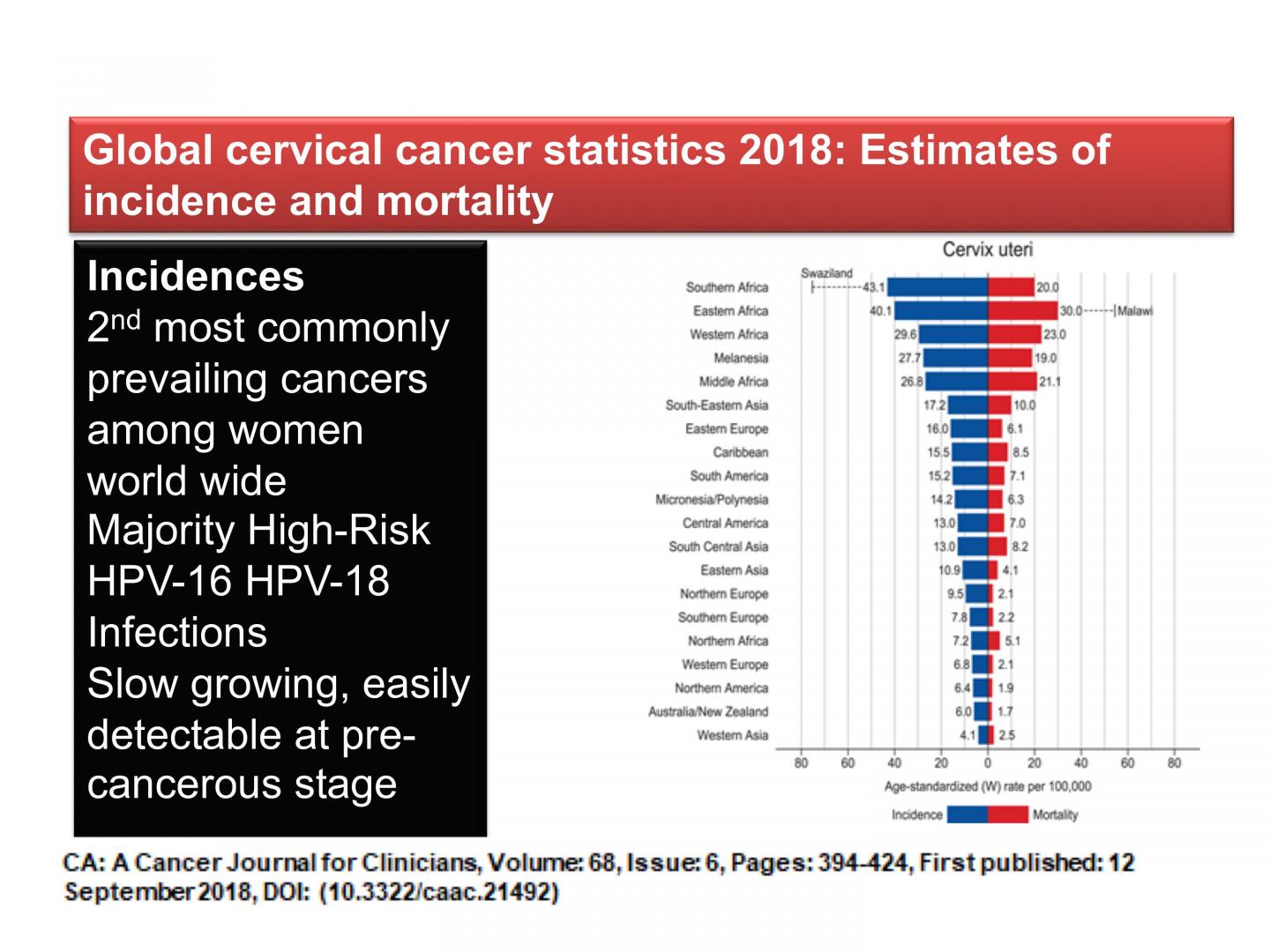
Credit: (A Cancer Journal for Clinicians (2018). Volume 68, Issue: 6, Pages: 394-424. doi: 10.3322/caac.21492)
According to the World Health Organization, cervical cancer is the fourth most common type of cancer affecting women worldwide. Currently, early screenings of pre-cancerous tissues and vaccination have proven to be the most effective treatment strategies. However, the lack of such interventions in developing nations has led to its high occurrence. Among the South East Asian nations alone, India has the highest incidence rate of cervical cancer.
A recent paper from the lab of Prof. Sudhir Krishna at the National Centre for Biological Sciences, Bangalore, reviews the progress made in cervical cancer research over the past 25 years. This extensive coverage published in the journal of Experimental Cell Research highlights the role of a popular signalling molecule called Notch in human cervical cancer progression.
Cervical cancer is caused by the invasion of the human papillomavirus (HPV) in the female reproductive tissue called the cervix. Once the HPV makes itself at home in the cervical tissue (host), it establishes a healthy life cycle for itself and triggers the uncontrolled growth of cervical cells. It does so by employing genes and proteins that promote cell proliferation, also known as oncogenes. However, it cannot do this without activating cell growth-promoting factors within the host cell itself. The question then is what are the molecular factors within cells that complement the invasive capabilities of the virus and how are they regulated by the HPVs?
A gene quite often linked to various types of human cancers is a molecular player called Ras. However, in many instances, analysis of human cervical cancer tissues rarely showed the expression of mutant Ras. This meant that there were other molecules involved in cervical cancer progression.
In such a hunt for finding other molecules responsible for cervical cancer progression, Sudhir and his team of researchers identified Notch. Notch is a signalling protein that resides on the cell’s membrane. It responds to specific information from neighbouring cells and triggers a signalling cascade that alters cell fate.
If one were to look at the literature on Notch signalling, we would be rather confounded to find that Notch functions both in tumour-promoting and tumour-suppressing conditions. However, the first clue that strongly seemed to nail Notch’s role in cancer progression was the observation that many cervical cancer tissues showed signatures of increased Notch signalling. In addition, molecules known to enhance Notch signalling were found to be abundant, while the levels of those proteins that negatively regulated Notch pathway were found to be dampened. All this strongly seem to point to Notch as the primary culprit.
Progression of cervical cancer had always been thought to occur in stages. Firstly, there being an invasion by the HPV and then the local proliferation of cervical cells. Following this, a subset of cells was thought to acquire the capacity to move around the body and infect other tissues – a phenomenon known as metastasis. However, Sudhir and his team are of the opinion that cervical cancer progression may not always follow such a textbook route. In fact, their data seems to argue that local proliferation of cells is carried out independently by a certain subset of cells. Simultaneously, another group of infected cervical cells, carrying a different molecular imprint, may diverge into metastasis. Such parallel routes may thus make cancer progression increasingly complex in nature and probably, more rapid too.
“This review thus makes the point that a real understanding of a specific science question evolves over several decades, concomitant with changes in technology and growth in other related areas,” concludes Sudhir. A systematic understanding of the intricate relationship between HPV, Notch signalling and the various molecular players affected within the cells hold the key to treating human cervical cancer at various stages of its progression. Towards this end, Sasikala, one of the authors who steered this review, is now working towards identifying important molecules that Notch signalling activates in human cervical cancer.
###
Media Contact
Sudhir Krishna
[email protected]
Related Journal Article
http://dx.