• HOME
  • NEWS
  • EXPLORE
    • CAREER
      • Companies
      • Jobs
    • EVENTS
    • iGEM
      • News
      • Team
    • PHOTOS
    • VIDEO
    • WIKI
  • BLOG
  • COMMUNITY
    • FACEBOOK
    • INSTAGRAM
    • TWITTER
Saturday, May 2, 2026
BIOENGINEER.ORG
No Result
View All Result
  • Login
  • HOME
  • NEWS
  • EXPLORE
    • CAREER
      • Companies
      • Jobs
        • Lecturer
        • PhD Studentship
        • Postdoc
        • Research Assistant
    • EVENTS
    • iGEM
      • News
      • Team
    • PHOTOS
    • VIDEO
    • WIKI
  • BLOG
  • COMMUNITY
    • FACEBOOK
    • INSTAGRAM
    • TWITTER
  • HOME
  • NEWS
  • EXPLORE
    • CAREER
      • Companies
      • Jobs
        • Lecturer
        • PhD Studentship
        • Postdoc
        • Research Assistant
    • EVENTS
    • iGEM
      • News
      • Team
    • PHOTOS
    • VIDEO
    • WIKI
  • BLOG
  • COMMUNITY
    • FACEBOOK
    • INSTAGRAM
    • TWITTER
No Result
View All Result
Bioengineer.org
No Result
View All Result
Home NEWS Science News Biology

23,000 years ago, humans in Israel enjoyed a new bounty of food options

Bioengineer by Bioengineer
January 26, 2022
in Biology
Reading Time: 2 mins read
0
Fig 1. Map with location of southern Levantine Epipaleolithic sites mentioned in the text (a), plan of Ohalo II (b) and plan of Brush Hut 1 (c).
Share on FacebookShare on TwitterShare on LinkedinShare on RedditShare on Telegram

As climate shifted 23,000 years ago, humans in Israel experienced a new abundance of food, according to a study published January 26, 2022 in the open-access journal PLOS ONE by Tikvah Steiner of the Hebrew University of Jerusalem and colleagues.
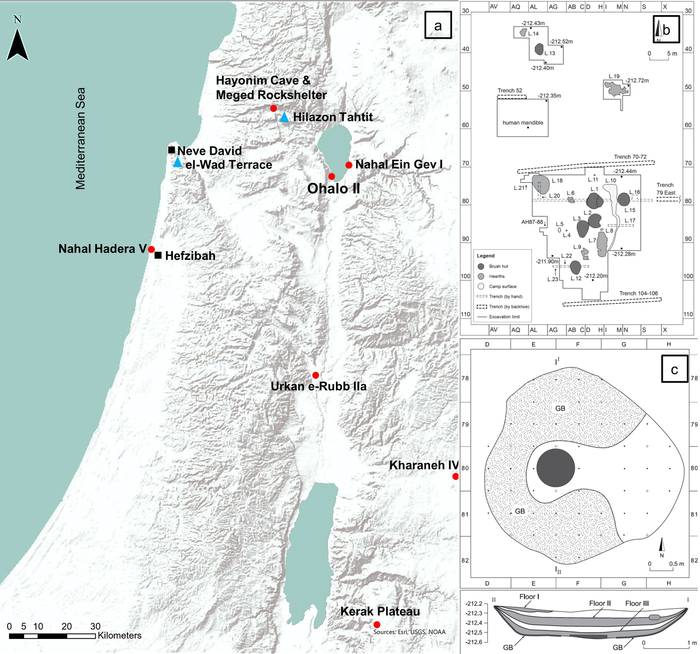
Fig 1. Map with location of southern Levantine Epipaleolithic sites mentioned in the text (a), plan of Ohalo II (b) and plan of Brush Hut 1 (c).

Credit: Steiner et al., 2022, PLOS ONE, CC-BY 4.0 (https://creativecommons.org/licenses/by/4.0/)

As climate shifted 23,000 years ago, humans in Israel experienced a new abundance of food, according to a study published January 26, 2022 in the open-access journal PLOS ONE by Tikvah Steiner of the Hebrew University of Jerusalem and colleagues.

The submerged archaeological site of Ohalo II, located on the southern tip of the Sea of Galilee in Israel, preserves extensive evidence of human occupation about 23,000 years ago. This was a time period of global climate fluctuation, and also a time when humans notably diversified their dietary habits. Some researchers have suggested this diet shift was necessary due to decreasing food availability, while others suggest the change was an opportunistic one made possible by increasing food abundance. In this study, Steiner, Nadel and colleagues from a multidisciplinary team from four Israeli and Spanish universities tested these competing hypotheses via analysis of animal remains at Ohalo II.

The authors examined over 20,000 animal remains, including reptiles, birds, and mammals, from well-preserved successive floors of a brush hut at the site. The results show that the people of Ohalo II were successfully hunting prime large game, while at the same time gathering a wide variety of fish, other small animals, and plants.

According to the authors, this evidence does not indicate a drop in food availability, but rather an abundance of multiple prey sources. They suggest that while some animals were gathered for meat, others might have been hunted for pelts (e.g.: foxes, hares) or shells (e.g.: tortoises). From this study, it seems that fluctuating climate conditions did not create food stress, at least in this region, but instead new dietary opportunities. The researchers hope that this work at Ohalo II will serve as a model for similar investigations of human diet changes at other locations and time periods.

The authors add: “The choice of a littoral habitat that could be intensively exploited year-round may be an example of niche selection. The availability of multiple food sources within a rich habitat may have driven exploitation of myriad local resources, rather than targeting mainly energetically-rich large prey.”


Journal

PLoS ONE

DOI

10.1371/journal.pone.0262434

Method of Research

Observational study

Subject of Research

People

Article Title

Abundance or stress? Faunal exploitation patterns and subsistence strategies: The case study of Brush Hut 1 at Ohalo II, a submerged 23,000-year-old camp in the Sea of Galilee, Israel

Article Publication Date

26-Jan-2022

COI Statement

The authors have declared that no competing interests exist.

Share12Tweet8Share2ShareShareShare2

Related Posts

Successful Birth Following Uterus Transplant Marks Medical Breakthrough — Biology

Successful Birth Following Uterus Transplant Marks Medical Breakthrough

May 1, 2026
Cockatoos Mimic Peers to Sharpen Adaptation Skills, Study Finds — Biology

Cockatoos Mimic Peers to Sharpen Adaptation Skills, Study Finds

May 1, 2026

Gut Microbe’s Sulfated Bile Acid Eases Pediatric Sepsis

May 1, 2026

AI Breakthrough Solves One of Science’s Most Challenging Math Problems

May 1, 2026

POPULAR NEWS

  • Research Indicates Potential Connection Between Prenatal Medication Exposure and Elevated Autism Risk

    832 shares
    Share 333 Tweet 208
  • New Study Reveals Plants Can Detect the Sound of Rain

    714 shares
    Share 285 Tweet 178
  • Scientists Investigate Possible Connection Between COVID-19 and Increased Lung Cancer Risk

    67 shares
    Share 27 Tweet 17
  • Salmonella Haem Blocks Macrophages, Boosts Infection

    61 shares
    Share 24 Tweet 15

About

We bring you the latest biotechnology news from best research centers and universities around the world. Check our website.

Follow us

Recent News

Family Health Needs of Disabled Elders Explored

Mcu Controls Bone Growth Through Mitochondrial Calcium

Physical Disorders, ADLs, Cognition, Depression in Nursing Homes

Subscribe to Blog via Email

Enter your email address to subscribe to this blog and receive notifications of new posts by email.

Join 82 other subscribers
  • Contact Us

Bioengineer.org © Copyright 2023 All Rights Reserved.

Welcome Back!

Login to your account below

Forgotten Password?

Retrieve your password

Please enter your username or email address to reset your password.

Log In
No Result
View All Result
  • Homepages
    • Home Page 1
    • Home Page 2
  • News
  • National
  • Business
  • Health
  • Lifestyle
  • Science

Bioengineer.org © Copyright 2023 All Rights Reserved.